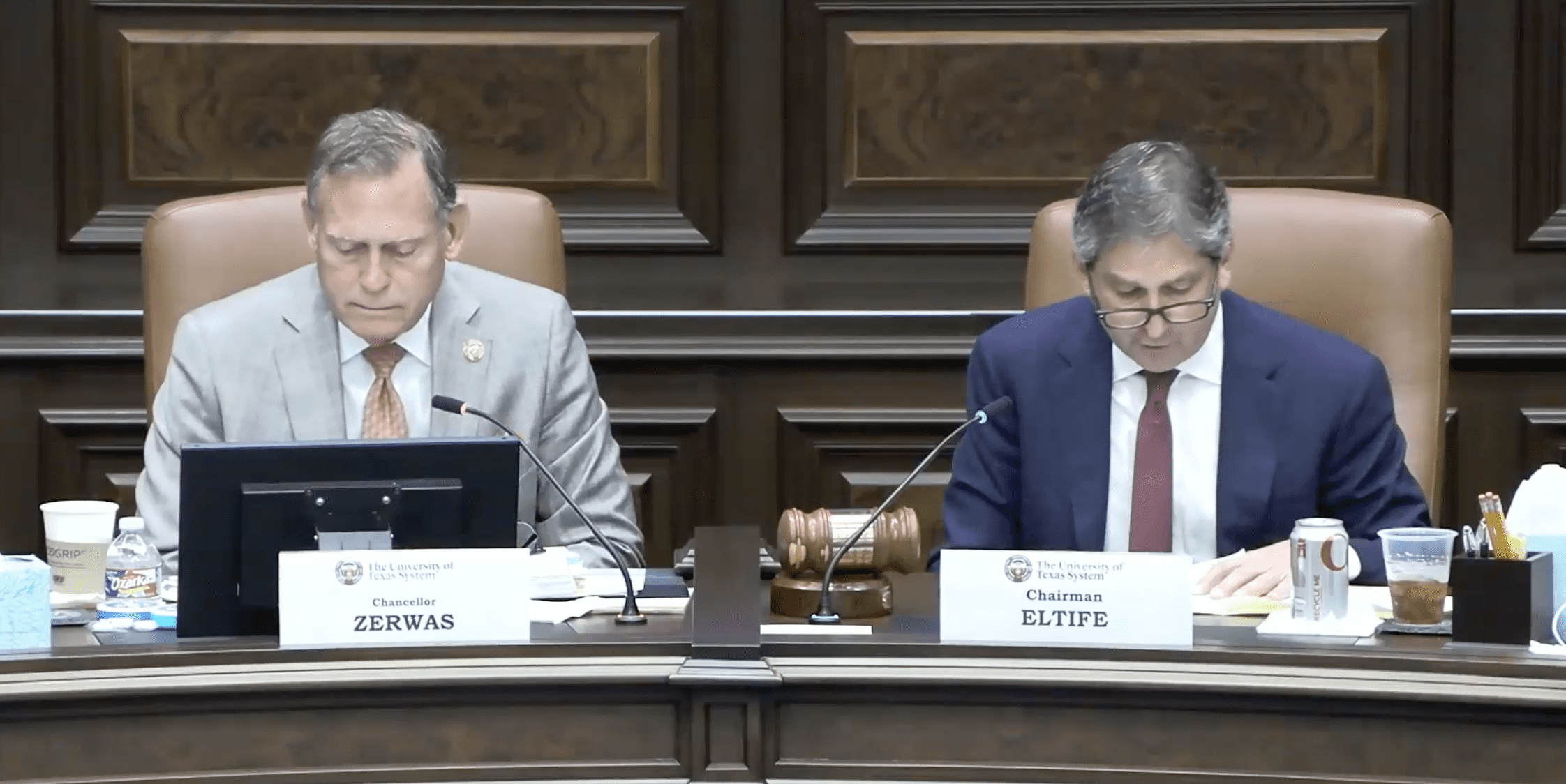
AUSTIN—The University of Texas System Board of Regents approved new rules Thursday morning, formally asserting their ultimate authority, creating limited-purpose faculty advisory groups, and instituting annual reviews for senior campus leaders.
These rule changes, outlined in the meeting’s agenda, were necessary to bring the UT System into full compliance with a recently passed state law.
Senate Bill 37, a measure lawmakers passed during the regular legislative session this year, clarified formal lines of authority for university governance. As part of that process, the new law establishes that “the governing board of the institution exercises ultimate authority and responsibility for institutional oversight.”
Today’s change brings UT System rules in line with state law.
SB 37 also requires campus presidents to conduct annual reviews for the positions of vice president, provost, and dean. Today’s rule change adopts similar language.
In addition, regents are now required to hold a formal review of department chairs “at least every six years” while permitting the option for more frequent review. This action is not required under SB 37 but has nevertheless been undertaken by the regents.
SB 37 also abolished the practice of “shared governance,” which had previously permitted boards and university presidents to delegate formal decision-making authority to selected faculty. The new law permits universities to establish faculty advisory groups that have no final decision-making authority.
Regents had previously adopted an interim policy abolishing the old bodies. Today’s rule change creates a formal structure to establish new, advisory-only ones.
Regents also discussed matters unrelated to compliance with new state law.
They approved the latest Regents’ Outstanding Teaching Awards cohort. Recipients included Dr. Karen Magruder, a left-wing environmental activist.
Regents also approved formal employment contracts with new system Chancellor John Zerwas, new UT-Austin President Jim Davis, and a pay raise for UT-San Antonio President Taylor Eighmy as part of the consent agenda.
On Wednesday, regents held a series of committee hearings. The hearings included a presentation from UT-Austin President Jim Davis on the status of renovations for the building which will host the School of Civic Leadership beginning in 2026. Davis stated that total construction expenditures “would not exceed” the $100 million regents committed to the endeavor in May.
Prior to the Wednesday session, a handful of protestors met outside the UT System building, some of whom later migrated into the back of the board room. Protestors held signs but were otherwise silent and did not return on Thursday.
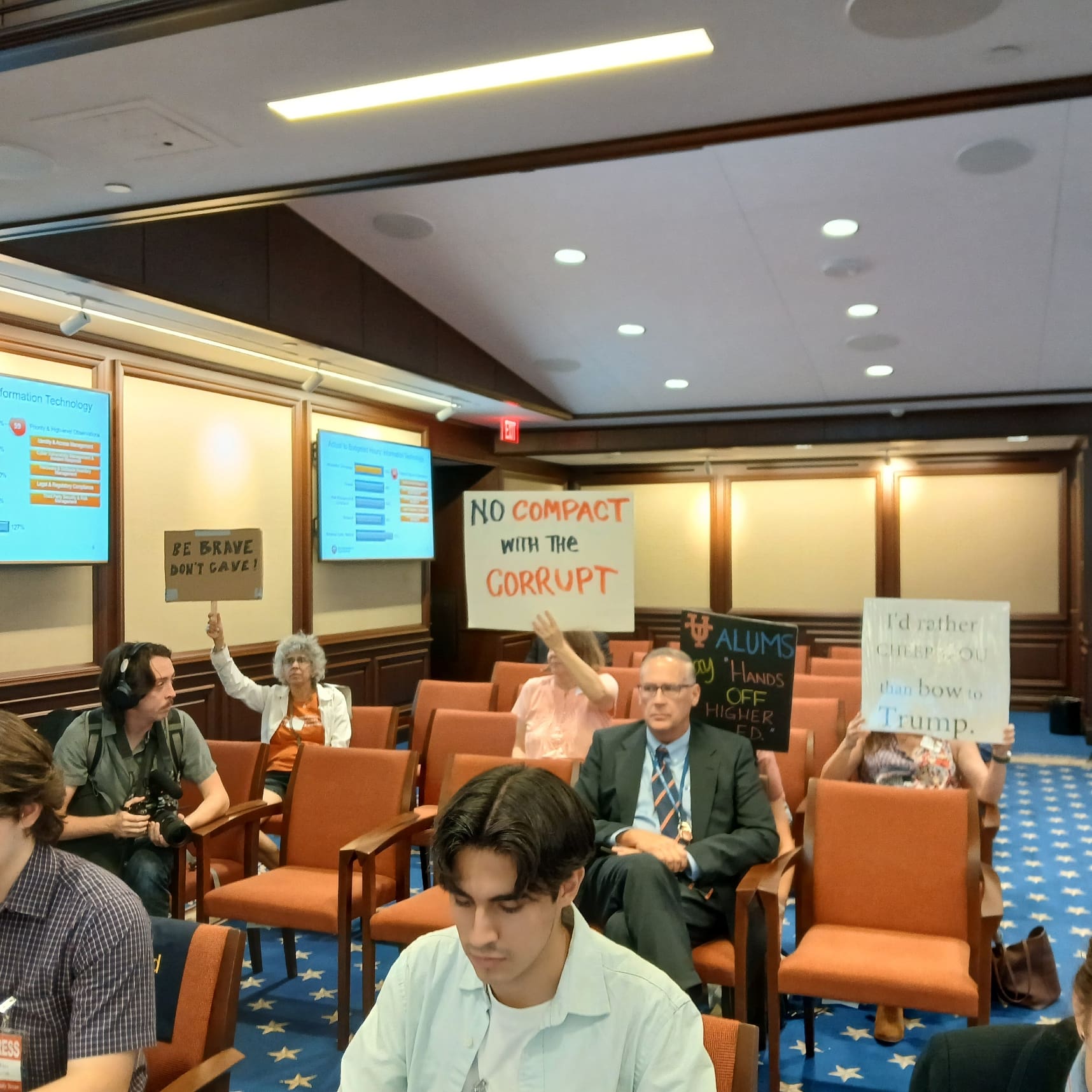
Several representatives from the UT-Austin chapter of Students for a Democratic Society addressed the board prior to Wednesday’s session. SDS representatives urged the board to reject participation in the Trump administration’s higher education compact.
Chairman Kevin Eltife thanked the SDS representatives for “respectfully” expressing their “difference of opinion” and told SDS “now we will move on with our board meeting.”
Regents discussed security audits and cybersecurity during their executive sessions on both Wednesday and Thursday, but took no action in the open session. Texas Scorecard requested comment on the nature of these discussions but did not receive a response before publication.
Board Chairman Kevin Eltife stated that UT-Austin and UT-MD Anderson are in the process of exploring the creation of a new healthcare complex in North Austin “near the Domain.” No further details were provided.
UT-Austin’s JJ Pickle research facility is already in that vicinity.
The University of Texas System is overseen by a board of regents that is appointed by the governor and confirmed by the Texas Senate.