This article has been updated since publication.
Local landowners voiced concerns about the potential impact of a proposed South Texas 765-kilovolt transmission line on water resources. One of the companies that proposed the line stated it has consulted with federal, state, and local agencies.
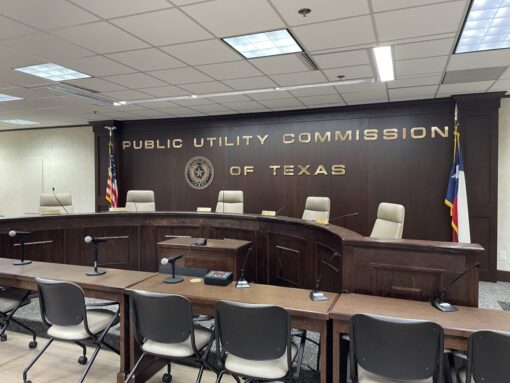
Transmission service providers AEP Texas and city of San Antonio-owned CPS Energy proposed the Howard to Solstice line. Out of the 77 possible routes for the line, AEP Texas and CPS Energy presented Route 4 as the “best-meets” route as it addresses routing criteria from the Public Utility Commission of Texas (PUCT) and the requirements under the Public Utility Regulatory Act. PUCT engineer Lawrence Rahmes also recommended Route 4.
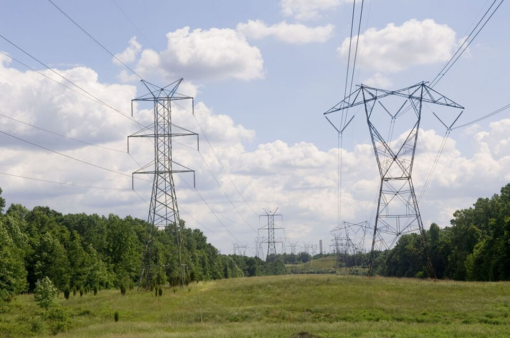
The line would stretch approximately 371 miles crossing 14 counties including Bexar, Medina, Uvalde, Val Verde, Kinney, and Pecos. Utility engineers estimated the cost at about $2.2 billion, which would equate to roughly $5.9 million per mile.
This line is part of the Permian Basin Reliability Plan. Critics have said PUCT, grid operator ERCOT, and electricity delivery company Oncor have expanded what lawmakers authorized as a limited regional fix into a statewide project, with lifetime costs approaching $100 billion, without explicit legislative authorization.
According to a filing from local landowners, Route 4 would cut through approximately 5.5 miles of the Edwards Aquifer Recharge Zone, which is responsible for carrying water into the Edwards Aquifer. The Edwards Aquifer Conservancy states the aquifer provides water to approximately 2.5 million people across South Central Texas.
These landowners preferred Route 4 over alternatives that would roughly double the miles of aquifer crossings and extend into the contributing zone, “the drainage area where surface water flows into streams and rivers before reaching the Recharge Zone.”
Water is a current statewide concern. The Texas Water Development Board (TWDB) has drafted a $174 billion plan for the state’s future water needs over the next 50 years.
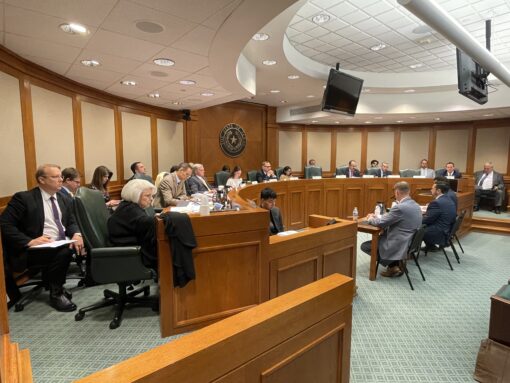
During the roughly week-long May administrative law hearing on the Howard to Solstice line, Heather Wofford focused on the transmission line’s underground concrete piers and the “state’s water crisis.” She asked witnesses for the transmission service providers whether or not concrete pourers will draw water directly from an aquifer.
“There are services that do provide water for construction,” Brent Harris, project manager with AEP Texas, replied. “I know a lot of times that’s who our contractors will use” in the region, but admitted he doesn’t know where these providers source their water from.
AEP Texas spokesman Omar Lopez wrote in a statement to Texas Scorecard that “across the project, no adverse impacts to groundwater are expected to occur from the construction and operation of the proposed transmission line.”
Concerns were also raised about herbicides. Harris and Gary McClanahan, another witness for the transmission service providers, admitted that herbicide is an option to “manage the vegetation” in a 200-foot right of way.
Through testimony from Harris and McClanahan, the joint applicants indicated that right-of-way vegetation management—including CPS Energy’s selective clearing and AEP’s transmission vegetation methods, such as occasional herbicide use—would be conducted in accordance with established utility practices and applicable safety and environmental requirements.
Rene D. Ruiz, an attorney representing local landowners, pressed Harris on whether he has conducted any studies on whether herbicides can migrate into private wells or get into the water table.
“I personally have not,” Harris responded. Neither he nor McClanahan recalled if they included any such study in their application or responses to information requests.
Ruiz stated that her clients are worried about their private water wells because of the lack of a mitigation plan for potentially impacted wells.
McClanahan said they will attempt to avoid water wells, but at the time they did not have a specific mitigation plan for private wells. In his statement, Lopez wrote “Route 4 has zero recorded water wells within 200 feet of the project centerline, according to the Environmental Assessment.”
In his written testimony and during the hearing, McClanahan said that public datasets, including data from TWDB, were used to find recorded well locations, but that not all wells are known, and PUCT is being asked to choose a route before all water wells have been located.
Regarding specific mitigation plans for private wells, McClanahan said, “those are based on a case-by-case basis that gets handled during the design and easement acquisition process.” An easement is a legal right to use someone else’s private property for a specific purpose.
The design and acquisition process will take place when PUCT commissioners make a final decision on which route after administrative law judges make a recommendation. Commissioners can also deny the application. On June 17, the commissioners voted to “abate” an application for another 765-kV line until a later date, when they will decide on that application for another segment.
PUCT’s decision window runs until August 29, 2026. According to the Applicants’ project schedule, detailed engineering design and land acquisition would follow route selection, with a target in‑service or completion date mid‑2028 if the line is approved.
Several landowner and expert witnesses proposed alternate routes and argued that those routes could reduce impacts on specific aquifer recharge zones, conservation easements, or communities. According to hearing transcripts, Rahmes’ direct testimony and cross‑examination indicated he did not re‑run the full comparative ranking on every late‑filed route.
In his statement, Lopez wrote:
AEP Texas consulted with federal, state and local agencies – including the Texas Water Development Board – and several non-governmental organizations during our comprehensive routing process and siting process. The process considers land use, the environment, public input, engineering guidelines and estimated costs to develop the alternative routes including potential impacts on wetlands, streams and water bodies.
Table 4-2 in the Environmental Assessment includes detailed data by route including the number of recorded water wells within 200 feet of the project centerline, stream and river crossings, and length of potential rights-of-way across ponds and lakes. Route 4 has zero recorded water wells within 200 feet of the project centerline, according to the Environmental Assessment … If the PUCT approves a final route in the area of any aquifer, stream, river or source of water, we will follow best management practices and will comply with all environmental permits and notification requirements.
Texas Scorecard asked AEP Texas, CPS Energy, TWDB and PUCT about the procedure for handling newly discovered water wells during the building of the transmission line.
In a statement from TWDB, a spokesperson wrote that it “does not assess the potential impacts of proposed transmission line projects on water sources,” and that PUCT has not yet chosen a final route for the Howard to Solstice line. “Route Selection will likely be a key factor in local evaluation of any potential impacts to water resources and water management strategies in the area.”
Texas has 16 Regional Water Planning (RWP) groups, each responsible for “developing and maintaining” its regional plan.
“When TWDB staff occasionally receive notifications from electric utilities regarding proposed transmission line projects, they review available maps and project schematics to determine whether any recommended water management strategies identified in the state or regional water plans may be affected,” the statement read. “If relevant strategies are identified within a proposed project area, that information is included in the response to the utility from TWDB.”
The Region J Regional Water Planning Group manages the Plateau Regional Water Planning Area. Neither the Region J RWP nor Texas Commission on Environmental Quality responded before publication on whether AEP Texas or CPS Energy had contacted them about Route 4 and its impacts on water wells and aquifers there.
In response to a request for comment, CPS Energy replied that “this is a pending matter at the PUC” and pointed towards the case docket for further information. AEP Texas did not provide a response regarding what the procedure would be if a new water well was discovered.
A spokesman for PUCT did. “[U]tilities must conduct an environmental assessment of a proposed transmission line route which should identify sensitive land areas. It is common for the PUCT to require the utility to cooperate with directly affected landowners in the event something is discovered during construction to implement certain changes to the approved route to minimize the line’s impact on their home or property,” he wrote.”
As previously reported, multiple groups have asked for PUCT to pause on the project, with Texas Public Policy Foundation specifically asking for commissioners to wait until state lawmakers can take it up in 2027. The Senate Business & Commerce Committee announced it will hold a July 29 public hearing on the state grid and managing the 765-kV lines’ impacts on private property rights.
If you are a citizen with information regarding bureaucratic overreach, please email scorecardtips@protonmail.com.