In response to lawmakers’ request for a pause on extra-high-voltage transmission lines, transmission service providers admitted reliance on wind and solar power, along with government intervention, is driving Permian Basin energy issues. This aligns with a third-party report that the lines are primarily built to support wind and solar, while local reliable generation alternatives were never fully examined.
Providers argued that public utility commissioners do not have the power to grant lawmakers’ request to pause the project. The next day, state senators announced they would hold a hearing on the proposed lines in late July.
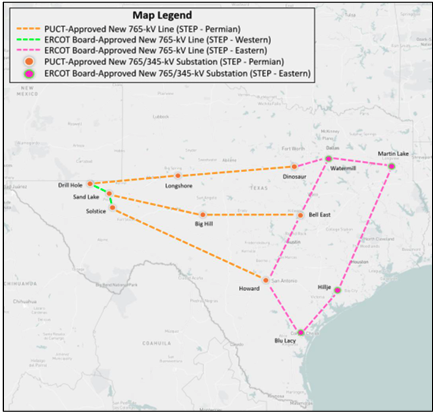
This centers on ERCOT’s 765-kilovolt Strategic Transmission Expansion Plan (STEP), a key part of the Permian Basin Reliability Plan (PBRP). STEP proposes three transmission lines spanning over 1,200 miles to move power from East Texas into the natural-gas-rich Permian Basin, with routes crossing North Texas, Central Texas, and South Texas.
The three lines are split into five interconnected segments for Phase 1. Phase 2 would build 765-kV lines from Northeast-East Texas southward through Central and South Texas. This eastern portion would tie into the lines leading into the Permian Basin.
On June 24, in a joint filing, Transmission Service Providers (TSPs) Oncor, Lower Colorado River Authority Transmission Service Corporation, AEP Texas, and City of San Antonio-owned CPS Energy admitted that the risk to sustained electrical supply in West Texas is “greatest during low-wind, no-solar conditions, when the Permian Basin relies heavily on imports” from the lower voltage 345-kV network.
The TSPs’ filing was in response to a June 15 brief by more than 40 state lawmakers asking PUCT to pause the project. They filed it in support of pro-landowner American Stewards of Liberty’s motion to defer deciding the need for the first four segments.
The lawmakers cited Dr. Brent Bennett, who wrote the May 2026 study by the Texas Public Policy Foundation (TPPF). Bennett warned that the “main effect of the 765-kV lines is to integrate more wind and solar into the ERCOT grid,” and that helping ERCOT “manage [such] a future system … to meet growing industrial demand” is the “primary rationale” for the lines.
This comes roughly five years after the 2021 winter blackouts. Two failures that energy specialist Jason Isaac said contributed to the problem are overreliance on “unreliable” wind and solar and market-distorting subsidies for wind and solar.
Bennett wrote that more transmission “does not ensure that enough new reliable generation will be built to meet demand and could even discourage such generation if the transmission provides wind and solar favorable market access.”
Bennett and ASL believe that building new dispatchable power generation, such as natural gas, in the Permian Basin was not fully examined as an alternative. The TSPs wrote they “do not dispute” that more such generation would benefit the Permian Basin.
But federal taxpayer-funded subsidies for wind and solar, combined with industrial consumers’ net-zero goals, Bennett wrote, have warped the energy market. As a result, few new reliable dispatchable power generation sources are listed in ERCOT’s current queue.
The TSPs’ filing described economic and transmission conditions consistent with Bennett’s critique. They wrote that state constraints on West Texas transmission flows “create significant impediments to the free-market’s development” of reliable generation in the Basin. They added that negative power pricing in the wind- and solar-heavy West Texas region “helps to explain why no new dispatchable generation units have been built in the Permian Basin in the last decade,” and that state incentives have “only produced plans for 2.5 GW of new dispatchable capacity in the Far West.”
In contrast, lawmakers wrote that adding approximately 4 to 5 gigawatts of natural gas generation in West Texas, along with “strategic generation siting in other ERCOT regions, could reduce or eliminate the need for the 765-kV transmission lines.”
Bennett called for PUCT to pause the project and let state lawmakers take over in 2027. He wrote that PUCT and ERCOT transformed a regional reliability directive (House Bill 5066, passed in 2023) into a de facto statewide grid plan, with a lifetime cost approaching $100 billion, all without an explicit legislative vote.
TSPs argued that HB 5066 authorized the project and that ASL’s cited deferral authority is “outdated.” They warned that the immense need for extra-high-voltage lines means delays would raise costs and risk the project’s ability to address rising power demand.
Bennett doesn’t believe the need is as immediate as TSPs claim. “[I]t is important to emphasize that the need for the 765-kV lines is driven by ERCOT’s assumption that Texas will continue to experience overbuilding of wind and solar, leading to new gas generation being constrained,” he wrote.
The TSPs argued that the May TPPF study “is not evidence in the record and should be treated as public comment” and that “ultimately the Commission must decide each case based on the evidence admitted into the record in that proceeding.”
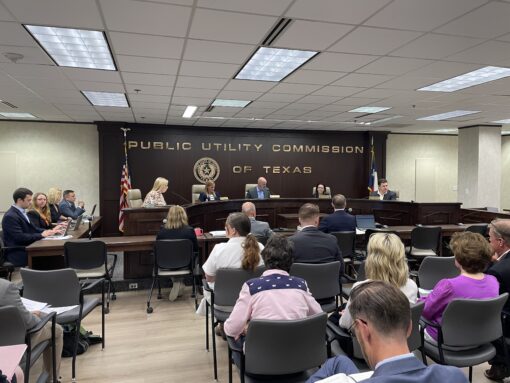
This refers to the process each segment of the line is undergoing. The TSPs filed applications to build each segment, then the State Office of Administrative Hearings held hearings for each. Afterward, administrative law judges make recommendations to PUCT, and the governor-appointed-commissioners decide.
On June 17, PUCT commissioners voted to abate deciding on the first segment until it’s time to decide on the third, likely sometime in August.
Fort Worth attorney Tony McDonald criticized this process. “Administrative agencies are not courts, and the matters they consider are political decisions, not decisions of blind justice. The demands of the public and their elected representatives are highly relevant to making good decisions on public policy,” he wrote. “The administrative law process makes a mockery of republican form of government, insulating inherently political decisions through the guise of a fake, court-like process.”
Ultimately, Bennett believes the issue will not be solved until there is “broader wholesale market reform,” a point he and co-author Jamila Piracci made in January. Gov. Greg Abbott directed PUCT to do so in July 2021. As previously reported, a presentation to state senators estimated that by 2029, Texas’ energy generation mix would be up to 62 percent solar, wind, and batteries.
A day after TSPs’ filing, the state Senate Business & Commerce Committee announced it will hold a July 29 public hearing on the state grid and mitigating the 765-kV lines’ impacts on private property rights.
If you are a citizen with information regarding bureaucratic overreach, please email scorecardtips@protonmail.com.