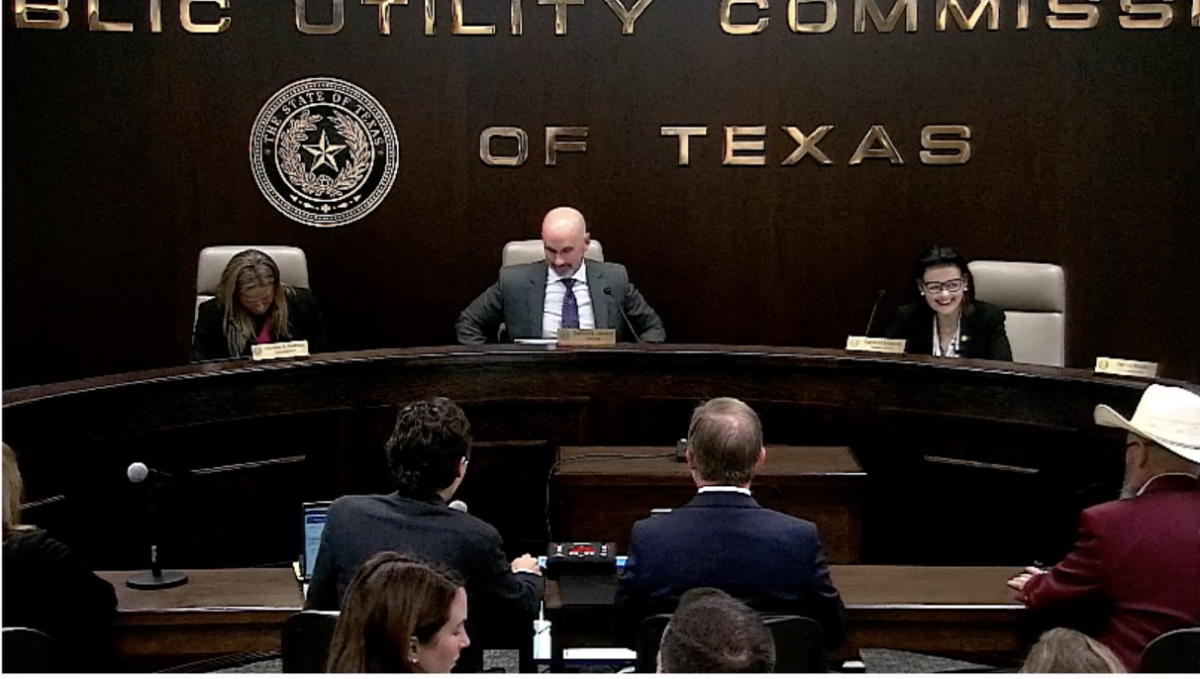
Landowners impacted by a proposed 765-kilovolt transmission line filed a request with the Public Utility Commission of Texas for an “independent investigation and a forensic audit” of electric load and generation models the Electric Reliability Council of Texas developed.
They argued that ERCOT’s 2024 Permian Basin Reliability Plan and 2024 Regional Transmission Plan appear to use materially different assumptions about the timing and location of future electricity demand and generation, and they asked for an independent audit to reconcile the models. The landowners wrote this is important because the Permian plan was used to justify three proposed 765-kV lines.
This centers on the 765-kV Strategic Transmission Expansion Plan (STEP) Permian, a key part of the Permian Basin Reliability Plan (PBRP). STEP-Permian proposes three transmission lines spanning more than 1,200 miles to move power from East Texas to the natural gas-rich Permian Basin. A pro-landowner group likened this project “to hauling water to the sea.” The Texas Public Policy Foundation estimates the lifetime cost of all STEP projects ERCOT approved through December 2025 at nearly $100 billion, to be borne by ratepayers.
The three proposed lines are split into five interconnected segments crossing North, Central, and South Texas. The Public Utility Commission of Texas (PUCT) has approved three of these segments, making up two lines. The third is on hold after the commission remanded one of its segments to the State Office of Administrative Hearings.
On September 17, landowners John Burrow and Kevin Kennedy, impacted by the third line, filed a forensic audit request with PUCT, which oversees grid manager ERCOT. They want the commission to request the Texas Senate Business & Commerce Committee, chaired by State Sen. Charles Schwertner (R–Georgetown), to create a working group “to select, direct, manage, and coordinate with an independent auditor.”
Burrow and Kennedy want the commission to “abate any further action” on the three 765-kV lines until the audit is completed and state lawmakers have an opportunity to take “any action deemed necessary” based on the findings.
“We’re not accusing ERCOT of ‘cooking the books,’ we’re saying the difference in the models [is] too significant, and they must be investigated,” Kennedy told PUCT commissioners Friday.
The filing compared ERCOT’s 2024 Permian Basin model with its Regional Transmission Plan (RTP) conducted that same year.
Burrow and Kennedy wrote that the two models show a roughly 42,000-megawatt difference in planned future generation: the 2024 PBRP model selected 17,170 MW in new generation, while the 2024 Regional Transmission Plan selected 59,200 MW.
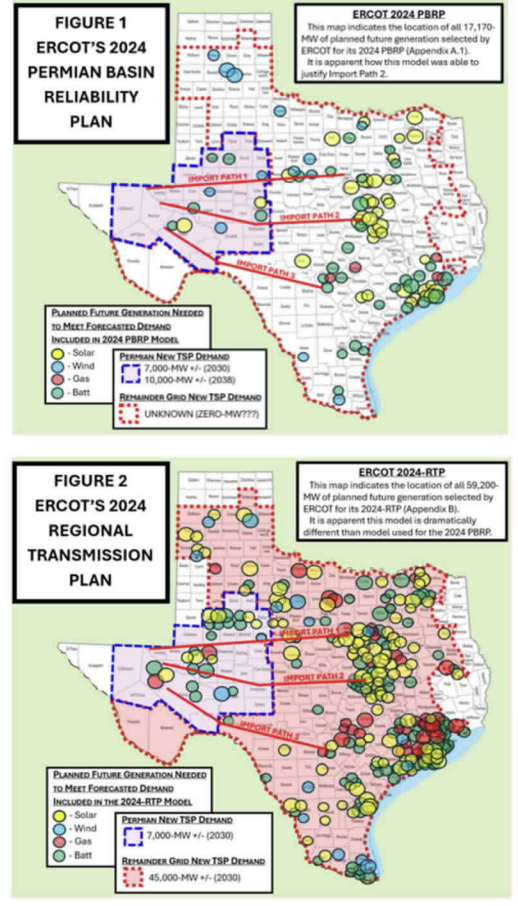
“The concern is that the two models appear to contain materially different temporal and spatial distributions of load and generation, while both were used to evaluate reliability and bulk transmission needs utilizing a system-wide model and data analysis,” they wrote.
Burrow and Kennedy argue that the difference warrants a bus-level reconciliation of the models’ underlying load and generation assumptions.
They noted the PBRP model “appears” to have included “new and substantially increased 2024” transmission service provider forecasted load data in the Permian Basin region, while “significant portions of the load representation” outside “appears to have remained based on” forecast information from 2023.
They also noted that ERCOT’s PBRP modeling inputs “appear to vary greatly” from those for its 2024-RTP, despite both having been developed and analyzed at the same time and pulling information from the same universe of known and available 2030 data.
“When two planning studies look at the same future Texas electric grid using materially different assumptions about future load and generation, that deserves an explanation,” Burrow told commissioners Friday. “Maybe there is a reasonable explanation, but when the consequences involve billions of dollars paid by Texas ratepayers and thousands of Texas landowners are facing eminent domain, I and many other Texans don’t believe ‘trust us’ is good enough.”
Dr. Bennett wrote that Kennedy and Burrow’s filing is “correct in pointing out that the PBRP used incomplete data relative to the 2024 and 2025 regional transmission plans.” But he cautioned there is a “common thread” running through these and ERCOT’s subsequent work used to justify the 765-kV lines.
“ERCOT is using one mix of generation resources with over 90% of new capacity coming from wind, solar, and energy storage. ERCOT never tested its models to see if the 765-kV lines were needed in situations where more new natural gas generation was built,” Dr. Bennett wrote. “Any transmission plan that relies so heavily on diffuse, intermittent resources will be forced to include large amounts of cross-state transmission, so the models are rigged to require the 765-kV lines from the start.”
A spokesperson wrote, “ERCOT has no comment at this time.”
One of the requests in Burrow and Kennedy’s filing is for the audit to determine whether or not the recommendation for 765-kV transmission lines was “prematurely embedded in later modeling” instead of independently re-established.
They also want the audit to evaluate whether ERCOT’s PBRP modeling process complied with 2024 federal reliability and model-data standards, including North American Electric Reliability Corporation (NERC) MOD-033, which the filing describes as addressing planning-model validation.
Burrow and Kennedy wrote that the MOD-033’s underlying technical rationale acknowledges that “planning models must be validated against actual system behavior because inaccurate or incomplete models can produce misleading reliability assessments, including inaccurate identification of system limitations, violations, and transmission needs.”
Dr. Bennett wrote that PUCT “has not budged from its position that the entire 765-kV plan is necessary and has not even attempted to consider alternatives.” TPPF has called on the commission and ERCOT for nearly a year to examine alternative generation scenarios.
“Lieutenant Governor Patrick just raised a red flag on ERCOT executive compensation. Texans demand the same accountability on something that is 2,000 times larger,” Kennedy said.
Conflict between Patrick and electric regulators has been steadily escalating.
On September 16, Patrick wrote in a social media post he had “lost total confidence and trust” in ERCOT Chairman of the Board Bill Flores. He published this following Flores making conflicting statements about whether or not he informed Patrick of upcoming approval of a proposed contract extension for ERCOT President and CEO Pablo Vegas. If finalized, Vegas would have a maximum earning potential of $6.4 million in 2027. This would not be paid out that year, but over a period of time.
The ERCOT board did not finalize the agreement following public criticism from Patrick. It was widely reported that Patrick also wants the board to undo a roughly 30 percent increase in average pay that members approved for themselves the same week. Ex-officio members, including PUCT Chairman Gleeson and Commissioner Courtney Hjaltman, are not impacted by that raise.
On July 31, Patrick and Schwertner urged PUCT to deny all pending 765-kV applications and not consider reapplications until after lawmakers reform the approval process in 2027. On September 9, Patrick said he was “very disappointed” PUCT commissioners had approved the first line.
Critics have argued that PUCT, the Electric Reliability Council of Texas (ERCOT), and electricity delivery company Oncor transformed a regional reliability directive into a de facto statewide 765‑kV grid plan without an explicit vote by state lawmakers.