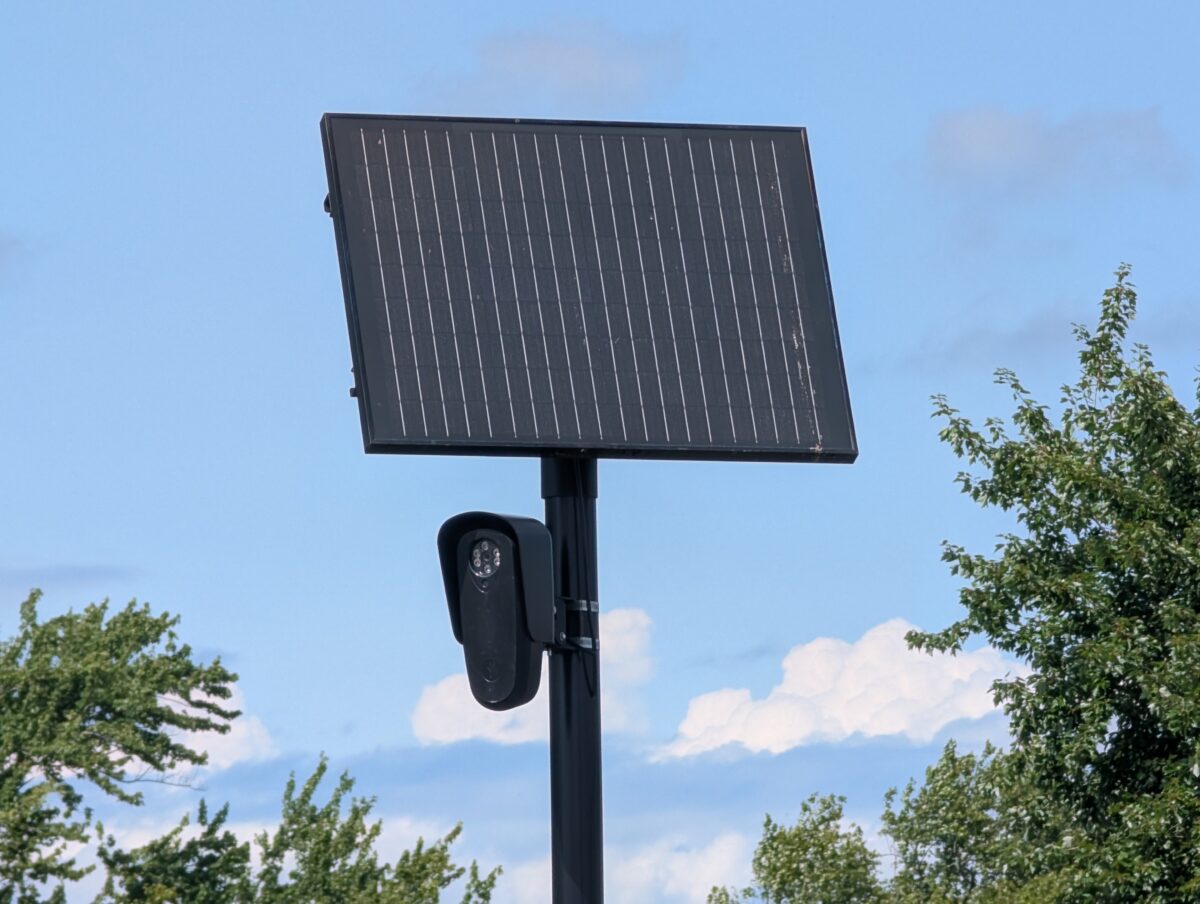
Witnesses told a U.S. Senate panel that Flock Safety’s rapidly expanding network of AI-powered cameras raises serious concerns about data security, warrantless surveillance, and the ability of private companies and law enforcement agencies to track Americans’ movements.
The U.S. Senate Judiciary Subcommittee on Crime and Counterterrorism heard from Benn Jordan, a cybersecurity engineer, on Wednesday.
He researched Flock’s security weaknesses in 2025.
“I found that Flock, at the time, did not require their clients to use multifactor authentication. This led me to find Flock law enforcement accounts for sale by a Russian vendor on a Dark Web marketplace,” said Jordan.
Jordan also “found insufficiently protected sensitive information stored on Flock cameras including photos, license plate data, logs, API keys, passwords, and communications.”
He could view, delete, and modify 30 days of streaming footage as well as zoom in on phone screens through 60 of Flock’s new Condor cameras.
“Last year it was discovered that Flax Typhoon, a Chinese state-backed hacking group, had accessed this system and maintained a hidden backdoor for over a year. Since this attack was likely the result of misconfigurations by a 3rd party, it can’t be fixed by a file scan or security patch,” said Jordan.
He also discovered a lack of end-to-end encryption. “The most alarming consequence of this is in Dunwoody, GA, where FOIA requests show that Flock employees had viewed cameras on their network over 1000 times, including the ones in sensitive areas like the interior of a Jewish community center and a playground.”
When asked how vulnerable Flock’s systems are, he noted that they are not required to have government-grade security or any cybersecurity requirements.
Jordan suggested independent security testing, inspections, and privacy guardrails.
Alasdair Whitney, legislative counsel for the Institute for Justice, warned of additional vulnerabilities. “Last week, hackers who pulled a Flock camera off a pole reported that they had copied its storage, recovered an encryption key the company had left on the device itself, and accessed roughly three weeks of footage showing some 50,000 vehicles. Consider what that means in a city like Norfolk, home to some of the largest naval installations on earth.”
He suggested that foreign intelligence would pay for such a record.
Committee Chairman Josh Hawley (R–MO) revealed that Flock applied for a patent that would give it the capability to track people across a dynamic surveillance network.
Hawley noted that AI intelligence combined with Flock can create facial recognition.
“We see how authoritarian countries like China arguably use this technology to repress human rights,” said Sen. Cory Booker (D–NJ).
Ross Teeple, sheriff of Pinal County, Arizona, warned that “if we rely on private camera networks to act as a dragnet, continuously logging the habits of innocent Americans without a warrant, we are paving the way to an AI-driven surveillance state.”
Teeple noted the benefits of Flock cameras to law enforcement but called for clear statutory boundaries.
“If my deputies need a search warrant to put a physical tracker on a vehicle, where is the line for camera systems that build an identical, AI-driven map of a citizen’s life?” asked Teeple.
Whitney proposed model legislation entitled the Protecting Everyone from Excessive Police Surveillance (PEEPS) Act, which would require a warrant for historical location information from public or private databases.
“It requires a record of every access, employee supervisor audits every 30 days, and an annual public report. Importantly, it caps data retention at seven days absent a warrant, and it makes evidence obtained in violation of the Act inadmissible,” Whitney stated.
Lindsey Isaacs testified that she spent 13 days in jail, including time in solitary confinement and a mental health unit, and faced the possibility of life in prison due to the faulty interpretation of data from a Flock camera.
“In my case, a Flock camera captured my vehicle a few miles from the scene of a terrible crash. That piece of information became part of an investigation that ultimately led to my arrest on three counts of vehicular homicide and 13 days in jail for a crash I had nothing to do with,” said Isaacs. She was ultimately released, but warned the committee that “surveillance technology does not exist in a vacuum” and affects the lives of real Americans.
Hawley quoted Flock CEO Garrett Langley: “We’ve already given up the traditional sense of privacy. . . . And we live in a pretty safe world given those tradeoffs.”
“Do you want to make a tradeoff?” asked Hawley. “Are we living in a world where we have to suffer the deprivations that Ms. Isaacs did?”
The hearing follows nationwide pushback against Flock systems, including in Texas.
In August, Gov. Greg Abbott paused state funding of Flock cameras, and in September he directed the Texas Department of Transportation to stop issuing new permits for Flock cameras and other ALPRs on state-owned roads.
Multiple Texas cities have rejected, canceled, or deactivated their Flock cameras, including Bastrop, El Paso, Elgin, and Wylie.
Concerned Texans have been able to express their opinions and concerns about Flock via city council meetings, including in Amarillo.
The Republican Party of Texas’ 2026 platform includes a call for the ban of ALPRs.
Texas lawmakers are expected to evaluate possible guardrails for ALPRs during the 2027 legislative session.