Records from Texas’ electrical grid managers bolster critics’ concerns that a proposed extra-high-voltage transmission line project would increase state reliance on unreliable wind and solar generation.
These open-source records are reports published by the Electric Reliability Council of Texas and its independent market monitor, Potomac Economics. ERCOT’s reports pointed to a “potential” final 765-kilovolt buildout that would reach into the Texas Panhandle. Potomac Economics reports the region “has abundant wind and solar resources” that are currently “export-constrained.” Potomac wrote that “transmission projects have not kept pace with the large increase in renewables in the Panhandle and growing demand in the Permian Basin.”
The issue of moving energy around the Panhandle as a limited project would have been addressed by House Bill 5066, a 2023 state law. But that project was transformed into a larger statewide transmission project by the Public Utility Commission of Texas (PUCT).
This is about the 765-kV Strategic Transmission Expansion Plan (STEP), a key part of the Permian Basin Reliability Plan (PBRP). It currently has two stages. Stage one consists of the three STEP Permian transmission lines spanning more than 1,200 miles to move power from East Texas to the natural gas-rich Permian Basin. A pro-landowner group likened this project “to hauling water to the sea.”
The next stage consists of the more than $9 billion STEP Western and STEP Eastern lines that together span roughly 1,200 miles. The ERCOT board approved these in December 2025. The STEP Eastern applications to PUCT are expected in early 2027.
PUCT must give final approval on each segment of each line. These lines may not be the final product. A January 2025 ERCOT report displays a potentially even larger buildout could follow.
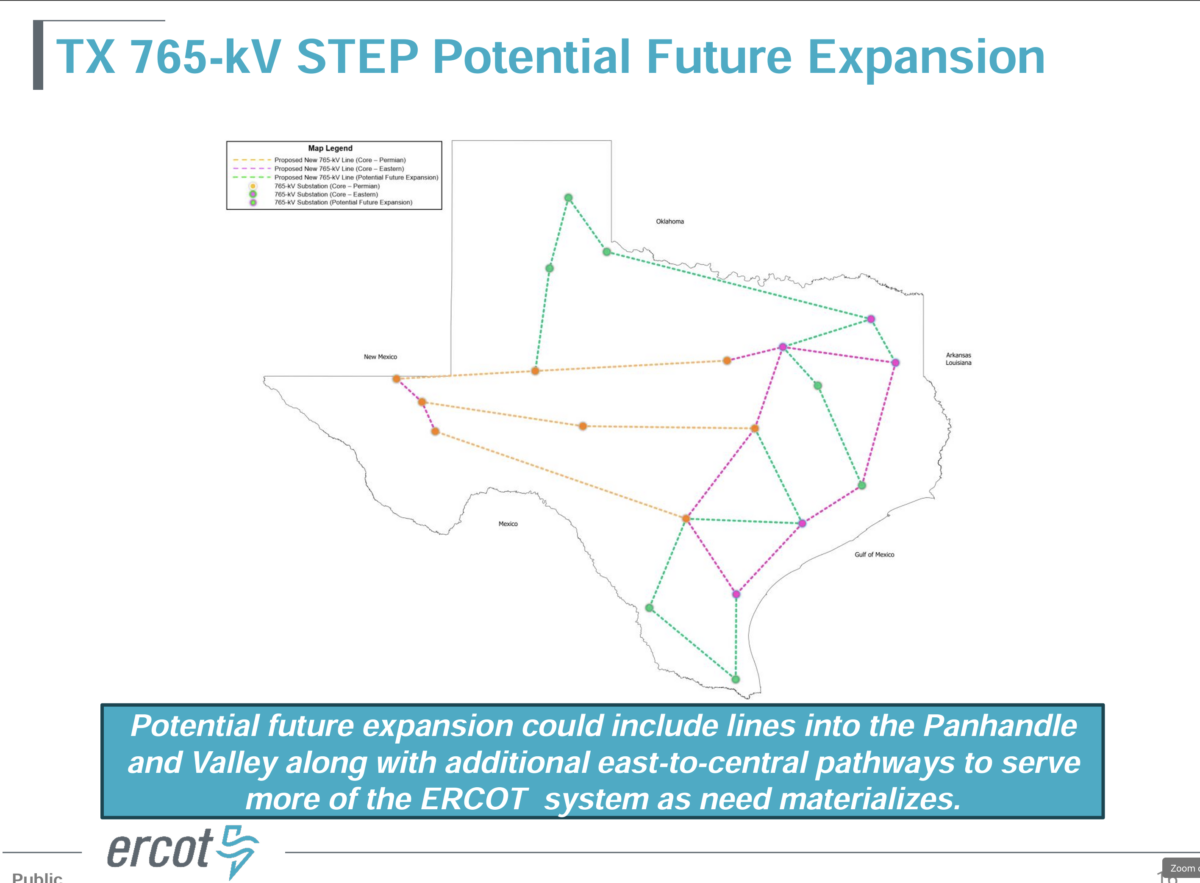
“As the system continues to evolve, the core plan could be expanded to serve more of the ERCOT system as need materializes,” ERCOT wrote in its Regional Transmission Plan (RTP) 345-kV Plan and Texas 765-kV STEP Comparison. “This option could expand the 765-kV system into the Panhandle and Valley areas or add additional east-to-central pathways. Any potential future expansion options would be further evaluated as system needs evolve.”
Dr. Brent Bennett of the Texas Public Policy Foundation commented that the above map gets to the Foundation’s “central concern with the entire STEP: if nothing changes, then the ‘core’ that has been approved so far is just the beginning.” He noted that this map is not in ERCOT’s 2025 RTP. “[I]t’s not clear if they are still considering it in their models or if it was just a one-off,” he wrote.
When asked about the potential expansion, PUCT spokesperson Rich Parsons wrote, “No action has been taken.” ERCOT stated: “It remains under consideration. Any transmission expansions beyond the 765-kV projects identified in ERCOT’s 2024 Regional Transmission Plan remain in the long-range planning and study phase.”
State Sen. Kevin Sparks (R–Midland) has expressed concern that wind and solar power would flood the new 765-kV lines. According to Dr. Bennett, this potential 765-kV total buildout would allow ERCOT to tap into this power.
“In the absence of market reform that would better value reliability and stop overpaying wind and solar, the 765-kV STEP will primarily be used to move wind and solar around the state, responding to the huge temporal and geographic swings in their output,” he wrote to Texas Scorecard. “And it would facilitate more wind and solar buildout that would increase instability and necessitate more transmission lines in the future. This is what happened after the CREZ lines, and it will happen again if nothing changes.”
State lawmakers mandated the CREZ, short for Competitive Renewable Energy Zones, transmission lines in 2005. Its purpose was to transfer wind energy from West to East Texas.
As previously reported, transmission service providers admitted that reliance on wind and solar power is driving Permian Basin energy issues. Energy policy specialist Jason Isaac linked the February 2021 blackouts to Texas putting “so many eggs in the renewable basket.”
A July 2024 Energy Alliance report found that from 2014 to 2024, the percentage of Texas’ energy generation composed of wind and solar increased from 13.5 percent to 38 percent. An April 2026 Senate committee hearing referenced a University of Texas forecast that solar, wind, and batteries would make up 62 percent of the generation mix by 2029.
Rising Electric Bills
Throughout the debate on transmission and unreliable power is the question of cost to ratepayers.
TPPF estimates the lifetime cost of all STEP projects ERCOT approved through December 2025 at nearly $100 billion. Dr. Bennett wrote that ERCOT ratepayers would bear the burden, facing a 7-8 percent increase on their average bill—more than $150 a year.
Meanwhile, TPPF found the project would help industrial consumers meet ESG “net zero” goals. A pro-transmission coalition that includes the Texas Oil & Gas Association, Texas Association of Manufacturers, and the Association of Electric Companies of Texas, published a letter opposing delay of the STEP Permian 765-kV transmission projects.
Texas residential ratepayers have paid rising costs for years. Dr. Bennett testified before the House State Affairs Committee on August 19 that while Texas ranks as the fourth best state in industrial electricity rates, in residential rates it ranks 28th.
“TPPF’s research has demonstrated how the combination of socialized reliability and transmission costs being imposed by wind and solar generation is falling primarily on Texas residential consumers, who have seen their average prices rise by more than 30% since 2020,” he said. “The spread between residential, commercial, and industrial rates has widened since 2020 with the latter two categories appearing to reap the benefits of historically low fuel costs while residential consumers see consistent price increases.”
A TPPF study reported that in 2024 the average ERCOT ratepayer paid 57 percent more in transmission charges than in 2010, after adjusting for overall rising delivery demand and inflation. It also found that since 2010 Texas ratepayers have paid nearly $15 billion in support of transmission investments for solar and wind, and are paying $1 billion a year.
Texas Scorecard asked ERCOT if a plan is being considered that would result in the net decrease of the average ratepayer’s monthly bill relative to what it is today. They replied:
ERCOT facilitates the operation of the competitive wholesale and retail markets, but does not set retail rates, which are determined by retail electric providers. Additionally, transmission cost allocation policy is set by the Public Utility Commission of Texas, informed by data and analysis ERCOT provides.
Dr. Bennett has advocated that the solution to Permian Basin energy demand is for lawmakers to reform the electricity market, enabling the development of more reliable energy generation where it is needed. “Market reforms would definitely decrease ratepayer bills in the long-run (short-run outcomes depend on the weather year-to-year),” he wrote to Texas Scorecard.
PUCT is set to consider three segments of the STEP Permian lines on August 28. Landowners impacted by the proposed lines and lawmakers have urged PUCT to deny all of the pending 765-kV applications until after the 2027 state legislative session.
At this point, the Public Utility Commission of Texas could either approve, abate, or deny the applications, or as advocates are suggesting, consider market reforms that would move Texas away from unreliable energy.