State Sen. Kevin Sparks expressed concerns about a plan to build extra-high-voltage transmission lines into the energy-resource-rich Permian Basin, specifically issues such as property rights, reliable power generation, and its cost to ratepayers.
Known as the Permian Basin Reliability Plan, lawmakers originally authorized it as a limited fix for a specific region. The Public Utility Commission of Texas expanded it into a broader build‑out. The state agencies involved in the process expanded the project beyond its limits with minimal public input. Aside from Texans being burdened by increased costs, the expansion could lead to other large projects being launched with little direct accountability.
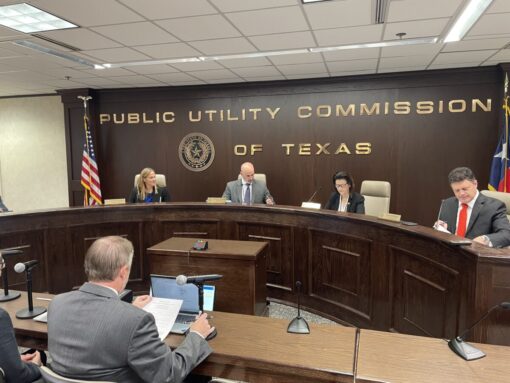
“I probably represent more land being crossed by these three 765kV lines than anybody else here,” Sparks (R–Midland) said during the April 1 hearing of the Senate Committee on Business & Commerce. “It concerns me that we’re going to—and I get calls daily, multiple times a day—wind up eminent domaining a bunch of property.”
He questioned Public Utility Commission of Texas (PUCT) Chair Thomas Gleeson about the total cost of the roughly 1,400-mile, $30 billion to $40 billion project.
“I hear we’re going to put off talking about cost allocation, while at the same time we’re marching forward at light speed,” he told Gleeson. “That cost has got to go somewhere. I think I’ve been told that some of that transportation allocation to West Texas is some of the highest in the state.”
Gleeson replied that “we’re not putting anything off, we’re going to comply with the law (Senate Bill 6), and again, we will change the methodology by which we allocate transmission.” As for determining rates, he said that process comes after construction, which in his example could take three years, when the utility would provide information to show “what their costs actually are,” and file a rate case.
As previously reported, Texas ratepayers are expected to shoulder the burden of this $33 billion project for years—about $3 billion annually and more than $200 a year for a typical household under current cost-allocation methods. In his testimony at a March administrative law hearing with the State Office of Administrative Hearings, PUCT engineer Eduardo Acosta admitted that “during construction, there may be overruns.”
Sparks also raised concerns about whether there will be enough reliable energy flowing through these new lines. He referenced a University of Texas presentation earlier that day, which reported that by 2029, Texas energy generation mix would be up to 62 percent of solar, wind, and batteries, not reliable dispatchable energy sources such as gas, clean coal, and nuclear energy.
“What is being built on the east side of these 765kV lines that we’re going to build that’s going to bring us dispatchable power?” Sparks asked. “It seems like maybe that’s putting the cart before the horse a little bit.”
Gleeson replied that PUCT is looking at its market design to try and incentivize more generation, noting that the current design doesn’t drive it into thermal dispatchable power, like natural gas. He said that while the Texas Energy Fund has gone “a long way” in helping with this in the short term, we do have a long term issue that we need to address to find ways to bring more thermal dispatchable generation on the grid.”
The Permian Basin is already an energy rich resource area, raising questions about why transmission lines are being built into it. American Stewards of Liberty stated this area “has one of the most abundant natural gas sources in the world” and that this project “is akin to hauling water to the sea.”
As previously reported, critics have stated electricity delivery company Oncor, with the Electric Reliability Council of Texas’ and PUCT’s blessing, has helped morph this project beyond original intent, without new explicit legislative approval or broad public consent. Gleeson told senators at the April 1 hearing that PUCT “will keep you all in the loop of what we are doing and make sure that there is broad support for what we’re trying to do.”
There is already a broad front formed in opposition to this plan. In early March, dozens of parties, including landowners, contested Oncor’s request to build an extra-high-voltage transmission line. American Stewards of Liberty is one of the filers in this case against Oncor.
Whether the administrative law judges will allow this project expansion to continue remains to be seen. Based on past case history, the ALJ’s proposal for decision in a transmission case is often issued six to eight weeks after the hearing, with a PUCT final order six to eight weeks after that.
Under Texas Utilities Code §37.057, the commission must approve or deny an application for a new transmission facility certificate no later than 180 days after it is filed.
Gleeson told senators he expects the plan’s first project application in mid-June and then will follow the approval process.
If you are a concerned citizen who has information regarding bureaucratic overreach, please email scorecardtips@protonmail.com.