EL PASO—Adam Kincaid, the mapmaker at the center of Texas’ 2025 redistricting case, took the stand on Tuesday, offering detailed testimony about his work and methodology in constructing the state’s new congressional boundaries.
Kincaid asserted repeatedly in the federal courtroom that race was never factored into his mapping decisions. Instead, he testified that in his view, it is both wrong and unconstitutional to consider race when drawing political boundaries.
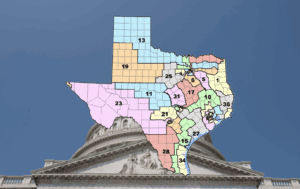
The latest congressional map creates five new GOP-opportunity districts. Plaintiffs suing over the map include the League of United Latin American Citizens (LULAC), the National Association for the Advancement of Colored People (NAACP), the Mexican American Legal Defense and Educational Fund (MALDEF), and the Mexican American Legislative Caucus (MALC).
Methodology Explained
During his testimony, Kincaid described an extensive process using ESRI software that incorporated historic voting patterns and election data stretching back to 2012.
He said partisan instructions played a central role: every Republican incumbent had to remain within their current district, and districts that President Trump carried by above 60 percent in prior elections needed to retain at least that margin.
Instructions also required improving or maintaining performance in districts where Trump had lower support. Criteria for five Republican pickup districts included Trump carrying each by at least ten points, a win by U.S. Sen. Ted Cruz in 2024, and a solid margin for Gov. Greg Abbott.
Kincaid analyzed a broad range of elections—primary, gubernatorial, presidential, and attorney general—often reaching back more than a decade.
Unlike the Plaintiffs’ map experts Dr. Matt Barreto and Dr. Moon Duchin, who were present in the courtroom, Kincaid said he considered a much wider selection of voter data. He did this by obtaining Texas voter files and analyzing which party’s primary election an individual has voted in, among other factors. He then aggregated this data to the block-level, a granularity that Barreto and Duchin did not have.
He explained that this fine-grained data allowed him to assess party affiliation on a level that is arguably one of the most advanced methodologies deployed.
Kincaid placed emphasis on using natural boundaries—rivers, highways, county and city lines—when drawing maps where possible. He also tried to maintain existing district lines where appropriate.
Population equalization, compactness requirements, and avoidance of splitting incumbent home addresses guided further modifications.
Plaintiffs’ experts were unaware Kincaid had considered any of these factors or details when generating their own maps. Instead, they were making assumptions based on academic standards and traditional redistricting considerations.
Disputes
Plaintiffs objected to this evidence shortly before Kincaid testified, arguing that some of the partisan block-level data was provided too late. The State countered that Plaintiffs themselves had introduced new evidence on even shorter notice just a day before.
Plaintiffs also objected to Kincaid being called as a “fact witness,” arguing that the State would use him as an “expert” witness, prompting continual objections by Plaintiffs throughout his testimony. Judges will decide later whether such a designation is appropriate.
During cross-examination, Kincaid responded to repeated questions regarding racial data, consistently stating that none was used, appearing relaxed and confident in his responses.
At one point, Plaintiffs referenced the Department of Justice letter that called for Texas to redraw congressional boundaries. Kincaid explained that he opposed releasing the letter—not because it referenced race—but because he felt it was unnecessary and misinterpreted relevant precedent from Petteway v. Galveston. That decision held that coalition districts, combining multiple minority groups, are not protected under the Voting Rights Act.
Kincaid also disagreed with Abbott’s interpretation of the Petteway v. Galveston decision during a CNN interview, but said his presentation of racial data after the map’s release was not problematic as Plaintiffs had previously argued.
Next Steps
Plaintiffs were unable to effectively challenge Kincaid’s data during his testimony, as they did not possess equivalent data inputs or the advanced partisan datasets he employed.
Throughout the proceedings, Plaintiffs’ experts Barreto and Duchin observed Kincaid closely and collaborated during breaks, possibly preparing to leverage his methodology and information to create new data or maps aimed at countering his testimony.
With limited success in discrediting his technical methods, Plaintiffs pivoted their argument in two new directions.
First, they claimed that even if Kincaid did not personally consider race, legislators may have acted with racial intent when voting on the map. However, their intent is not relevant to the merits of the map itself.
Second, they alleged Kincaid’s acquisition of voter files—used to derive granular, block-level partisan data—may have been unlawful, raising separate legal questions beyond the scope of this case. Kincaid testified that he received the data from the Republican National Committee and signed a non-disclosure agreement.
The State has not had a chance to respond, and cross-examination of Kincaid was not finished when court broke for the day. Kincaid will return to the stand on Wednesday.
The trial is set to continue through Friday, though appeals are expected regardless of the three-judge panel decision.
Day 5 Trial Coverage
Day 4 Trial Coverage
Day 3 Trial Coverage
Day 2 Trial Coverage
Day 1 Trial Coverage