This article has been updated since publication to include a statement from Oncor.
It was revealed during a local government committee hearing that electricity delivery company Oncor has identified 19 endangered or threatened species in its application to build 765-kV transmission lines from East Texas into the energy-rich Permian Basin.
Margaret Byfield of American Stewards of Liberty said Oncor’s current federal permit authorizes it only to deal with four of these species, and that the company is avoiding doing its due diligence.
Oncor disputed this characterization in a statement to Texas Scorecard.
Oncor conducted an Environmental Assessment and Alternative Route Analysis as part of this proposed project. This work included a thorough evaluation of the project area’s community values and resources, cultural resources, land use, threatened and endangered plant and animal species, and more. Our detailed findings will be reviewed as part of the thorough, highly regulated process we follow when building new transmission lines. The current Incidental Take Permit remains effective for the 11 species covered under Oncor’s Habitat Conservation Plan. Should additional permits be needed, we will continue to work with the U.S. Fish and Wildlife Service to remain in compliance with pertinent laws and regulations.
The dispute comes as property owners protest the Permian Basin Reliability Plan. Originally authorized by lawmakers as a limited fix for a specific region, critics have said the Public Utility Commission of Texas, grid operator ERCOT, and Oncor expanded it into a broader build-out of these transmission lines with minimum public input. The Texas Public Policy Foundation has estimated the project would cost $90 to $100 billion over its lifetime. Aside from Texans being burdened by increased costs, the expansion could lead to other large projects being launched with little direct accountability.
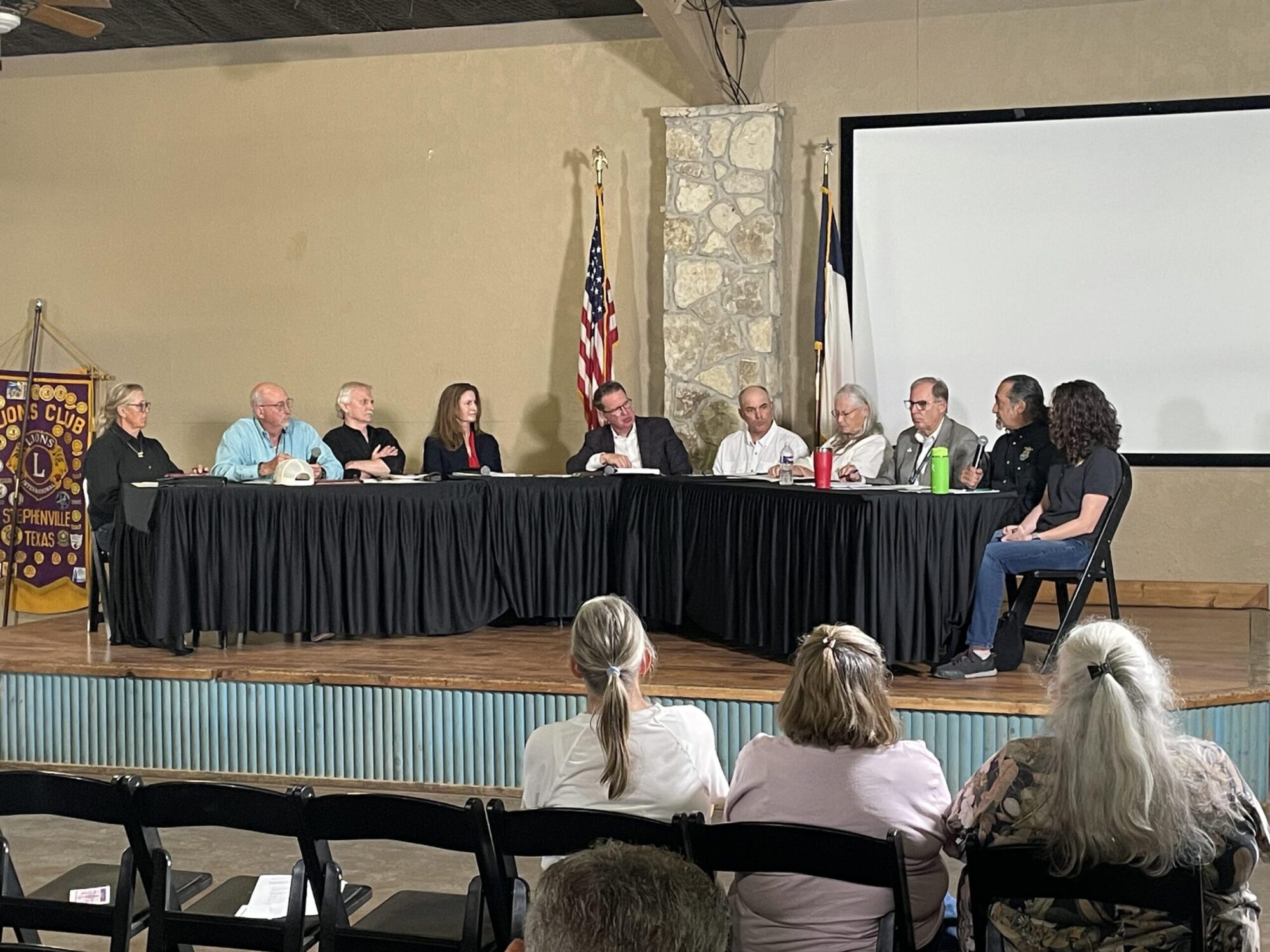
On April 28, the Erath-Somervell Sub-Regional Planning Commission (ESSRPC) met to discuss potential threats to endangered wildlife within Erath and Somervell counties.
At issue was the Incidental Take Permit which the U.S. Fish and Wildlife Service issued Oncor in 2012, covering roughly 100 counties statewide and about a dozen endangered species for 30 years. “Take” means to harass, harm, pursue, hunt, shoot, wound, kill, trap, capture, or collect, or attempt to do so. Omar Bocanegra of U.S. Fish and Wildlife Service’s Fort Worth office was present to answer questions.
The permit gives Oncor the right to take an endangered species, and outlines what the company must do to avoid a taking, or how to mitigate when they do take a species. Without this permit, Oncor would have to seek individual approval each time a project might affect protected wildlife.
Margaret Byfield, a consultant to the commission and executive director of nonprofit American Stewards of Liberty, said that Oncor had not done any surveys to determine presence or absence of endangered wildlife. Under their current permit from U.S. Fish and Wildlife, if such surveys are not done, then Oncor would have to presume such species are present.
“If they don’t do those surveys, they have to presume that on every route they will be taking species,” she said.
Even though no survey was done, Oncor may believe protected species are present. Byfield said the electricity delivery company’s application for the proposed 765-kV transmission lines included an “environmental assessment”—which she said was one in name only—that identified 19 species that are endangered or threatened in the area. But of those, only four are covered by their current permit from U.S. Fish and Wildlife.
She then read a portion of the permit aloud stating that
If actions associated with implementation of the Oncor Habitat Conservation Plan are shown to result in incidental take of listed species not covered by the permit, those activities that are shown to cause take must immediately cease, and any take that has occurred shall be reported to the Austin office within 48 hours.
Byfield asked Bocanegra if she was correct in interpreting this to mean that if Oncor were to take any of these species not covered by the current permit, “construction has to stop.”
“That sounds like standard language in some of our permits, and that’s probably the advice that we would give everybody,” Bocanegra replied. “You can’t take a species under the Endangered Species Act without a permit or some type of incidental take statement.”
When asked if he knew of any studies covering how transmission lines of this type may affect local wildlife, Bocanegra said he wasn’t aware of any. “The first time I think I knew about this line may have been through the letter that I received from [Erath County] Judge [Brandon Huckabee] here,” he said.
He explained that typically new technology races ahead of research that studies its effects. “We’re concerned about newer technologies that are continuing to spread out across the land, and how those interact with fish and wildlife resources,” he said. “Drone use and renewable energy and all these things we don’t really understand. But as a generalizer, I think in Texas, it’s still a matter of habitat loss, and in many instances, fragmentation that’s having the largest impact on fish and wildlife resources.”
When it comes to enforcing the provisions of the Incidental Take Permit and endangered species protections, Bocanegra said it is largely limit‑based and self‑reported, with a heavy reliance on the honor system and annual reporting, instead of active on‑the‑ground policing by federal agencies.
That didn’t sit well with Gary Buchholz, owner and manager of GKB Cattle Co. “When you got to handle that many counties and it’s on your honor system, who checks the checkboxes?” he asked.
Buchholz shared that every one of the proposed routes for the 765-kV lines would run through his ranch. “We do not know what this line is going to do for us, how it’s going to affect our [cattle’s] genetics, how it’s going to affect our employees that work for me on a daily basis,” he said. “How am I going to pass this on to the next generation? It’s just got us totally flipped upside down.”
Byfield threw a red flag at the state-supervised Oncor. “It is really clear that Oncor is trying to avoid their federal due diligence on this route,” she told Texas Scorecard.
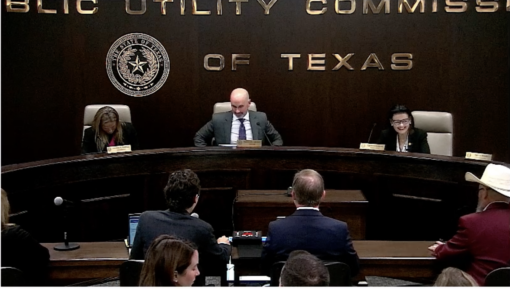
As previously reported, the Public Utility Commission of Texas institutes regulations on utility companies like Oncor. PUCT did not provide a response to a request for comment before publication.
Erath County Judge Brandon Huckabee said that his office invited the Texas Parks and Wildlife Department to attend. No representatives were present. “I think having a conversation with us would be prudent, and we hope that we can still have that with them,” Huckabee told Texas Scorecard. “We have a lot of very concerned citizens that I think have really valid concerns of the impact that these lines could have to their land.”
The department did not provide a response to a request for comment before publication.
Members at the ESSRPC Tuesday meeting included Erath County Judge Brandon Huckabee, Somervell County Judge Danny Chambers, and Stephenville Mayor Lonn Reisman.
Sub-regional planning commissions, according to American Stewards of Liberty, are authorized under Section 391 of the Texas Local Government Code. When coordinating with state agencies on plan development, this type of commission’s general purpose is “to make studies and plans to guide the unified, far-reaching development of a region, eliminate duplication, and promote economy and efficiency in the coordinated development of a region.”
This is part of a process that American Stewards of Liberty called “coordination” between all levels of government.
“The Texas State code places the burden to harmonize policies on the State agencies,” ASL wrote. “There are unique nuances as to what each agency is required to do based on the specific laws they implement. Nevertheless, the end goal remains the same: to harmonize the plans, objectives and policies across all levels of government.”
ASL credited the 391 commission process in stopping development of the unpopular Trans-Texas Corridor, and with helping border counties Kinney and Uvalde receive more border security support from the governor’s office.
If you are a citizen with information regarding bureaucratic overreach, please email scorecardtips@protonmail.com.