Citizens asked state representatives to pause the proposed build-out of 765-kilovolt transmission lines, citing private property rights and a desire for considering alternatives.
While transmission proponents threatened rolling outages in West Texas if there is a delay, they admitted there’s a path to buy time.
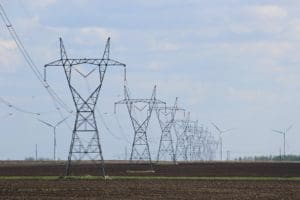
This is about the 765-kV Strategic Transmission Expansion Plan (STEP) Permian, a key part of the Permian Basin Reliability Plan (PBRP). STEP Permian proposes three transmission lines spanning more than 1,200 miles to move power from East Texas to the natural gas-rich Permian Basin.
The three proposed lines are split into five interconnected segments that would cross North, Central, and South Texas. The Public Utility Commission of Texas (PUCT) must approve each segment.
Rogue Bureaucrats
Critics have argued that PUCT, the Electric Reliability Council of Texas (ERCOT), and electricity delivery company Oncor transformed a regional reliability directive into a de facto statewide 765‑kV grid plan without an explicit vote by state lawmakers.
As he did before state senators on July 29, PUCT Chairman Thomas Gleeson admitted that lawmakers’ regional reliability directive in House Bill 5066 did not mandate building 765-kV lines. Instead, PUCT chose that path “after a lot of analysis by ERCOT and others.”
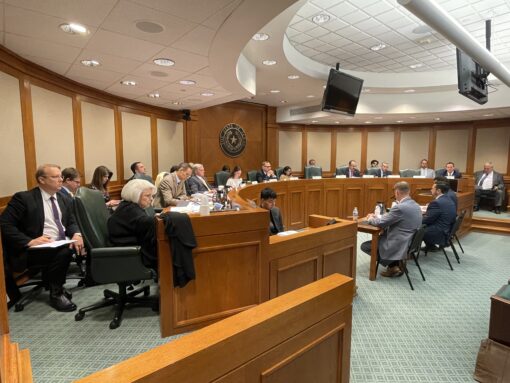
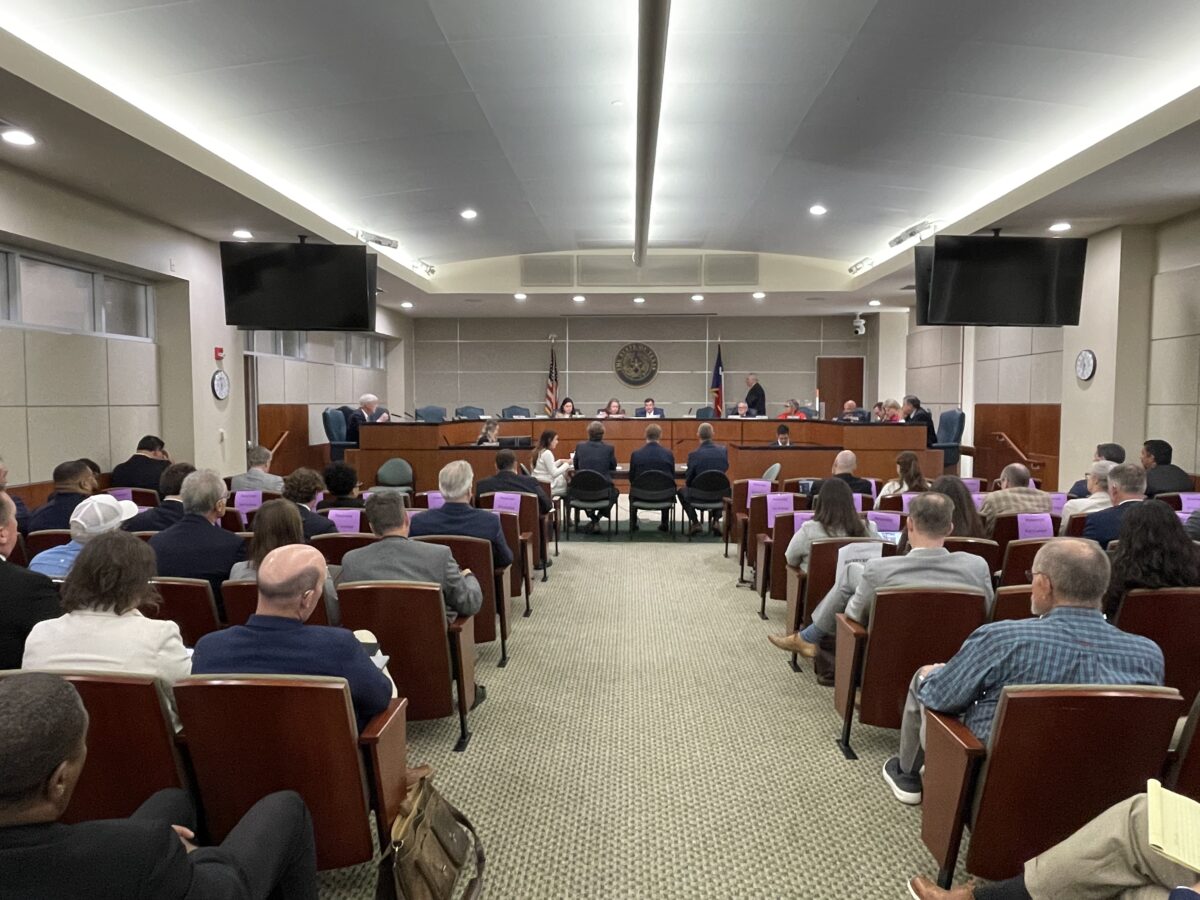
He said this again at the August 19 hearing of the Texas House State Affairs Committee.
What HB 5066 did do, Gleeson said, was shorten the decision time frame for such projects from one year to 180 days. State Rep. Charlie Geren (R–Fort Worth), who wrote the law, pushed Gleeson on how PUCT went beyond what lawmakers intended.
Geren said that reduction was suggested based on the Permian Basin Reliability Plan. “Not y’all deciding that we’ve got to run lines all the way across the state,” he said. “I think we need to relook at that.”
He held up a copy of the ERCOT Workshop June 2024 plan and asked if that was what his law authorized. “I’m looking at this [ERCOT June 2024 plan]; there wasn’t much talk of 765s. It was mostly the lower voltage. But then, all of a sudden 765s came around,” Geren said.
Gleeson replied that after HB 5066 was passed, PUCT directed ERCOT to examine a Permian plan, and that the law also requires transmission planning around the state. “What they came back with were options for us to consider at different voltage levels,” Gleeson replied.
Gleeson framed the choice as between building 765-kV lines or a “spider web” of lower voltage 345-kV lines around the state. However, lobbyist Will McAdams, a former PUCT commissioner, told lawmakers the 765-kV plan will cover Texas with a “spider web” anyway.
He told lawmakers that if the Longshore to Drill Hole segment, one of the 765-kV projects PUCT will discuss on Friday, August 21, is delayed “it will affect 400 miles of 345 kV network that’s supposed to connect into it, and so this entire spider web of grid starts getting delayed.”
Fighting Delays
Landowners and lawmakers have urged PUCT to deny all of the pending 765-kV applications until after the 2027 state legislative session. A coalition of transmission service providers, lobbyists, and bureaucrats threatened lawmakers that any delay could invite power outages.
“ERCOT is projecting that as early as next summer, far west Texas could see rotating outages. So every day that we don’t make a decision on building transmission just exacerbates that issue,” Gleeson claimed.
“We need to accommodate landowners at every phase, but it’s catastrophic if we do not address this. Not to mention the reliability problems that have already been identified about the regional rolling blackouts that are imminent, and that’s already there,” said Todd Staples of the Texas Oil and Gas Association.
However, if rolling outages in West Texas are “imminent,” Staples mentioned a time-buying solution. He told Texas Scorecard that companies are having to purchase “temporary” diesel generators and gas turbines “that are exorbitantly expensive” as they wait on a transmission buildout. A spokesperson for TXOGA stated that a company mentioned during the hearing “recently had to invest $125 million” for this resource.
McAdams, who warned lawmakers against delay, told Texas Scorecard that “yes, it is possible” that such power generation could be deployed to buy more time to consider the 765-kV project.
Dr. Brent Bennett of the Texas Public Policy Foundation estimates the lifetime cost of all STEP projects ERCOT approved through December 2025 at more than $90 billion to be borne by ratepayers. Jaren Taylor, an attorney representing Oncor, called that estimate “grossly exaggerated and bluntly kind of misleading, as it only looks at the cost and ignores all of the benefits that come from these projects.”
Bennett wrote to Texas Scorecard that the “lifetime cost includes debt and equity financing, maintenance, and taxes,” and “the greater risk [is] that the lines will cost much more.”
Dan Gattis, a lawyer who represents landowners in condemnation cases and serves as first vice president of the Texas & Southwestern Cattle Raisers Association, warned against rushing. “The oil and gas industry, year after year, session after session, will always tell you the sky is falling, and an emergency is now, and today is dire,” he said. “I will tell you the decisions that have been made over Texas landowners on their land, those decisions cannot be undone once they are done.”
When asked about temporary power generation, ERCOT pointed to its December 2025 Trending Topics paper. “The document explains the steps ERCOT has taken to examine the costs and effects of expanding the current 345-kV system vs. moving to 765-kV lines. It also includes links to the original planning studies for deeper research,” ERCOT’s statement read.
This response was in line with a transmission coalition’s framing of the Permian power problem as a choice between 765-kV lines, a web of lower-voltage lines, or outages.
Critics argue that building new dispatchable power generation, such as the natural gas the Permian Basin is rich in, was not fully examined. Dr. Bennett believes the “need” for 765-kV lines is based on ERCOT’s assumption that Texas will continue to overbuild wind and solar generation.
As previously reported, transmission service providers admitted that reliance on wind and solar power is driving Permian Basin energy issues. At a July Senate hearing, State Sen. Kevin Sparks (R–Midland) expressed his concern that this type of power would flood the lines.
Katie Coleman of the Texas Association of Manufacturers and Texas Chemistry Council admitted at the Wednesday hearing that unreliable power sources will feed the 765-kV lines. “Anytime you build new facilities, yes, there will be renewable electrons that flow across those facilities,” she said.
Bennett has argued that lawmakers need to redesign the market, enabling the buildout of more reliable power generation.
Stephen Bauer, a rancher and District 10 state director for the Texas Farm Bureau, told lawmakers he wants a thorough evaluation of “all reasonable alternatives” before any final approval. “The 765-kV transmission line requires substantial right-of-way that can affect irrigation systems, aerial applications, pasture management, future improvements, and overall productivity of the agricultural land,” he said.
Media Burns Nazerenas, a fourth-generation rancher from McCulloch County, said Oncor and LCRA did not give her a timely notice of “a previously undisclosed alternative route” that would have “an enormous footprint” on her land. She said it would devastate her ranching operation.
State Rep. Ken King (R–Canadian), the committee chair, raised his eyebrows. “They’ve not offered to plant your grass back and do anything?” Nazerenas replied, “correct.”
“I find that disheartening,” King replied. “I had a big transmission line come through my ranch, and that power company … they just came out planting grass and stuff.”
Gerald Nobles Jr., from a long line of family ranchers whose property would be affected by the proposed 765-kV transmission lines, told lawmakers that the process “is a manipulated mess” designed to “deliver a predetermined outcome.”