This article has been updated since publication.
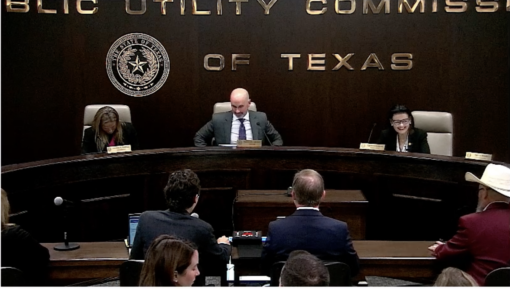
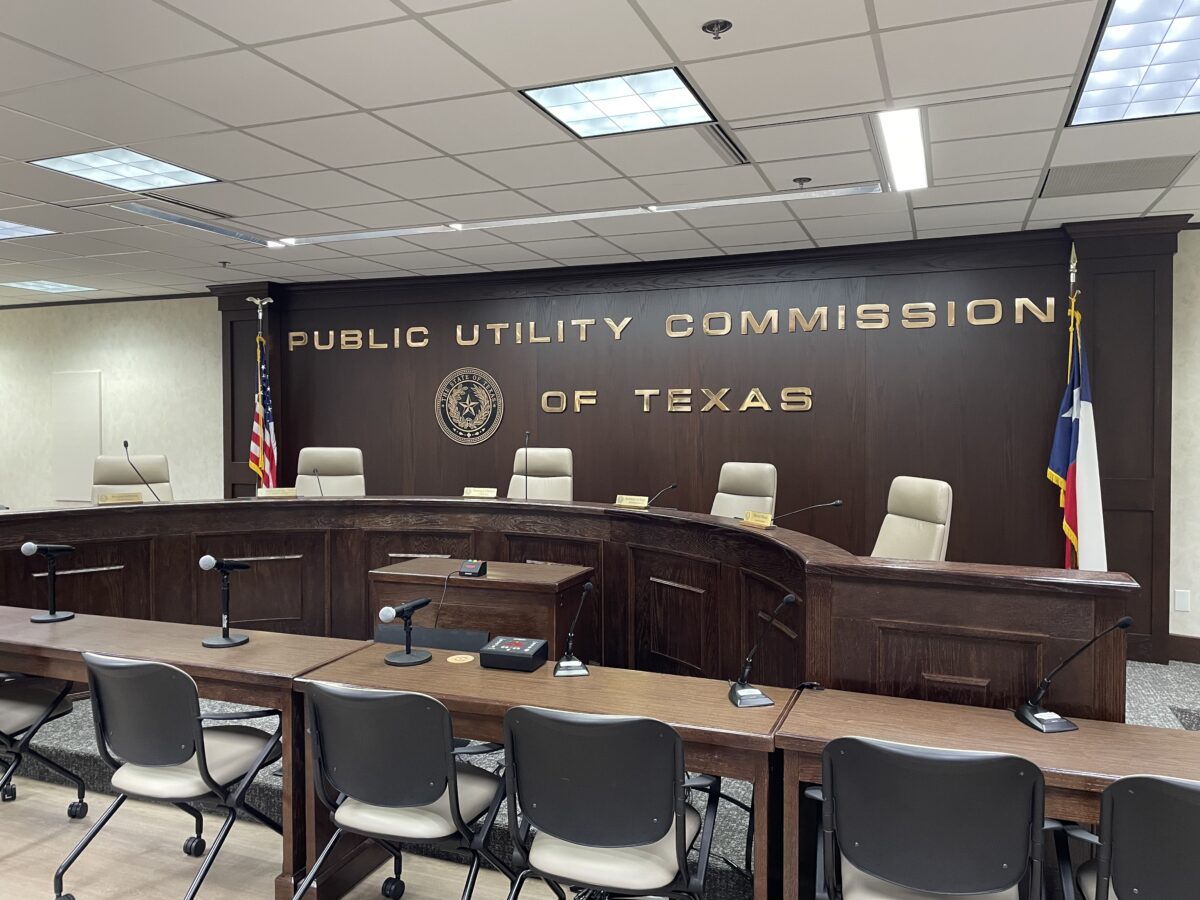
In a unanimous decision today, members of the Public Utility Commission of Texas denied a request for a hearing on the adequacy of routes proposed for a 765-kilovolt transmission line.
This focused on the routes utilities Oncor and the Lower Colorado River Authority proposed in their application for the Bell County East to Big Hill extra‑high‑voltage transmission line. Spanning about 199 miles, this line covers the area from just north of Austin to south of San Angelo. This line, together with the Big Hill to Sand Lake segment from south of San Angelo to Pecos, forms the central 765‑kV import path—one of three proposed extra‑high‑voltage import paths designed to move large amounts of power across Texas into the energy-rich Permian Basin.
Critics have argued that the Public Utility Commission of Texas (PUCT), the Electric Reliability Council of Texas (ERCOT), and electricity delivery company Oncor transformed a regional reliability directive into a de facto statewide 765‑kV grid plan without an explicit vote by state lawmakers. A pro-landowner group likened the project “to hauling water to the sea.”
Applicants proposed multiple routes for this line. After last week’s administrative law hearing with the State Office of Administrative Hearings (SOAH), administrative law judges will make a recommendation for commissioners to consider.
Save the Lampasas, an organization of more than 50 affected landowners and more than 600 community members in Burnet County, proposed two specific alternative corridors for the transmission line. Chairman Thomas Gleeson said that the PUCT has 20 years of precedent on whether “an application contains an adequate number of reasonably differentiated alternative routes,” and that there are situations where “that justif[ies] a limited number of alternative routes.”
“The applicants provided evidence to show that an adequate number of reasonably differentiated routes, considering all facts and circumstances, was presented,” Gleeson said before the unanimous vote. “Although there are a limited number of corridors in the study area, they did provide a reasoned justification for those routes as proposed.”
Save the Lampasas, and 4K Land and Cattle Company appealed to PUCT after administrative law judges denied appeals for a route adequacy hearing. Days before the administrative law hearing on the Bell County East to Big Hill line, the commission agreed to consider the appeal and placed it on its June 18 agenda after the hearing.
“Instead of giving the parties a chance to present all evidence, the SOAH Order simply accepts the conclusory statements in the Applicants’ Consolidated Response,” Save the Lampasas’ attorneys wrote. The SOAH order “fails to address the fact that the Applicants have failed to provide a reasoned justification for limitation of routing to this relatively narrow portion of the study area.”
“Despite the large number of filed routes, the Application confines a 214- to 244-mile, unprecedented 765-kV project to a narrow study area spanning only about 35 miles north-to-south, which funnels alternatives into a few convergent corridors,” 4K Land’s appeal stated.
4K’s lawyers wrote that the applicants had failed to consult with Texas Parks and Wildlife Department resources, that their routing design process contained “methodological deficiencies,” and that the study area chosen for the proposed line “is anomalously narrow by every geometric measure applied.”
Save the Lampasas’ appeal suggested that the consultants who presented Oncor’s and LCRA’s Environmental Assessment and Alternative Route Analysis may have been stretched thin. The attorneys wrote that these consultants were “essentially simultaneously responsible for presenting the Environmental Assessment and Alternate Route Analysis for multiple 765-kV projects and other 345-kV transmission line projects that were also filed this year.”
An Alternative Route
On the other hand, STL argued it had identified other, less impactful alternative routes that Oncor and the LCRA had not proposed but that commissioners should be allowed to consider.
Unless the ALJ’s order was reversed, they wrote “the Commission’s only routing options available will all traverse the northeastern portion of Burnet County. Further, if the Commission approves such a route, the impact on the property, the property owners, and the affected community will be irreversible and in perpetuity.”
Gleeson disagreed. He said that neither Save the Lampasas nor 4K Land and Cattle Company had shown they were entitled to a route adequacy hearing.
Landowner Kevin Kennedy decried the setup of the current system for approving transmission lines. “How can a landowner possibly mount a winning argument on need, route adequacy, or any of these complex issues when the deck is stacked so high against them?” he asked. “This system is in need of a complete overhaul, and I intend to be front and center in that reform effort. I beg Governor Abbott to act on the People’s behalf. Help your rural constituents.”
Gov. Greg Abbott appointed all five PUCT commissioners.
Yesterday, these commissioners voted unanimously to pause a decision on a separate 765-kV line until the segment of another line has finished processing through SOAH.
In a joint statement to Texas Scorecard, Oncor and LCRA wrote that after the PUCT’s decision, they “will work expeditiously to keep this project moving forward.”
“This critical project will support Texas’ long-term electric reliability needs, and the PUCT’s decision allows the project to continue under its existing procedural schedule,” the statement read in part. “These transmission lines are urgently needed to ensure reliable electric service to West Texas, as ERCOT has repeatedly identified in its analyses over the past several years and as established by the overwhelming weight of the record evidence developed in this proceeding … Oncor and LCRA TSC will continue working through the established PUCT processes and will remain engaged with landowners, communities, and other stakeholders as the project moves forward.”
Their full statement may be read in its entirety here.