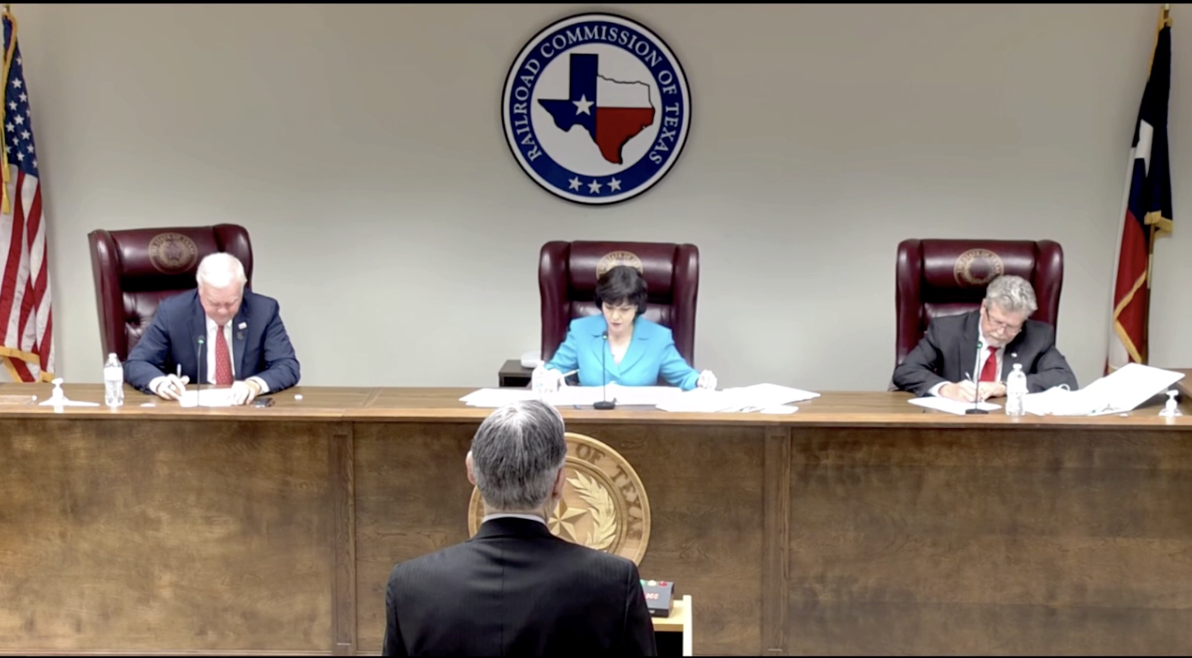
In a 2-1 vote, the Texas Railroad Commission approved ExxonMobil’s application for its Rose Carbon Capture and Storage permit, to be sited in Jefferson County.
Commissioner Wayne Christian, who said he is a fan of ExxonMobil, was the lone no vote against Commissioners Christi Craddick and Jim Wright. “We are moving toward a socialist type system of government rather than free market,” Christian said.
Jason Isaac, CEO of American Energy Institute, told commissioners that ExxonMobil’s Jefferson County project is “heavily influenced by government incentives,” and the company’s recent quarterly results reported $14.5 billion in profits.
“If carbon capture is a good investment, Exxon has the financial resources to make that investment. The question is, why should taxpayers subsidize it, especially when Exxon itself acknowledges in its SEC disclosures that government policy is important to the economics of its low-carbon business?”
Isaac also countered claims the project would benefit the environment. He told commissioners the project would store approximately 53 million metric tons of carbon dioxide below ground over 13 years.
“During those same 13 years, at today’s rate, the world would emit approximately 481 billion metric tons of CO2,” he said. “That’s about one-hundredth of one percent that’s going to be stored here.”
Isaac highlighted that the Trump administration was moving in the opposite direction.
“Yesterday, … [EPA] Administrator [Lee] Zeldin and the Trump administration announced it was eliminating Biden-era greenhouse gas regulation that pushed power plants towards carbon capture. And last year, Energy Secretary Chris Wright terminated 24 Biden-era awards totaling more than $3.7 billion, primarily involving carbon capture and other decarbonization projects,” he said.
Isaac linked the Rose Carbon Capture permit with the Public Utility Commission of Texas’ recent approval of two 765-kilovolt transmission line projects. Isaac said ExxonMobil supports both as part of its pursuit of net zero emissions goals.
“Exxon has committed to achieving net zero, scope one, and scope two emissions from its Permian operation, and Exxon tells us exactly how it intends to get there: electrification,” he said. “Meeting that commitment requires electrification, that company helps commission a forecast projecting enormous electricity demand. That forecast is then used in planning billions of dollars of transmission infrastructure, and ratepayers get stuck with the bill.”
The Texas Oil & Gas Association, which supports the transmission line project, published a statement from its president, Todd Staples, praising the commission’s vote to approve the permit.
Craddick asked Sarah Spikes of the Cheek Texas Community Association, which protested the application, about ExxonMobil’s community involvement. Spikes said she first learned about the project at the company’s June 2024 community meeting, followed by another in August. She said those meetings stopped in summer 2025 once she and her community members acquired legal representation.
“The community was not allowed to select whom they wanted to represent or to bring our own experts or scientists to sit at the table,” said Spikes.
Spikes alleged that while local media reports state the injection site will be two miles away from their neighborhood, she and her fellow residents found it would only be 0.8 miles from the nearest home.
“We have concerns involving groundwater pressure propagation, abandoned wells, emergency preparedness, or cumulative impacts that emerge years from now. Those consequences may not be easily reversed,” she added.
Isaac also warned of risks with carbon capture and storage, saying that carbon dioxide is “incredibly dangerous in high concentrations.”
“There are reported instances around the world of safety issues happening, and it’s just for nothing. It’s a misallocation of resources,” he said.
Arden Elliott, of the commission’s hearings division, reported that examiners found the application met all requirements and would “not endanger any oil, gas, or mineral formation, will protect groundwater, will not endanger human health and safety, and that the reservoir is suitable for protecting against the escape of injected carbon.”
As previously reported, ExxonMobil wrote in a statement that the permit “is grounded in facts, validated by science, and engineered for safety.”
Craddick rebuked ExxonMobil, but then voted for the permit.
“We’ve had it with Exxon right now,” she said. “You better show up and be part of the community. Give them information. Be there for their safety.”
Christian made a motion to remand the application back to the hearings division. “I’m still concerned that we have not gotten this permit right, and it’s not safe,” he said. No one seconded his motion.
Commissioner Jim Wright disagreed. “Given that this thing has gone through a hearing process, with the best people we have that I know of, I think this thing is safe,” he said.
“I am disappointed by the outcome. I remain unconvinced that the record adequately establishes the project’s long-term safety,” Christian wrote in a statement. “What is the point of permanently injecting carbon dioxide underground? These projects also require massive taxpayer subsidies, and I am concerned they will drive up costs for the consumers I was elected to represent.”
In a statement to Texas Scorecard, an ExxonMobil spokesperson called the decision “a major milestone for the state of Texas. The Railroad Commission clearly recognizes the important role carbon capture and storage can play in meeting growing global demand for lower-carbon products while supporting new jobs and economic growth. We look forward to building on this momentum as we continue expanding our CCS business across the U.S. Gulf Coast.”
State Rep. Jon Rosenthal (D–Houston), who is a candidate to replace Wright in the November 2026 election, also praised the vote. “I am glad to see that the Railroad Commission approved this CCS program,” he wrote in a statement. “Like I said last week, Texas is positioned to be a leader in CCS, and I’m looking forward to supporting this technology further and ensuring appropriate management when I am on the Railroad Commission.”
His Republican opponent, Bo French, did not respond to a request for comment before publication.
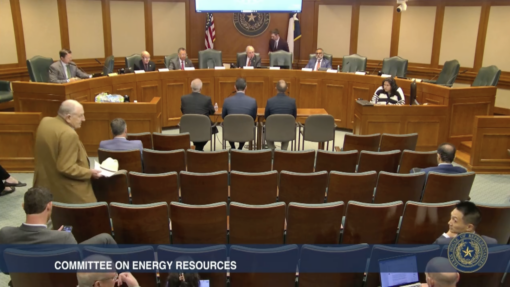
Rosenthal is on the Texas House Energy Resources Committee, which also had a hearing that morning. State Rep. Drew Darby (R–San Angelo), the committee chairman, rebuked Christian in a social media post for not showing up to discuss the commission’s new public comment rules. Darby and Vice Chair State Rep. Eddie Morales (D–Eagle Pass) discussed subpoenaing Wright.
Christian had announced earlier in the day he would not be attending after the meeting was moved to 11:30 am, writing that it would conflict with his railroad commission duties and then he would be departing Austin for a pre-scheduled commitment. “I also cannot ignore the political circumstances surrounding today’s hearing. A member of your committee is currently a candidate for RRC,” he wrote.