This article has been updated since publication with a statement from Oncor and Lower Colorado River Authority.
Landowner Kevin Kennedy argues it doesn’t appear utilities complied with the notice requirements in state law for roughly 1,400 addresses. He’s asking for administrative law judges to extend enough time for the owners of these lands to be heard.
“I had no idea that stuff like this went on [in Texas],” he said. “It’s a breach of the public trust.”
Andrew Clark, spokesman for electricity delivery company Oncor, wrote in a statement that “Oncor and [Lower Colorado River Authority] TSC complied with all state laws and regulations when providing landowner notice for this project, and in several ways exceeded those requirements.” He added that “administrative law judges have already concluded that Oncor properly followed the law.”
Both are referring to the Bell County East to Big Hill 765-kV transmission line, one of three 765-kV transmission lines in Texas’s Strategic Transmission Expansion Plan. It will carry power from East Texas to the energy-rich Permian Basin and is part of the Permian Basin Reliability Plan—which state lawmakers had authorized as a targeted fix for a specific region.
Critics argue that the Public Utility Commission of Texas (PUCT), grid operator ERCOT, and Oncor have expanded it into a much broader transmission buildout with minimal public input. Brent Bennett of the Texas Public Policy Foundation estimates the project will cost $90–100 billion over its lifetime.
Beyond higher costs, critics warn that this expansion sets a precedent for bureaucrats to pursue other large-scale projects with little accountability.
Kennedy said that he was notified in June 2025 that a route from the proposed line would be crossing into his property and invited him to a public hearing. Oncor and LCRA are jointly responsible for planning and building the Bell County East–Big Hill 765‑kV line, with each utility owning and operating roughly half.
The packet looked like junk mail to him.
“I almost threw the mailer away because I didn’t recognize what it was,” Kennedy said. Inside, he found a “tiny” 200 mile map. Kennedy said he previously worked 20 years as a consultant for the Texas Department of Transportation, and even so he found the map in the mail “illegible.” “I’ve studied maps my whole life, and I couldn’t figure it out.”
He almost missed the hearing. It was only because of a friend’s warning that Kennedy attended the June 2025 meeting in Lampasas. “Sure enough, they had a route coming through my property, but the notice didn’t say that.”
Since then, Kennedy has had to organize with others and fight back. He is concerned about what he says appears to be roughly 1400 new landowners added after the June meeting and not notified until early April 2026.
Kennedy shared with Texas Scorecard a spreadsheet that lists close to 1,400 individual or entity landowners (such as limited liability corporations or trusts). He got this information by downloading Oncor’s 4,200‑name application mailing list from the Public Utility Commission of Texas. He and his team removed everyone listed in the June 2025 public meeting notification.
“Their rights of due process have been totally trampled,” he said of the other property owners.
Kevin Kennedy, Ashley & Erik Gulbranson, and John Burrow, are working to file a motion next week to give these landowners more time to organize and defend their rights. They will request the administrative law judges grant a roughly 5–10 month extension for the addresses added after June 2025 and only notified in spring 2026. They will also seek to have the upcoming June hearing and September PUCT commissioners’ decision pushed back for the same amount of time.
For Kennedy, this is about enforcing state law—specifically 16 Texas Administrative Code 22.52. That law states that an electric utility must hold at least one public meeting prior to filing a licensing application if 25 or more persons would be entitled to receive direct mail notice of the application. It must send first-class mail notice of that meeting to landowners within 300/500 feet of centerline or adjacent to proposed substations.
“Failure to provide notice in accordance with this section will be cause for day-for-day extension of deadlines for intervention and for commission action on the application,” the law states.
According to Kennedy, it appears Oncor and LCRA failed to give proper notice and public‑meeting access to all affected landowners. That contention, if sustained, could support a day-for-day extension under the rule.
In his statement, Clark provided a timeline of Oncor’s actions, and provided copies of mailed notices for the line’s application and meeting. “While some residents participated earlier in the preliminary engagement process, the formal opportunity to intervene in the CCN proceeding was the same for all impacted individuals. All landowners identified at filing received the same mailed notice, project information, and opportunity to intervene,” he wrote.
Kennedy said the process is in sharp contrast with his experience with the Texas Department of Transportation, which always sent mail with the agency logo on it, and used multiple channels and regular updates to invite the public to a meeting about a project affecting them. He said turnouts for such meetings were huge.
“TxDOT is probably the finest public agency in the country,” Kennedy said. “I just assumed that that’s the way the whole state of Texas operates, but not the case with utility lines.”
Kennedy’s complaint is in line with those raised by others. Questions raised against the three‑line 765‑kV transmission program include those of “due diligence,” adherence to state security law, and the exclusion of Texans from the process. An administrative law judge highlighted the short timeline for an upcoming hearing. Twenty-five state lawmakers have called for it to be paused.
The hearing for the Bell County East to Big Hill 765-kV transmission line is the week of June 8 before the State Office of Administrative Hearings. The hearing for the Howard-Solstice Transmission Line, managed by AEP Texas Inc. and the City of San Antonio’s CPS Energy, will be from May 19 to 22. Citizens may watch a livestream of these hearings through the SOAH YouTube channel.
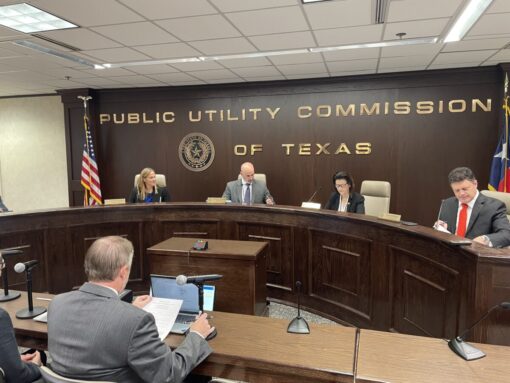
Administrative law judges will make recommendations from these hearings to the commissioners of the Public Utility Commission of Texas. The commissioners will make the final decision. The deadline for a decision on the Longshore to Drill Hole line is scheduled for June 9. The Bell County to Big Hill line deadline is September 22. Gov. Greg Abbott, whom Texans have called to stop the project, has appointed both PUCT and SOAH leadership.
“We’ll just … have to see if the state is going to do what’s right or the state is going to not protect the people,” Kennedy said. “If it doesn’t get stopped, then I’m gonna have to move to Oklahoma or something.”
PUCT Press Officer Ellie Breed provided a written statement. “Utilities are required to host public informational meetings and invite affected landowners, publish notices in newspapers in affected counties, and notify all affected landowners by mail on the date the application is filed. Please see PUCT Rule §22.52,” she wrote. “Compliance with notice requirements is a key issue that is considered in the contested case.”
LCRA wrote in a statement that both itself and Oncor “have complied with all applicable rules and regulations throughout this process, including all landowner notifications.”
The full statement from Oncor can be viewed by clicking the link.
If you are a citizen with information regarding bureaucratic overreach, please email scorecardtips@protonmail.com.