This article has been updated with a statement from Oncor.
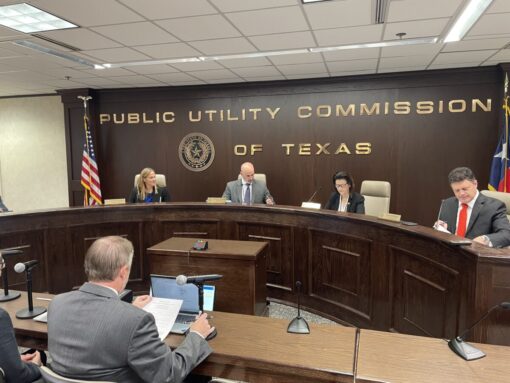
Attorneys questioned whether the Public Utility Commission of Texas is giving more weight to utilities than to landowners and raised concerns about possible inadequate attention to national security concerns during hearings on proposed extra-high-voltage transmission lines. Multiple proposed routes would, if approved, cross parts of the Edwards Aquifer region, at a time when Texas needs to expand its water supply.
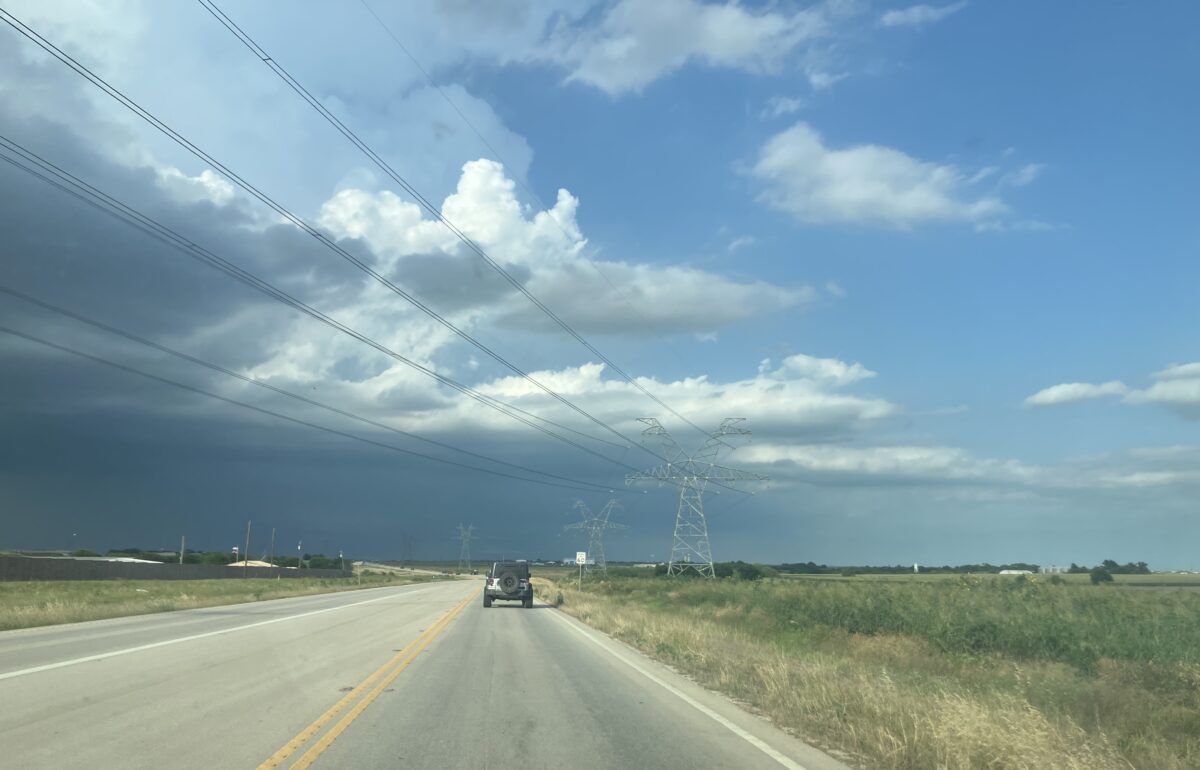
The Howard to Solstice and Dinosaur to Longshore Switch lines are segments of three proposed 765-kV transmission lines that are part of the Permian Basin Reliability Plan—which state lawmakers had authorized as a targeted fix for a specific region.
These lines will carry power from East Texas to the energy-rich Permian Basin. American Stewards of Liberty has likened the project to “hauling water to the ocean.” Brent Bennett of the Texas Public Policy Foundation estimates the project will cost $90–100 billion over its lifetime.
Critics have argued that the Public Utility Commission of Texas (PUCT), grid operator ERCOT, and Oncor expanded it into a much broader transmission buildout with minimal public input.
Landowners participated in two administrative law hearings this month to express opposition to all or parts of the project. Each lasted at least four days, reflecting the accelerated time frame state lawmakers authorized in 2023. Administrative Law Judge Sarah Starnes, who presided over the Howard to Solstice hearing, said “the practical effect of that 180 day deadline is that nobody here is going to have as much time as they think they need.”
Utilities Bias
Responses during the hearings did little to assuage concerns about the lack of public input.
Under cross-examination in the Howard hearing, PUCT engineer Lawrence Rahmes admitted that his analysis, in which he recommended route 4 as the “best meets route,” did not include direct testimony filed by intervenors on April 17. PUCT spokesman Rich Parsons said Rahmes’ “duties are to review the application and provide recommendations, including a route” for the Howard line, which would run through South Texas.
Rahmes, who filed his testimony on April 24, responded to attorney Natasha Martin that “the testimonies I considered were that of the applicant” and confirmed that his recommendation was based solely on information in the record from the applicant. He also told Attorney Clay Steely that “my testimony does not consider intervenor testimony.”
The applicants for the Howard to Solstice line are AEP Texas and San Antonio-owned CPS Energy. Neither responded to a request for comment before publication.
Rahmes blamed the short time frame allotted to him. “When I checked, there was over 250 testimony filings within the interchange, including testimony and exhibits,” he said during Martin’s cross-examination. “I did not have the time, and it was not feasible for me to consider all testimony filings prior to my submission of testimony.”
In the Dinosaur to Longshore Switch hearing, PUCT engineer Eduardo Acosta admitted under cross-examination that while he had read the intervenor’s testimony, he had not read every submission. He agreed that he had not used an identified scoring or weighting system in his analysis, but rather made a judgement call, though he did use the staff’s route-comparison tables.
Attorneys also raised concerns about the transmission team’s judgment on national security.
National Security
“Are issues of national security important to the commission when they’re considering the placement of transmission lines?” Martin asked Rahmes. “I would believe so. I guess I’m not too sure exactly,” he replied.
Martin asked Gary McClanahan of WSP, a company serving as project manager for the Howard to Solstice line, if he had heard of the Lone Star Infrastructure Protection Act. He replied he heard about it but knew nothing else.
WSP did not return a request for comment before publication.
The Lone Star Infrastructure Protection Act was passed in 2021 by state lawmakers in response to Chinese billionaire Sun Guangxin—who reportedly has ties with the Chinese Communist Party—buying land in Val Verde County near Laughlin Air Force Base.
As previously reported, entities reportedly controlled by Guangxin protested that proposed routes for the Howard line would come into proximity with its land.
State Rep. Eddie Morales (D–Del Rio) raised this issue to PUCT Chairman Thomas Gleeson in a March 12 letter. “[M]y office has also been made aware that some routing alternatives may cross or closely approach large tracts of land reportedly owned by entities connected to Chinese national interests, including companies associated with Mr. Sun Guangxin and Xinjiang Guanghui Industry Investment Group,” he wrote.
Morales questioned Gleeson on this. In response to a series of inquiries about this and other issues raised during the hearing, PUCT spokesman Parsons wrote to Texas Scorecard that “we are unable to comment on legal proceedings.” Morales’ office did not respond before publication about PUCT’s response.
Martin asked McClanahan if he knew if any of the route links identified in Morales’ letter are owned by foreign national entities. “I do not,” he replied.
This issue drew the attention of the Office of Public Utilities Counsel, which asked PUCT to take the Lone Star Infrastructure Protection Act into consideration.
Laughlin Air Force Base is directly tied into this project as well. Under cross-examination by Val Verde County Attorney David Martinez, McClanahan said that the U.S. Department of War had expressed concern in November 2025 about proposed Howard to Solstice line routes potentially interfering with Laughlin’s radar system.
McClanahan said the routing plan had been adjusted to address DOW and Laughlin’s concerns, but admitted that “there are no documents saying they were satisfied or they were unsatisfied” with the changes.
Proposed routes would also cross into the Dickinson Conservation Easement, property that Laughlin Air Force Base has enforcement rights over.
Under cross-examination Romey Swanson, who helped develop the Laughlin Air Force Base Compatible Use Study, confirmed that the U.S. Department of War would have to approve condemning a right of way across the easement for the transmission line project.
Swanson—a Gov. Greg Abbott appointee to the Farm and Ranch Lands Conservation Council—is also executive director of the Devils River Conservancy, which he said is opposed to two of the proposed routes.
Another section of the proposed 765-kV lines, the Dinosaur to Longshore segment, also comes into proximity with a military installation: Dyess Air Force Base. A transcription of that hearing showed discussion of DOW’s concern about possible impacts on military operations and on terminal instrument procedures, or TERPS, and DOW instructed Oncor to coordinate with Master Sergeant Aaron Siders, an Air Force TERPS specialist.
DOW expressed no objection “at this time” to the proposed coordinates and heights of the line, but reserved the right to object later if final design conflicted with Dyess operations. Amy Zapletal of Oncor confirmed that until the lines are finalized, it doesn’t yet have a final decision from DOW. “I think all parties are waiting for that formal approval of the route by the commission,” she said, noting “communications are actually still active with Dyess.”
When asked what would happen if DOW rejected the line PUCT picks, Oncor’s Corin Cooley said that “we would make mitigation measures through the design process.”
In response to a request for comment, Oncor spokesman Andrew Clark wrote, “Oncor is familiar with FAA and DOD requirements for transmission line construction near airfields. In recent years, Oncor has worked with both institutions to successfully build new transmission lines near military bases and commercial airports and does not anticipate any impediment to construction due to airfields.”
Texas Scorecard had also asked if Oncor staff are aware of the Lone Star Infrastructure Protection Act and if they are keeping it under consideration in the development of their proposed 765-kV lines. Clark replied that “Oncor monitors and abides by all state laws and regulations.”
During the Howard to Solstice hearing, attorney Martin asked PUCT engineer Rahmes whether, if he were made aware of a potential issue that could impact national security, that would be something he would consider. “I would have to do more research and dig to understand what the situation is,” he replied.
DOW did not respond to a request for comment before publication.
Due Diligence
Concerns over due diligence have also been raised about this rushed project, starting with an April 28 meeting of the Erath-Somervell Sub-Regional Planning Commission regarding Oncor and federal wildlife preservation requirements.
Multiple proposed routes of the Howard-Solstice line under consideration would also cross over different parts of the Edwards Aquifer.
Currently, the state is taking steps to address its water supply. The Texas Water Development Board has drafted a $174 billion plan for the next 50 years for future water needs.
Texas Scorecard asked TWDB if it had been consulted to ensure the proposed transmission lines do not impact the state’s water sources and plans to expand the water supply.
“The Texas Water Development Board does not assess the potential impacts of proposed transmission line projects on water sources,” it wrote in a statement. “Our understanding is that the STEP and 765‑kV transmission projects are currently progressing through the Public Utility Commission of Texas (PUC) approval process. For additional details or project‑specific information, we encourage you to contact the PUC directly.”
The application from AEP Texas and CPS Energy states that “the Project is expected to be a regulated activity” of the Texas Commission on Environmental Quality, and wrote that “the amount of recharge area that would be disturbed by construction is minimal when compared with the total amount of recharge area available for the aquifer systems in the region.”
State Sen. Roland Gutierrez (D–San Antonio) cautioned AEP and CPS Energy leadership that the Aquifer “landscape supplies drinking water to millions of Texans,” and that “since 2000, the City of San Antonio has invested more than $325 million to safeguard nearly 190,000 acres of the recharge zone from threats to water quality. Routing transmission infrastructure through or near these protected areas could jeopardize aquifer integrity and threaten long-term water security for surrounding communities.”
During the Howard line hearing, route 4, the recommended route, was discussed as avoiding the recharge zone.
The next administrative law hearing will be on the Bell County East to Big Hill 765-kV transmission line. It is scheduled the week of June 8 before the State Office of Administrative Hearings, but a landowner is fighting for more time so more affected landowners can be heard. Citizens may watch a livestream of the hearing through the SOAH YouTube channel.
Administrative law judges will make recommendations from these hearings to the five PUCT commissioners, all Gov. Abbott appointees, who make the final decision. The deadline for a decision on the Longshore to Drill Hole line is scheduled for June 9. The Bell County to Big Hill line deadline is September 22.
Parsons confirmed that at this time, “No applications have been approved.”
Twenty-five state lawmakers have called for the project to be paused, while Texans have asked Abbott to stop it.
If you are a citizen with information regarding bureaucratic overreach, please email scorecardtips@protonmail.com.