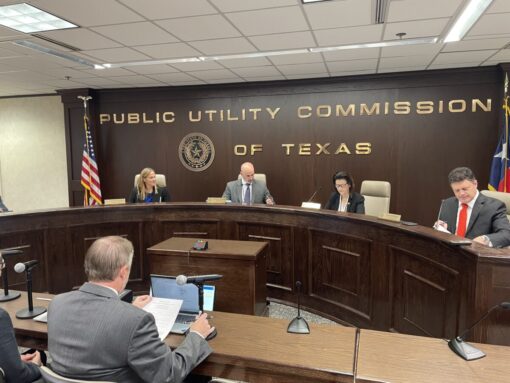
A committee of local governments in Erath and Somervell counties questioned Oncor representatives about the potential impacts of proposed extra-high-voltage lines. Concerns about ESG as a basis for the project were among the topics discussed.
At issue are three proposed 765-kV transmission lines set to bring power from East Texas to the energy-rich Permian Basin, which critics have equated to “hauling water to the ocean.” Brent Bennett of the Texas Public Policy Foundation estimates the project’s lifetime cost to be $90–100 billion.
These proposed lines are part of the Permian Basin Reliability Plan, which state lawmakers had authorized as a targeted fix for a specific region. Critics have argued that the Public Utility Commission of Texas (PUCT), grid operator ERCOT, and Oncor expanded it into a much broader transmission buildout with minimal public input.
On May 27, the Erath-Somervell Sub-Regional Planning Commission (ESSRPC) met with Oncor representatives Jaren Taylor and Thomas Yamin to discuss the segment of the project impacting the region, known as Longshore to Dinosaur.
Taylor, an attorney, pointed fingers away from Oncor and at PUCT, state lawmakers, and the State Office of Administrative Hearings as participants leveled complaints about the project. “This is a project Oncor [was] ordered to build by the commission,” he said. “Our job is to do transmission.”
As previously reported, attorneys have questioned apparent PUCT bias towards utility companies in this process, with one PUCT engineer stating he only took information from the applicant under consideration in his analysis and recommendation to the commission.
At the Wednesday hearing, questions were raised about environmental, social, and governance (ESG), which has been criticized as “a political agenda, nothing more.”
Margaret Byfield asked about a December 2022 study by S&P Global, which she said is what’s being relied upon for justification for building these transmission lines. Byfield is president of American Stewards of Liberty and is serving as a consultant to the ESSRPC. She asked if the study, commissioned by six oil & gas companies, includes a calculation for those companies to meet their ESG goals.
“Absolutely, I think that was part of it, and then the other part of it was existing loads that they have out there,” replied Oncor Attorney Jaren Taylor.
The study, commissioned by Chevron, ConocoPhillips, Devon Energy, Diamondback Energy, ExxonMobil, and Pioneer Natural Resources, mentions ESG multiple times and is one of the main, fundamental reasons or motivating factors behind the entire S&P Global study and the resulting electric load forecast. The report repeatedly links their ESG and emissions reduction targets to their push to move operations from diesel and natural gas to the electric grid.
In response to a request for comment, Chevron asked that questions be sent to the Texas Oil & Gas Association. Neither TXOGA nor the other companies responded before publication.
Dee Stephens, an Erath County Commissioner, asked why not just build power plants in the Permian Basin “instead of destroying our properties?” Taylor admitted that “additional generation in the Permian will help,” and mentioned that the transmission lines will carry power from east to west and west to east.
The power in question, according to Taylor, would be from wind and solar generation. “In times of heavy solar penetration onto the system, times when there’s a lot of sun and a lot of wind, you will have renewable energy flow across those lines back,” he said.
He claimed the planned Permian Basin-based generation would be “insufficient” because of “expected and occurred” electrical load growth in the basin.
Local commission members and attendees raised concerns about the power lines’ potential impact to local water supplies, specifically to abandoned, unplugged wells, as well as the Middle Trinity Aquifer and the Paluxy River.
“Has Oncor completed a groundwater vulnerability study analysis specific to [Erath] County?” Judge Huckabee asked. Taylor replied that Oncor’s environmental assessment includes a hydrology assessment.
“In that study, I believe it was pointed out that the only wells that were documented in Erath County were back to 2004,” Huckabee said. He noted that “a lot of wells” were dug before 2004 and Erath County has multiple aquifers. He asked for Oncor’s mitigation plan for the county’s water.
Taylor gave some mitigation examples, such as carving the right of way to exclude the water well or relocating the well itself. “There are some things that you can’t figure out until the back end of the process, and that’s just the simple fact of a PUC process when you don’t have access to the property,” he said.
Huckabee called the process of approving the transmission line routes before solving how to do it, “backward.”
He asked what part of the process in developing these lines will ensure groundwater isn’t contaminated.
Taylor referenced the early May administrative law hearing on the Longshore to Dinosaur line, and claimed that Oncor’s engineer in that hearing “walked through” the construction process utilized to try to ensure there’s no groundwater contamination.
According to a transcript of that hearing, Oncor engineer Corin Cooley said she had not seen “any direct effects” from the transmission towers’ concrete support structures foundations on groundwater, but acknowledged that when “you start to drill into any sort of soil, there’s the potential that the water table does start to fill the foundation,” but “not necessarily the other way around.”
She said Oncor uses “measures during the foundation installation process, such as casing or slurry or other preventative measures to restrict water from flowing into the foundation area.”
Water is a current statewide concern.
The Texas Water Development Board has drafted a $174 billion plan for the next 50 years for the state’s future water needs. TWDB has stated it does not evaluate transmission line impacts on water sources and that each of Texas’s 16 Regional Water Planning (RWP) groups is responsible for its own regional water plan.
Texas Scorecard sent a request for comment to the Region G Planning Group, which covers Erath and Somervell Counties. Tony Smith, project manager for the group’s technical consultant, wrote, “as far as I’m aware, the Brazos G Regional Water Planning Group has not been contacted about this project.”
When asked if Oncor had contacted the group, Yamin said, “’I’m not aware of that. I’m not the expert on that, so I wouldn’t be able to answer your question, but we could probably get you an answer on that.” Oncor did not respond to a question about this before publication.
The ESSRPC also questioned Oncor about species that may or may not be covered by its 2012 incidental take permit from the U.S. Fish and Wildlife Service. As previously reported, service representatives confirmed that if Oncor were to attempt to harass, harm, pursue, hunt, shoot, wound, kill, trap, capture, or collect a species not covered by its current permit, then “construction has to stop.”
Byfield said that of the 17 species Oncor identified that may be potentially impacted by the transmission lines proposed for this area, only two are covered under the company’s current permit. She asked if Oncor had filed to amend the permit, noting “due diligence” would have required them to start in 2024.
“I’m not aware if we’re in the process of trying to amend it. That doesn’t mean we won’t comply with every law, so if the permit says we have to do something, we will do it,” Taylor said.
On May 11, Christina Williams, acting project leader at the U.S. Fish and Wildlife Service, wrote that “Oncor has not applied to amend their permit.”
Taylor said that “there are other permits that allow the taking of species.” When Byfield asked for copies of this, Taylor said, “I suppose we could if you want to send us a request.” Byfield replied, “we just made the request.”
Taylor also mentioned Oncor had “multiple meetings” with the U.S. Fish and Wildlife Service about the project.
Texas Scorecard asked both Oncor and the U.S. Fish and Wildlife Service for information about these meetings and other permits. Neither responded before publication.
The next administrative law hearing will be on the Bell County East to Big Hill 765-kV transmission line. It is scheduled for the week of June 8 before the State Office of Administrative Hearings. Citizens may watch a livestream of the hearing through the SOAH YouTube channel.
Administrative law judges will make recommendations from these hearings to the five PUCT commissioners, all Gov. Abbott appointees, who make the final decision. The deadline for a decision on the Longshore to Drill Hole line is scheduled for June 9. The Bell County to Big Hill line deadline is September 22.
Twenty-five state lawmakers have called for the project to be paused, while Texans have asked Abbott to stop it.
If you are a citizen with information regarding bureaucratic overreach, please email scorecardtips@protonmail.com.