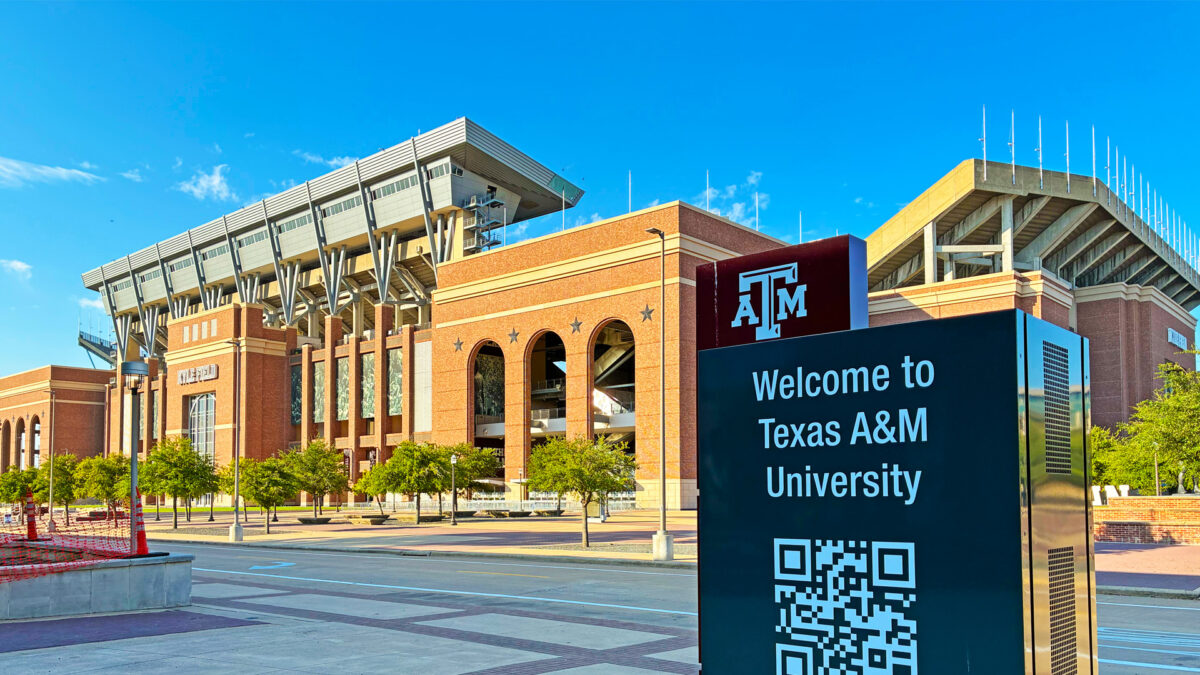
COLLEGE STATION—After the system chairman told members he did not expect any immediate changes in light of last week’s elections, Texas A&M regents received a series of briefings about the implementation of previously enacted reforms.
During the meeting of the Committee on Academic and Student Affairs, TAMU interim provost Dr. Jerry Strawser informed regents that the system was continuing to review and update its core curricula following its preliminary certification of compliance with a legislatively mandated review last August.
Strawser informed regents that additional courses would likely be removed from the core curriculum.
“We are going to continue to scrub available courses,” Strawser stated.
Strawser added that the final outcome hinges on regulations the Texas Higher Education Coordinating Board will adopt during its meeting next week.
Higher education authors Jason Brennan and Phil Magness have criticized these mandates as a subsidy for economically unsustainable programs that frequently shield woke curricula from accountability.
Also during the Academic and Student Affairs committee session, System Vice Chancellor Chris Bryan (Marketing and Communications) updated regents on the status of a civil discourse initiative that launched in 2025.
Bryan announced a series of events across the system during the spring 2027 semester. The program at College Station will feature a “nationally prominent keynote speaker.”
Texas Scorecard has previously reported that Texas A&M’s College Station campus paid former vice president Mike Pence $150,000 to speak at its initial civil discourse symposium last spring.
The committee was also briefed on a new Center for the Study of War and Society.
Regents authorized the creation of this center as part of their consent agenda.
Finally, the committee received a briefing regarding “micromobility safety.” System staff announced a ban on scooters on campus sidewalks and during special events. A series of other safety rules will also take force.
The restrictions will take action for the fall 2027 semester. Regents have previously expressed a willingness to consider a complete ban.
Dr. Robert Ambrose, associate director of the Texas A&M Space Institute, told the research committee that China was Texas A&M’s primary competitor. Ambrose spoke of the need for American researchers to work together “for the good of the nation.”
Texas Scorecard has previously reported on connections between the Chinese Communist Party and entities at Texas A&M unrelated to space research.
Eleven entities across the Texas A&M system, including eight separate colleges and schools at the College Station campus, engage in some form of space research. The Texas A&M Space Institute is scheduled to open next week.
System Chancellor Glenn Hegar also highlighted a recently announced partnership with the United States Space Force during his opening remarks.
Dr. Sherry Yennello, director of the Texas A&M Cyclotron Institute, told the research committee about a series of efforts, including research into the use of medical isotopes for cancer treatment.
The Committee on Facilities Planning and Construction approved several capital projects, including $205 million for semiconductor research in Bryan, $29 million for a sea turtle rehabilitation hospital in Galveston, and $14 million for a tornado shelter in Stephenville.
Regents approved a series of tenure appointments as part of their consent agenda. Tenure recipients were generally less controversial than previous cohorts, although a handful have academic backgrounds in China.
While there is no evidence of specific wrongdoing by the faculty members in question, state lawmakers have raised security concerns about academic researchers with a Chinese background.
System Chairman Robert Albritton addressed recent election results during his opening remarks, stating that he did not foresee major changes.
“Please keep doing what you’re doing,” Albritton directed the system staff.
Albritton also noted that Texas A&M “has great leadership in our system” and pointed specifically to “the chancellor’s office” as an example.
The Texas A&M system consists of 12 academic institutions and eight state agencies. The A&M system is overseen by a Board of Regents that is appointed by the governor and confirmed by the Texas Senate. Robert Albritton of Fort Worth is the current board chair.