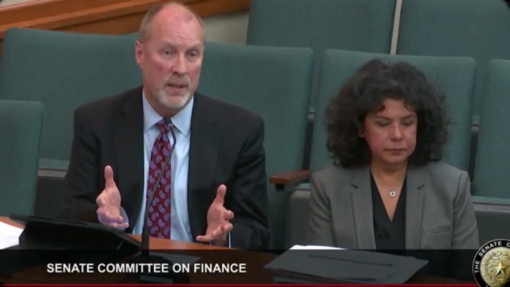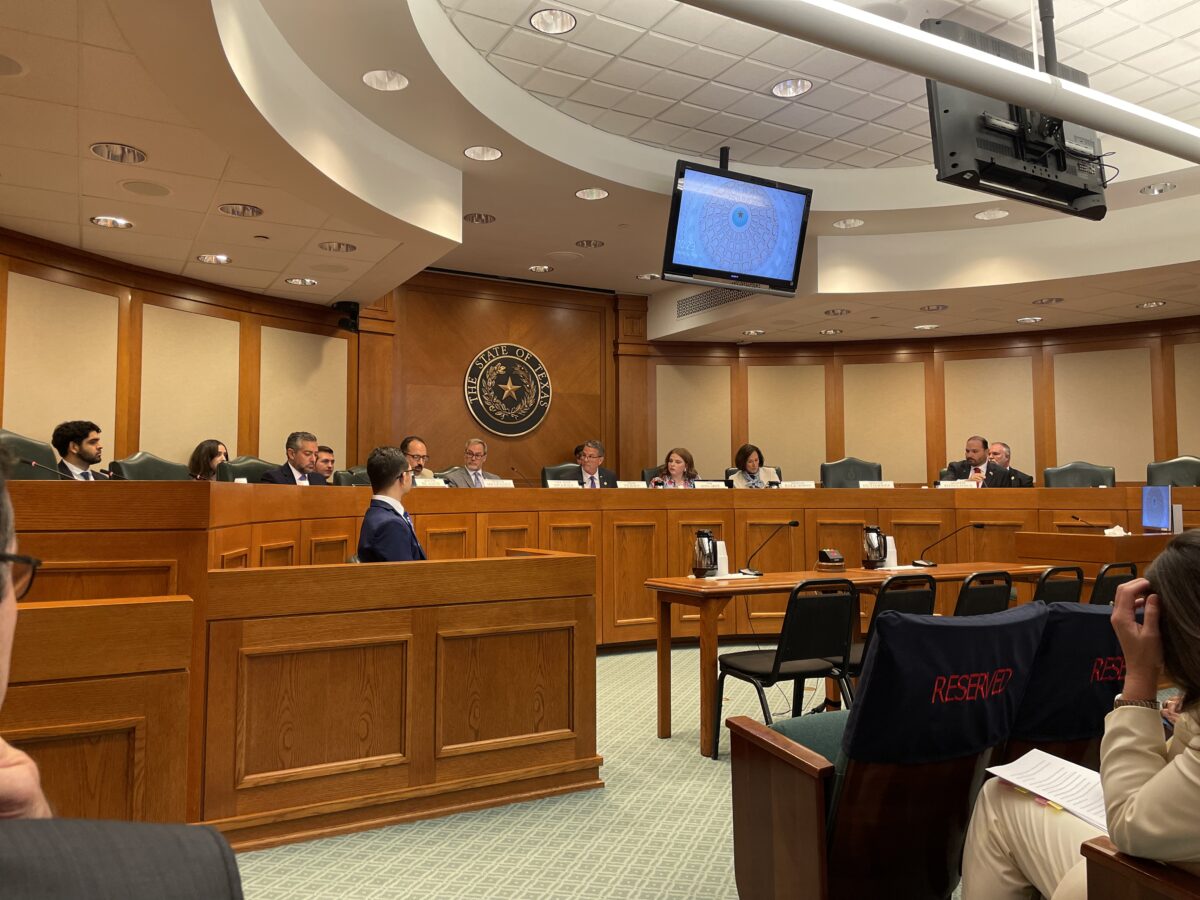
A Monday state Senate hearing explored two paths to increase Texas’ water supply, while also discussing concerns that cities are undercutting water infrastructure investment by transferring funds from water districts to their general funds.
The hearing took place as the state addresses building up its water stores. The Texas Water Development Board has drafted a $174 billion blueprint to address the state’s future water needs, double the cost of its 2022 plan. The board has warned that if recommended projects are not built, by 2080 roughly one in four Texans will have less than half the city water stores needed for a record-breaking drought.
Desalination, the “process of removing dissolved salts from water,” is one of the strategies the board laid out in its blueprint. In late March, Lt. Gov. Dan Patrick assigned evaluating the viability of desalination and regulatory efficiencies of it as an interim charge for the Senate to address before the 2027 session.
Senators on the Water, Agriculture and Rural Affairs Committee heard from two panels Monday on desalination of marine water and brackish water. The U.S. Department of the Interior has defined brackish water as having a “salinity (or total dissolved solids) higher than freshwater but lower than seawater.”
Desalination isn’t cheap, but committee chairman State Sen. Charles Perry (R–Lubbock) believes it’s necessary to expand the state’s water supply. “We have run out of the cheap water,” he said.
Lawmakers and industry witnesses described marine water desalination as costing roughly twice as much as brackish desalination on a delivered‑water basis, with marine projects in a higher cost band than brackish systems.
Perry said that brackish groundwater is Texas’ “largest opportunity” for water supply and will be the state’s backstop. Natalie Ballew of the Texas Water Development Board told senators that the state “does have a considerable amount of brackish groundwater,” with an estimated 3.3 billion acre-feet of slightly to moderately saline groundwater, and likely still more than that.
However, she cautioned that not all of it “can be recovered economically or while preventing undesirable impacts on existing users and freshwater.”
Regulatory hurdles lie ahead of the desalination process. Kelly Keel, of the Texas Commission on Environmental Quality (TCEQ), told senators that desalination projects typically require authorization from four of the agency’s programs: water rights, wastewater discharge, underground injection, and public water system approval.
Cari-Michel LaCaille, also with TCEQ, told senators that the water-rights permitting process can take 300 days, while the one for disposal of concentrate generated by desalination takes roughly 170 days. She said these estimates exclude public participation. Expedited permitting for sea-water desalination reduces these timelines to 70 and 35 days, respectively, though public notices are transmitted through the web and email.
LaCaille said TCEQ has implemented rule changes to “streamline” brackish and desalination reviews, bringing timelines down to 220 days for brackish surface water treatment and 120 days for brackish groundwater treatment, both using reverse osmosis. LaCaille said this is made possible by using computer modeling instead of pilot studies. LaCaille said no desalination applicants have used this expedited option so far.
Kasey Stinson, of the Seven Seas Water Group, said that while the state’s water policy strongly supports brackish desalination, the state’s permitting process doesn’t, with State Water Plan-aligned projects often taking 3 to 6 years to permit. “That mismatch is where projects stall,” he said. “They fail because the regulatory pathway is unclear, fragmented and politically uncertain for the local governments.”
Midland Mayor Lori Blong testified that her city is atop “an ocean of brackish water,” but regulatory and permitting structures “are not designed to meet the speed that Texas growth requires.”
Michael Irlbeck of EPCOR Utilities, which is developing a privately-financed seawater desalination plant in Galveston County with a capacity of roughly 26 million gallons per day, also called for regulatory reform. “Projects can only move as fast as permitting, and time always costs money,” he testified. “A robust permitting structure with clear requirements and timely procedures will attract private capital.”
Critics at the hearing raised concerns about making sure desalination is pursued in ways that will not hurt the environment, such as not discharging brine—a desalination byproduct—into “salinity-stressed” bays and estuaries.
Residents of Hillcrest—a community in water-stressed Corpus Christi—expressed their concerns to senators about a proposed desalination plant in their neighborhood expelling salt and dust, and increasing utility prices.
Desalination is a process that requires electricity. Irlbeck estimated that EPCOR’s project would require 11 megawatts of electricity to run. As Sen. Perry noted, “you can’t talk about water and not talk about power.”
Mayor Blong addressed the need for more power. “To support desalination projects in West Texas, we need increased power generation in the region,” she said. “That means more gas‑fired power, not just lines bringing power in from somewhere else.”
Blong referenced the three proposed 765-kV extra-high-voltage transmission lines to bring energy from East Texas into the energy-rich Permian Basin. This project has been widely criticized for not addressing the state’s needs for new power generation, threatening private property rights, and over allegations that electricity delivery company Oncor is not conducting due diligence in developing it.
State Sen. Lois Kolkhorst (R–Brenham) questioned the wisdom of building the transmission lines. “[I]f y’all need electricity, let’s generate it out there and not take all these wide swaths of land out of production,” she said. State Sen. Kevin Sparks (R–Midland) questioned why more reliable energy isn’t being built, noting that “private companies are willing to put the investment dollars in dispatchable base load power.”
Senators and witnesses also discussed a practice of large cities transferring money out of water and wastewater utilities into their general funds. Concerns were raised that this “annual drain” undermines infrastructure and water‑loss mitigation.
Larry French of Texas Public Policy Foundation estimated about $179 million per year in general fund transfers, which he called “payment in lieu of taxes,” from the top ten water losers in the state. “In summary, water utilities lose money not only from leaks, but also from policy choices that divert utility revenue,” he said.
Rick Ramirez of the Texas Municipal League and Brian Butcher, assistant city manager of Sugar Land, defended these transfers as cost allocation for shared services from the city—such as information technology, human resources, legal, and finance—to the municipal water and wastewater utilities.
Perry said the legislature will be having a “big conversation” about water in 2027. “The taxpayers are going to pay for this stuff one way or the other,” he said. “There’s no free option.”