A pro-transmission coalition announced an alliance with the Texas Association of Mexican American Chambers of Commerce on a controversial 765-kilovolt transmission line project.
The association has previously opposed efforts to curb illegal immigration and remove DEI initiatives.
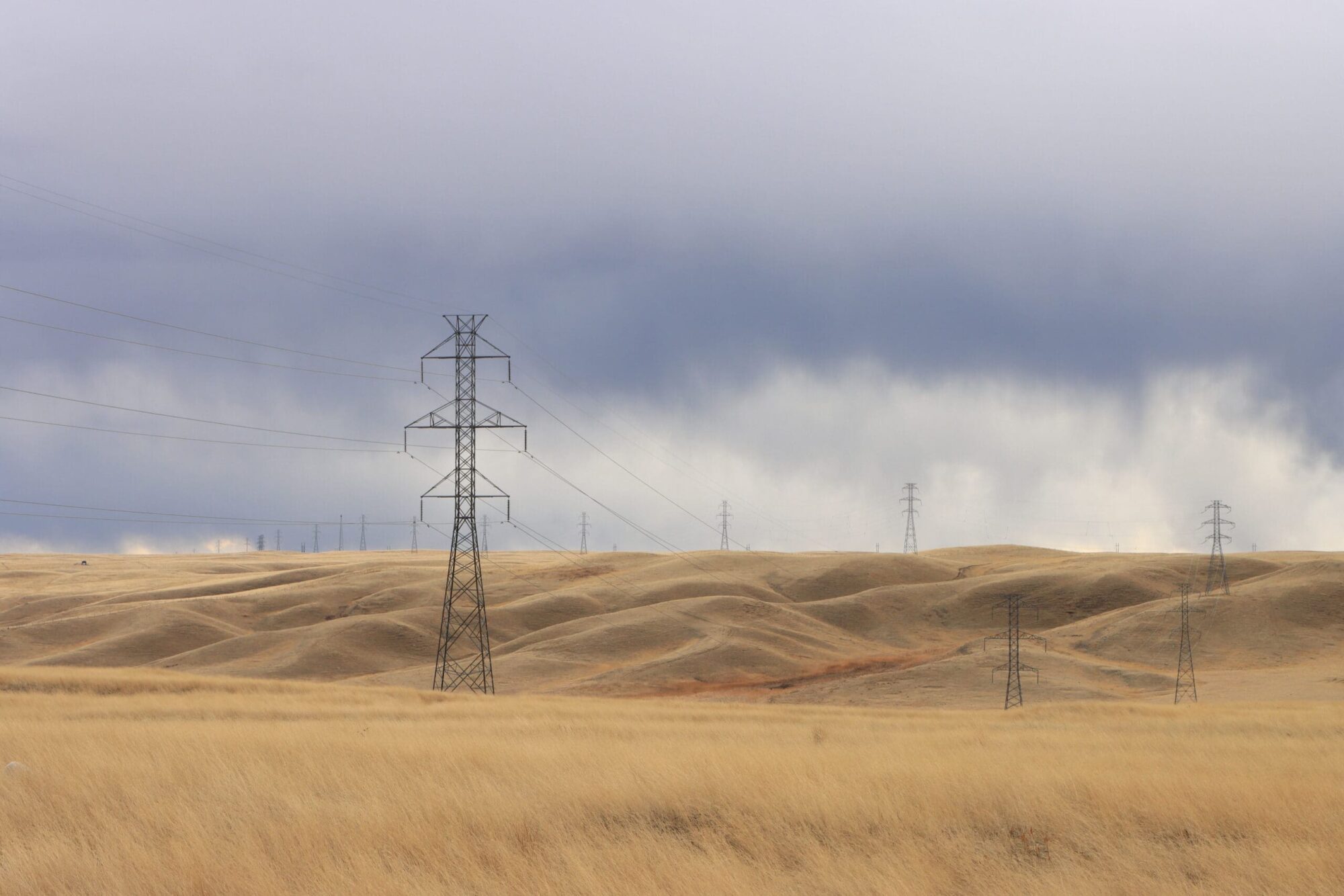
Texans for Responsible Infrastructure Investment (TRII)—a pro-transmission coalition of which Oncor and the Association of Electric Companies of Texas (AECT) are members—has been promoting the 765-kV Strategic Transmission Expansion Plan (STEP) Permian, a key part of the Permian Basin Reliability Plan (PBRP).
STEP Permian proposes three transmission lines spanning more than 1,200 miles to move power from East Texas to the natural gas-rich Permian Basin, with lifetime costs reportedly approaching $100 billion. A pro-landowner group likened this project “to hauling water to the sea.”
On Tuesday, TRII announced the Texas Association of Mexican American Chambers of Commerce (TAMACC) had joined them in promoting the lines.
TAMACC has a history of opposing efforts to stem illegal border crossings.
In December 2023, the association hosted a discussion on a campaign urging “President Joe Biden to expand parole and provide work permits” in response to Texas’ new law criminalizing illegal entry into the state, which Gov. Greg Abbott signed later that month.
Years earlier, in 2017, the association urged Congress to act after President Donald Trump rescinded the Deferred Action for Childhood Arrivals (DACA) program.
Created in 2012 by the Obama administration, DACA provided illegal aliens who entered the country as children with a renewable two-year work permit and prevented their removal from the country. TAMACC wanted Congress to “quickly and aggressively” find “a legislative solution that allows DREAMers who came to this country, through no fault of their own as children, to stay in the only country they have ever known, as productive residents.”
TAMACC also stepped into the DEI battle. Association President Pauline Anton announced in December 2025 TAMACC “strongly opposes” Acting Comptroller Kelly Hancock’s suspension of “new certifications under the Historically Underutilized Business (HUB) program.”
Hancock did this in October 2025 as part of an effort to ensure full compliance with the U.S. Constitution, the Texas Constitution, and Gov. Greg Abbott’s Executive Order GA-55, which prohibits race and sex-based preferences in state benefits such as government contracts.
TAMACC’s listed top partners include the Texas Department of Health and Human Services, Texas State University, and State Rep. Ramon Romero (D–Fort Worth).
None of these, nor Oncor, AECT, or TAMACC responded to a request for comment before publication.
“TRII is a non-partisan coalition focused on one thing: the reliable, affordable power Texas needs. We welcome organizations like TAMACC that share that goal,” TRII wrote in a statement.
STEP Permian is only the first phase of a much larger project.
The three proposed lines are split into five interconnected segments that would cross North, Central, and South Texas. The Public Utility Commission of Texas (PUCT) must approve each segment. Critics have argued that PUCT, the Electric Reliability Council of Texas (ERCOT), and electricity delivery company Oncor transformed a regional reliability directive into a de facto statewide 765‑kV grid plan without an explicit vote by state lawmakers.
The ERCOT board endorsed STEP’s two other phases in December 2025: the STEP-Western and STEP-Eastern 765-kV lines.
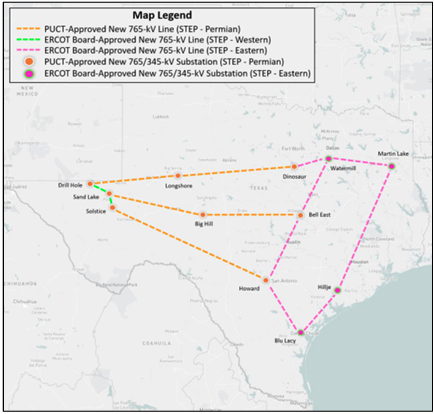
The roughly $742 million STEP-Western line, a project of transmission companies Oncor and AEP Texas, would span roughly 100 miles, broken down into two segments. The approximately $9.3 billion STEP-Western would span about 1,100 miles and is broken down into seven segments. This is a project of transmission companies AEP Texas, CPS Energy, Oncor, and CenterPoint Energy.
All of these must be approved by the Gov. Abbott-appointed Public Utility Commissioners of Texas. They are expected to take up part of the STEP Permian project in August after abating a decision on the first segment in June.