This article has been updated since publication.
Public Utility Commissioners have scheduled discussions on proposed 765-kilovolt transmission lines, even as Lt. Gov. Dan Patrick and State Sen. Charles Schwertner have called on them to deny all pending applications until after the 2027 legislative session.
Over the next three months, the Public Utility Commission of Texas (PUCT) has scheduled meetings to discuss four segments of the proposed 765‑kV lines. These segments make up the northern and middle Strategic Transmission Expansion Plan (STEP) Permian lines. The commission has placed those segments on agendas for August 28, September 25, and October 2. PUCT Chairman Thomas Gleeson says regulators will hear oral arguments from landowners.
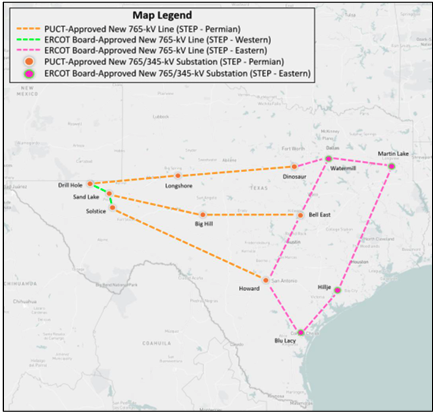
STEP Permian proposes three transmission lines spanning more than 1,200 miles to move power from East Texas to the natural gas-rich Permian Basin, with lifetime costs reportedly approaching $100 billion. A pro-landowner group likened this project “to hauling water to the sea” and backed the call to deny the applications.
The three proposed lines are split into five interconnected segments that would cross North, Central, and South Texas. PUCT must approve each segment. Critics have argued that PUCT, the Electric Reliability Council of Texas (ERCOT), and electricity delivery company Oncor transformed a regional reliability directive into a de facto statewide 765‑kV grid plan without an explicit vote by state lawmakers.
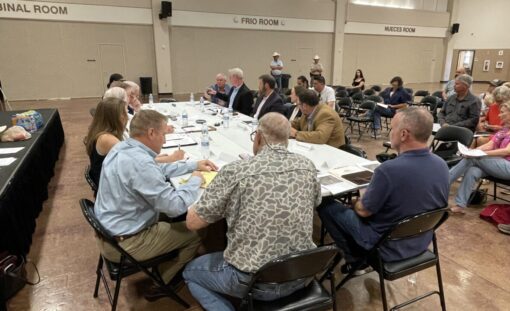
After a July 29 marathon state senate committee hearing where impacted landowners cried out for help, Patrick and Schwertner called for PUCT to deny all pending applications until after lawmakers have reformed the approval process. It was at this meeting that PUCT Chairman Thomas Gleeson admitted that PUCT had pursued the 765-kV project without an explicit vote by lawmakers.
Attorneys representing impacted landowners warned that “reform must precede” the 765-kV applications being refiled lest “the same deficiencies” manifested during this process—lack of proper notice, short timelines, and due process problems—repeat themselves.
Underlying the 765-kV project is the question of whether it is treating the symptoms of Permian Basin energy issues while ignoring the disease. On August 4, American Stewards of Liberty (ASL) called the 765-kV project “fundamentally flawed” and said it does not “address the underlying need for dependable power generation.”
“The proposed 765-kV project asks Texas landowners and ratepayers to bear enormous costs, condemn private property across thousands of miles, impose permanent easements on Texas Families, and cost consumers billions of dollars, yet it does nothing to materially improve the reliability and resiliency of the Texas grid,” the ASL statement read.
Texas Railroad Commissioner Wayne Christian has written that “new demand should be met by encouraging more localized, dispatchable natural gas generation.”
Gleeson admitted to senators that “the proliferation of renewables” in the Permian Basin is a reason why existing transmission lines are being overwhelmed by the power draws into the region. Transmission service providers have admitted that reliance on wind and solar power is driving energy issues.
State Sen. Kevin Sparks (R–Midland) expressed his concern that wind and solar would be the power source that floods the new 765‑kV lines. He said the state doesn’t have the right market construct to incentivize natural gas. The Texas Public Policy Foundation has called for “broader wholesale market reform.”
American Stewards of Liberty highlighted another cost to impacted landowners. The organization published a report stating that while the research is not unanimous, “a substantial body of evidence shows that high voltage transmission lines can and have reduced the value, utility, and marketability of nearby properties, and often significantly so.”
If the PUCT denies the applications, attorneys have asked lawmakers to set up a system where landowners can be reimbursed for what this fight has already cost them. “The utilities recover their costs of participation through rates. Landowners have no comparable mechanism,” they wrote.
Texas House Speaker Dustin Burrows announced that the Committee on State Affairs will hold an August 19 interim hearing on the proposed lines, one day before PUCT’s next regularly scheduled meeting on August 20.
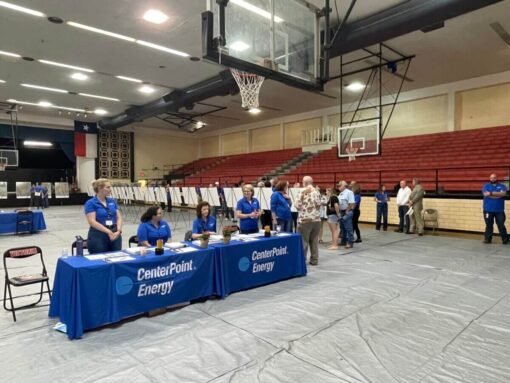
This is only the first of a two-phase 765-kV transmission line project. In December 2025 ERCOT approved the STEP Western and Eastern lines. CenterPoint Energy held an August 1 open house on a segment of theirs and AEP Texas’ proposed Eastern line, with the intention of filing an application in early 2027.
Rich Parsons of the PUCT declined to comment. “These matters are pending before the commission in contested cases, which is a legal process, so we cannot discuss them,” he said.
When asked about PUCT’s scheduling, Sen. Schwertner’s office referenced his and Lt. Gov. Patrick’s call for commissioners to deny the applications.
If you are a citizen with information regarding bureaucratic overreach, please email scorecardtips@protonmail.com