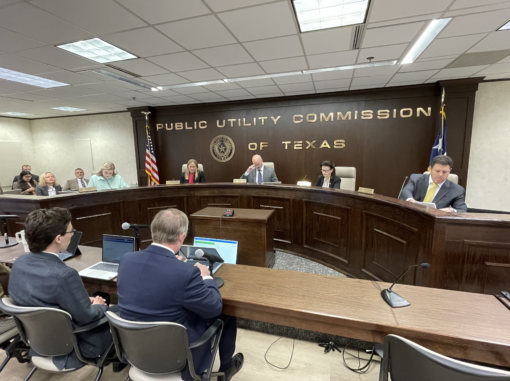
Texas’ Public Utility Commission asked state lawmakers for more than $90 million for fiscal years 2028 and 2029, more than 25 percent higher than the $71 million lawmakers approved in 2025.
This is after Gov. Greg Abbott, Lt. Gov. Dan Patrick, and Speaker of the House Dustin Burrows directed state agencies in July to reduce their baseline budget requests for the upcoming biennium by three percent. Exceptions to their directive include Medicaid programs, state pension systems, and employee group benefits.
“Affordability is the number one issue in Texas and America. The responsibility of every public agency is to recognize that concern—and radically reduce the burden of government in response,” wrote James Quintero of the Texas Public Policy Foundation (TPPF).
The Public Utility Commission of Texas (PUCT) oversees the Electric Reliability Council of Texas (ERCOT), the state’s electric grid manager. PUCT’s duties also include setting transmission and distribution rates for electricity, as well as rates for water and wastewater utilities, and land-based telephone lines.
After the July directive, PUCT filed its Legislative Appropriation Request (LAR). Quintero stated the agency requested $71.5 million in base general revenue (GR) funds, and $18.7 million in exceptional items.
Page 29 of PUCT’s 2028-2029 LAR, the summary of exceptional items request, contains a line item titled “restoration of 3% cut.”
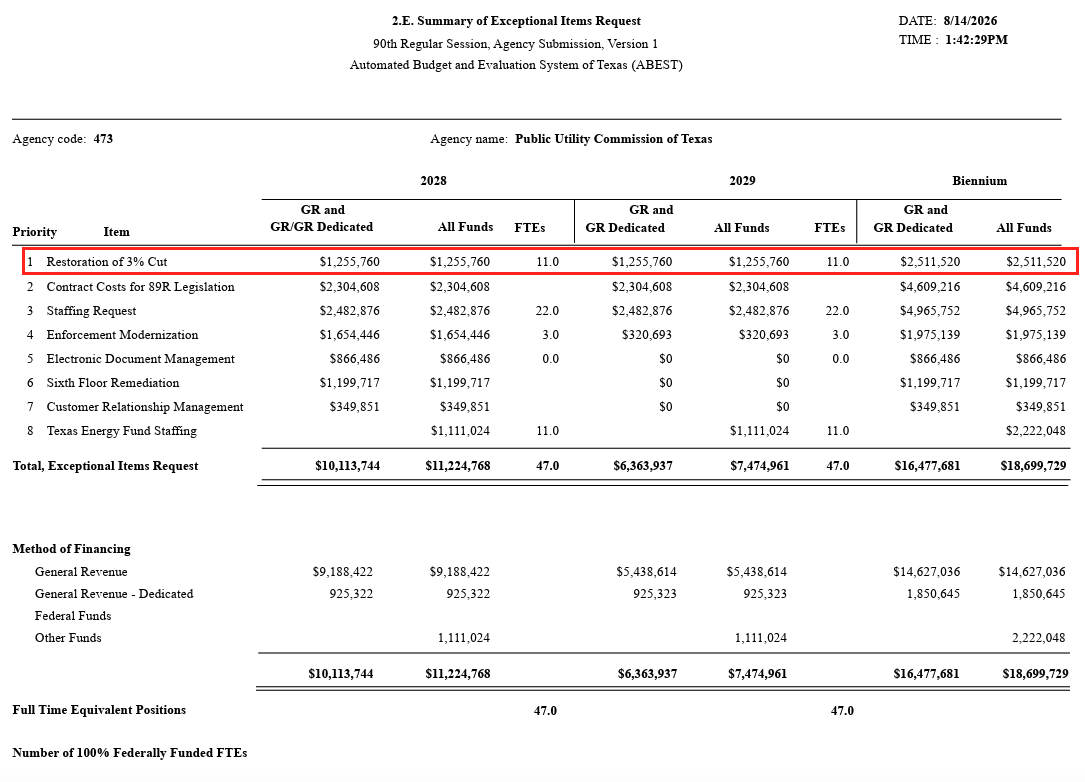
The GR and exceptional items numbers are higher than what PUCT asked for in its LAR for fiscal years 2026 and 2027, with the GR request 27 percent higher, and exceptional items 20 percent higher.
Exceptional items are the itemized priorities above an agency’s baseline limit. Abbott, Patrick, and Burrows directed agencies requesting exceptional items to find “lower-priority programs or other savings” to help pay for those items.
Quintero found that despite lawmakers appropriating more than $71 million to PUCT last session, the agency’s general revenue spending will reach more than $76 million, or 7.2 percent more than what lawmakers budgeted.
“The reason(s) for this overage is unclear, though it would not surprise me if it were data center-related,” Quintero wrote. He also noted that PUCT’s budget has grown over time.
“In the 2018-19 biennium, the agency’s general revenue (GR) appropriations totaled $26.6 million. A decade later, in the current 2026-27 biennium, its GR funding rose to $71.5 million, a nearly three-[f]old increase,” he wrote. “Such robust growth raises questions about prudence and fiscal discipline.”
When asked for comment, PUCT pointed Texas Scorecard to page two of its latest LAR.
“Recent legislative enactments have expanded the Commission’s oversight responsibilities in areas—including electric system resiliency, wildfire mitigation, distribution system management, Texas Energy Fund administration, and infrastructure planning,” it read. “As these responsibilities mature and new responsibilities are implemented, the Commission requires sufficient resources to ensure effective oversight and timely service to consumers, utilities, policymakers, and other stakeholders.”
PUCT’s funding request fits a pattern among state agencies. Texas Policy Research recently reported that most state agencies have requested in exceptional items more than three times their reductions of 2.9 percent in general revenue funding.
“At PUCT and elsewhere, state agency expenditure growth has been accelerated due to the Legislature’s swift approval of exceptional items, or wish-list expenses. These unnecessary requests increase the cost of government and yield tremendous inefficiencies, especially when considered over a long period and across many different agencies,” Quintero wrote.
Andrew McVeigh, president of Texans for Fiscal Responsibility, wrote, “The PUCT and every other government agency, department, commission, etc. exist at the pleasure of the legislature and the people of Texas. Their defiance of the requests of the Governor, Lt. Governor, and Speaker of the House are disappointing, but not terribly surprising.”
He continued, “Government entities have long existed with careless disregard for the people of Texas, and, more specifically, the people’s ability to pay. The legislature should consider implementing cuts themselves to encourage a course correction and make life more affordable for hard-working Texans.”
PUCT came under scrutiny this year because of its enactment of the 765-kilovolt Strategic Transmission Expansion Plan (STEP) Permian, a key part of the Permian Basin Reliability Plan (PBRP). STEP Permian proposes three transmission lines spanning more than 1,200 miles to move power from East Texas to the Permian Basin.
PUCT initially approved two of the STEP Permian lines, despite calls from landowners and lawmakers to pause until lawmakers met in the 2027 legislative session. Commissioners have since voted to extend time to consider rehearing motions on two of the lines. Because they remanded a segment of the third line to the State Office of Administrative Hearings, all three lines remain in a holding pattern.
STEP Permian is only phase one. The ERCOT board endorsed STEP’s two other phases in December 2025. These are the STEP Western and STEP Eastern 765-kV lines.
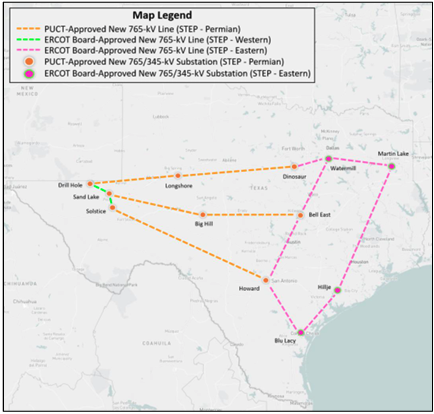
The roughly $742 million STEP Western line, a project of transmission companies Oncor and AEP Texas, would span roughly 100 miles, broken down into two segments. The approximately $9.3 billion STEP Eastern would span about 1,100 miles and is broken down into seven segments.
TPPF estimates the lifetime cost of all STEP projects ERCOT approved through December 2025 at nearly $100 billion, to be borne by ratepayers. Because of the Basin’s richness in natural gas, which can be used to generate electricity, a pro-landowner group likened this project “to hauling water to the sea.” A potential final buildout would tap into the solar- and wind-generation-rich Panhandle region.
“The PUC’s exploding budget would be justified if they were enacting policies that were keeping electricity rates lower for all Texans,” wrote TPPF’s Dr. Brent Bennett. “Instead, they are failing to address the overbuilding of wind and solar and layering on transmission costs. These choices are part of the reason why residential rates in ERCOT have risen by over 30% since 2021.”
Democrats swept statewide offices and gained control of the Texas House on November 3. The next legislative session begins January 12, 2027.