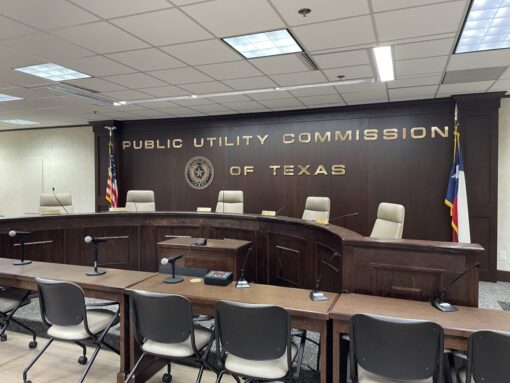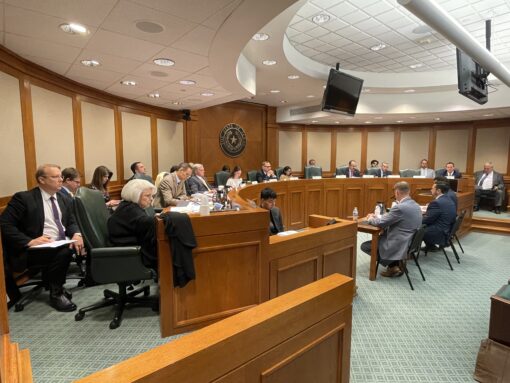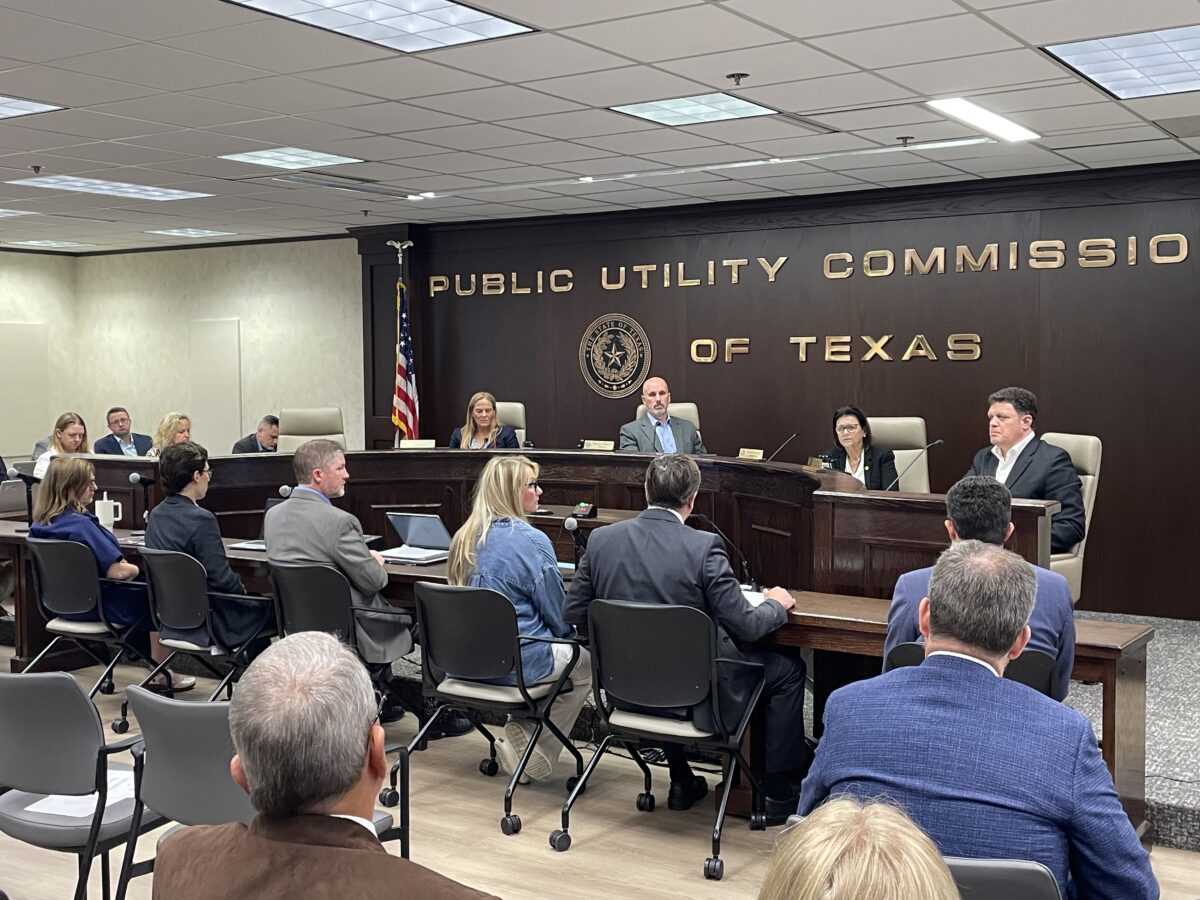
Lawmakers and landowners again told regulators to pause pending 765-kilovolt transmission lines, arguing that the approval process is broken and more transmission will not solve Texas’ electrical needs. Public Utility Commission of Texas Chairman Thomas Gleeson said each extra-high-voltage line segment will be dealt with one piece at a time.
Electric grid operators, meanwhile, admitted the state grid is heavily reliant on solar and wind generation.
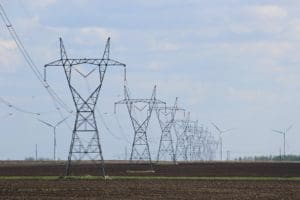
At issue is the 765-kV Strategic Transmission Expansion Plan (STEP) Permian, part of the Permian Basin Reliability Plan (PBRP).
STEP Permian proposes three transmission lines spanning more than 1,200 miles to move power from East Texas to the natural gas-rich Permian Basin, with lifetime costs reportedly approaching $100 billion to be borne by ratepayers. A pro-landowner group likened this project “to hauling water to the sea.”
The three proposed lines are split into five interconnected segments that would cross North, Central, and South Texas. The Public Utility Commission of Texas (PUCT) must approve each segment.
Critics have argued that PUCT, the Electric Reliability Council of Texas (ERCOT), and electricity delivery company Oncor transformed a regional reliability directive into a de facto statewide 765‑kV grid plan without an explicit vote by state lawmakers. Gleeson admitted that PUCT had pursued building these types of transmission lines without an explicit lawmaker vote.
Woody Rickerson, ERCOT senior vice president and chief operating officer, told commissioners that the power grid being planned for today is not the same one from 15 to 20 years ago.
“A large percentage of our generation now is intermittent. So, if the wind’s not blowing, you don’t have that generation, or if the sun is cloudy in the middle of the day, you may not have all of the solar. At night, obviously, you don’t have solar generation,” he said. “Then you have batteries that are limited duration that move power from one time to another, but they may only last for an hour or two hours or something like that.”
Dr. Brent Bennett of the Texas Public Policy Foundation warned that this is a high-risk situation.
“Since winter storm Uri, the ERCOT grid added over 30 gigawatts of solar, 20 gigawatts of storage, 10 gigawatts of wind, and only 4 gigawatts of gas. That means the current grid is becoming more vulnerable to a winter storm every year,” he said. “If the current trend continues, we estimate that a 1-in-10 winter storm in 2030 will lead to a multi-day outage exceeding 20 gigawatts in magnitude, regardless of how much new transmission is built.”
State Sen. Kevin Sparks (R–Midland) argued market distortions that are still ongoing brought us here. “The ERCOT market has been distorted for more than 25 years by close to $100 billion of federal tax subsidies to construct intermittent wind and solar projects,” he said.
Bennett noted that there are also local distortions. “We need to resolve the market design issues that are at the root of ERCOT’s grid reliability problems first, rather than continuing to cover over those flaws with more centrally planned transmission,” he said.
While transmission proponents push extra-high-voltage lines to solve the Permian Basin’s energy needs, Sparks pointed out there’s plenty of generation potential where the need exists.
“West Texas has the natural resources and the capital available to generate all of the power needed in the region,” he said. “With the correct market signals from ERCOT the state of Texas has the obligation and the duty to consider all factors and exhaust every alternative before seizing massive amounts of land from private landowners.”
Elizabeth Kunz, one of the impacted landowners, said she is a descendant of Sarah Dotson, the woman who designed and flew the first flag over Washington-on-the-Brazos.
“I wanted to just remind you that this is more than business; these are lives, and they’re being affected tremendously by this buildout,” the rancher told commissioners. “It’s our land. It’s our property.”
“Like at the Alamo, we will fight to our last breath to try and defend it.”
After a marathon July 29 Texas Senate committee hearing where impacted landowners cried out for help, Lt. Gov. Dan Patrick and State Sen. Charles Schwertner (R–Georgetown) called for PUCT to deny all pending applications until after lawmakers have reformed the approval process.
Gov. Greg Abbott, who has appointed all five PUCT commissioners, has called for “guidelines and guardrails” on transmission line expansion.
State Reps. Brad Buckley (R–Salado) and Shelby Slawson (R–Stephenville) warned PUCT that pursuing 765-kV lines went beyond the bounds of what lawmakers signed off with regional reliability directive House Bill 5066 back in 2023.
“Never did we hear about 765 transmission lines,” said Slawson, who was on the House State Affairs Committee in 2023. “It was not contemplated then that it would be a project of the massive scale that we’re looking at now, with thousands of landowners affected, and frankly, the inability for their voices to be adequately heard when there are that many people trying to intervene and protest in this process.”
“The contention that House Bill 5066 authorizes what is being proposed is a slap in the face to the legislative branch and a rogue interpretation by entities that seek profit and guaranteed returns on investment over honest interpretation of state law,” Buckley said. “The only remedy to this is denial of all applications for CCN, thus allowing the legislature, the people’s representatives, to take up this issue in the next legislative session.”
In conversation with staff, Gleeson confirmed that as of now all but one of the pending 765-kV applications have finished their administrative law process. The final one is the Bell County East to Big Hill segment. Spanning about 199 miles from just north of Austin to south of San Angelo, it links with the Big Hill to Sand Lake segment from south of San Angelo to Pecos, forming the center pathway.
“We will run through each of these and give them the due attention that they require as they come before us,” Gleeson said.
On August 21, PUCT is scheduled to decide on the two segments, Longshore Switch-Drill Hole Switch and Dinosaur to Longshore, that would make up the roughly 390-mile northern line.