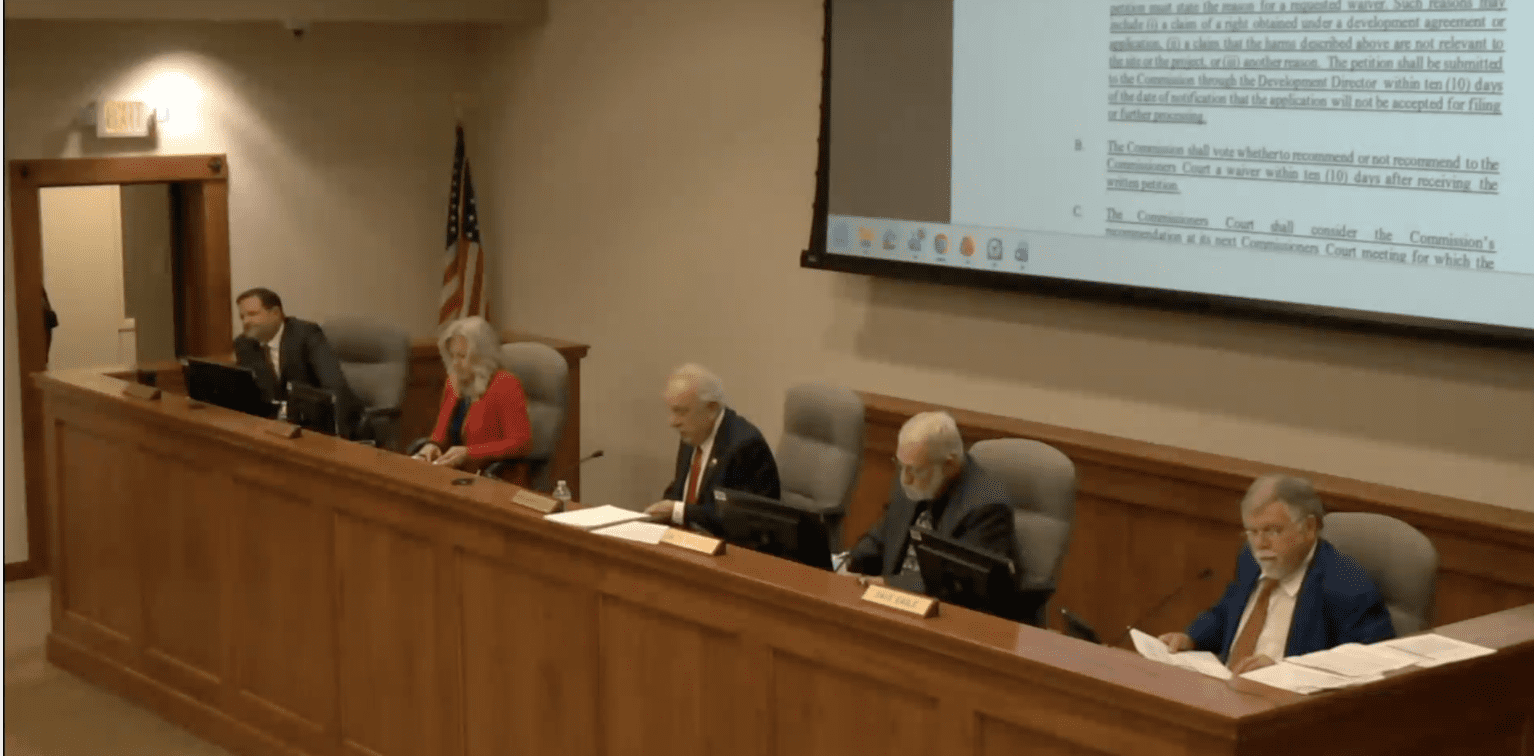
Hood County Commissioners voted Tuesday to adopt regulations for data centers and to reject the concept plan for one development.
The commissioners voted 3-2 to reject Pacifico Energy’s concept plan for its more than 560-acre data center and power generation development—known as Fort Spunky. Commissioner Nannette Samuelson placed this on the agenda after the Acton Municipal Utility District board voted unanimously to deny water service to the project on February 18.
Hood County citizens for the past several weeks have voiced concerns about the reported seven data center developments pending in the county and their potential effects on the local environment and economy.
“The fears … are all detached from reality,” Pacifico Chief Operating Officer Kevin Pratt told commissioners. “The court through political pressure keeps moving those goal posts over and over and this is another example of that.”
Both he and Michael Bass, an attorney representing Pacifico, asked the court to “drop” this item from its agenda, with Bass mentioning the company being willing to develop its own utility.
“If there’s no water how do you create a public utility? Where does the water come from?” Samuelson asked.
“There are enough onsite wells within the acreage,” Pratt replied, adding that Pacifico would not use up all the water within them.
In discussions with Commissioner Dave Eagle and County Judge Ron Massingill, Doug Shaw, general manager of the Upper Trinity Groundwater Conservation District, confirmed that even if the Texas Commission on Environmental Quality and the Public Utility Commission of Texas approved the company creating a new utility, the district board he represented would still be the final authority on whether Pacifico would get water access.
“These eight [board] members vote whether or not to allow those industrial wells to be drilled on that property, correct?” Massingill asked. “Correct,” Shaw replied.
Samuelson told Pratt that “your concept plan said [the] primary [water] source would be a MUD. You’re welcome to resubmit when you have a defined definitive water source.”
“I don’t think that will be kindly looked upon by a court,” Pratt said.
County Attorney Matt Mills advised commissioners that this decision would put them “on the brink of immediate litigation.” Massingill called for a short executive session. After emerging, the commissioners voted to reject Pacifico’s concept plan. “We’re all in for litigation,” Massingill said, noting his reluctance.
Earlier, the commissioners amended and unanimously passed three proposed changes to their Section One Development Permit Regulations. These included adding new checklist items on site development and concept plans where it concerns AI data centers, crypto mining facilities, power plants, battery storage facilities, “and any other large industrial user deemed appropriate by the Director of Development or the Commissioners’ Court.”
On February 11 and 25, Massingill and Commissioners Kevin Andrews and Jack Wilson voted against proposed moratoriums on data center developments.
While Mills had expressed reservations about moratoriums, he showed more confidence in these proposed regulations. “I’m not saying you’re bulletproof in regards to litigation but it’s stronger than the previous proposal,” he said, noting this would “actually be permanent” pending future actions.
After the vote, Massingill announced the new regulations passed unanimously.
The new checklists included requiring developers to protect the physical environment, “particularly the water quality,” “a demonstration of adequate water resources committed” to the project’s needs, and provision of a complete concept plan for all power generation facilities, including back up power and energy storage facilities.
The changes also require developers to show certification that the concept plan is in compliance with the Lone Star Infrastructure Protection Act. Passed in 2021, the law states Texans may not make infrastructure agreements with businesses or government officials from “China, Iran, North Korea, Russia, or a country designated [by the Texas governor as a threat to critical infrastructure],” nor give them control or direct or remote access to any of the state’s core systems.
State lawmakers passed this proposal after Chinese billionaire Sun Guangxin bought seven percent of Val Verde County’s land—30 miles from Laughlin Air Force Base—in 2015. J. Kyle Bass, an investor who pushed for the act’s passage, found it wasn’t being enforced a year later. Lawmakers followed up in 2025 with a new law, Senate Bill 17, which bans countries deemed dangerous by the U.S. director of national intelligence or the governor from buying Texas land.
Commissioners are set to revisit other data center developments at the March 24 meeting.