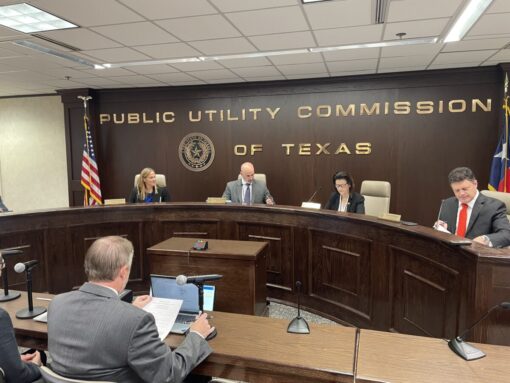
Public Utility Commissioners will vote on November 5 on extending time to consider rehearing motions on the second of three proposed 765-kilovolt transmission lines.
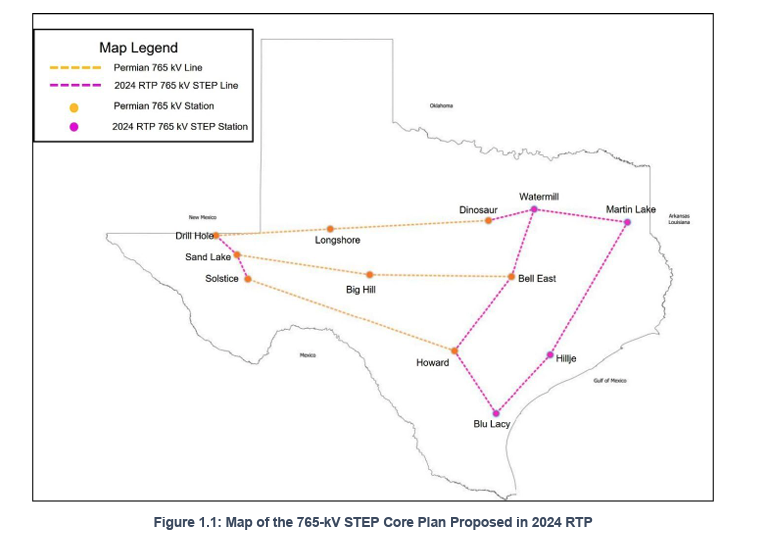
The Howard to Solstice line is a project of electric utilities AEP Texas and CPS Energy. It would span approximately 370 miles in South and West Texas from the San Antonio to Fort Stockton areas.
It is part of the 765-kV Strategic Transmission Expansion Plan (STEP) Permian, a key part of the Permian Basin Reliability Plan (PBRP). STEP Permian proposes three transmission lines, spanning more than 1,200 miles, to move power from East Texas to the natural gas-rich Permian Basin. The Howard to Solstice line is the southernmost line.
The Public Utility Commission of Texas (PUCT) approved Howard to Solstice on September 11.
Multiple parties have filed rehearing motions, including pro-landowner group American Stewards of Liberty (ASL).
“The Commission wrongly found that the PBRP establishes a need for additional service in the Permian Basin and identified [Howard to Solstice] as part of that solution,” the group wrote.
ASL also argued that state lawmakers “did not declare this Project necessary, require construction of a 765-kV import system, eliminate the Commission’s obligation under” Texas’ Public Utility Regulatory Act “to determine whether the facilities presented in this proceeding are necessary, or grant the Commission discretion to disregard” statutory requirements for the certification process.
What lawmakers did authorize, with House Bill 5066 in 2023, was the “development of a reliability plan for the Permian Basin,” ASL wrote.
The group further argued that because “the record does not establish” that “ERCOT meaningfully evaluated whether increased generation closer to the projected” demand “could reduce or eliminate the need” for the transmission project. Therefore, PUCT “lacked the necessary information to bridge the gap between the existence of projected regional load growth and the conclusion that this specific Project is necessary under PURA.”
Neither AEP Texas nor CPS Energy responded to a request for comment before publication.
Other issues have been brought to light. The Uvalde County Underground Water Conservation District warned that the route regulators approved for Howard to Solstice “could have a catastrophic effect” on multiple aquifers.
State law requires that if commissioners do not act within 55 days from the date of a PUCT order, rehearing motions are overruled. Commissioners may, in a written order, extend the deadline as much as 100 days after the PUCT order.
On October 15, the commissioners extended time to consider rehearing motions in both segments that make up Oncor’s Dinosaur to Drill Hole 765-kV project “to the maximum extent allowed by law.”
The third line, composed of two segments from Oncor and the Lower Colorado River Authority Transmission Services Corporation, is in a holding pattern after PUCT remanded the Bell County East to Big Hill segment to the State Office of Administrative Hearings.
PUCT has come under increased scrutiny. Commissioners approved two of the three proposed STEP Permian lines despite calls from landowners and lawmakers to stop the projects. Lt. Gov. Dan Patrick said he was “very disappointed” after PUCT approved the first line.
Critics have argued that the best way to address Permian Basin needs is by reforming the electric market, not building 765-kV lines. The Texas Public Policy Foundation estimates the lifetime cost of all STEP projects ERCOT approved through December 2025 at approaching $100 billion, to be borne by ratepayers.