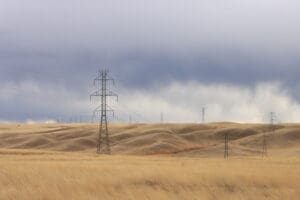
Segments of proposed routes for an extra-high-voltage transmission line come within less than 500 feet of a newly built elementary school in Florence Independent School District. Yet the state engineer reviewing the project said he did not know the facility was a school until affected landowners alerted him.
The disclosure came this week in testimony before the State Office of Administrative Hearings, where administrative law judges are weighing whether to recommend approval for the proposed Bell County East to Big Hill 765-kV transmission line, a project of Oncor and the Lower Colorado River Authority Transmission Services Corporation.
The line would run from just north of Austin to south of San Angelo and form the central link in a new 765‑kV “import path” designed to move vast amounts of power across Texas into the energy‑rich Permian Basin. A pro-landowner group has called this “akin to hauling water to the sea.”
Critics have argued that the Public Utility Commission of Texas (PUCT), the Energy Reliability Council of Texas (ERCOT), and Oncor transformed a regional reliability directive into a de facto statewide grid plan without state lawmakers’ authorization.
In May, Florence ISD registered its opposition to two segments in the Oncor and LCRA transmission line proposal coming in close proximity to its months-old elementary school.
The district expressed concern about potential health hazards the 765-kV transmission line—one that Oncor has no experience building—could present to school staff and students. The district argued that “Oncor and LCRA have the burden of proof in establishing” that the proposed segment poses no public safety risk to students and school staff and requested an alternative route avoiding the school.
Parents, school staff, trustees, and Superintendent Rick Kirkpatrick submitted witness statements opposing the proposed line. In a statement to Texas Scorecard, Kirkpatrick wrote that “parents, staff and citizens of the Florence ISD community” have communicated their objections to district administration.
During Monday’s hearing, Oncor representative Brenda Perkins said that PUCT “now has record of this newly constructed school,” and will decide which proposed route to use.
However, on Wednesday PUCT electrical engineer John Poole, responsible for reviewing the Oncor and LCRA application, admitted that the application identified the elementary school as a commercial industrial site. He wasn’t aware it was an elementary school until intervenors had notified him.
When questioned, Poole confirmed he had submitted his testimony on the project before the applicants had submitted an errata, a formal correction document. Colorado River Alliance’s attorney, David Brown, asked Poole that if he had been aware of the school, would that have altered which route he recommended to PUCT. “Yes,” Poole replied, and agreed that it’s important to avoid schools.
Perkins said the applicants’ team was aware of the school’s existence.
Russell Marusak, Oncor’s and LCRA’s routing witness, said that “we did drive out” and saw the school. “We certainly recognize schools and sensitivities of the public, but sometimes we have to give that route to satisfy the geographic diversity requirement and we also give alternatives the applicant can consider in their evaluation of the routes,” he said.
Oncor and LCRA had retained consultants Kimley-Horn and Associates and Halff Associates for routing assessment. Kimley-Horn did not respond to a request for comment before publication.
LCRA attorney Kirk Rasmussen asked Poole if there are other proposed routes that avoid the school PUCT commissioners could choose. He said yes.
Kevin Kennedy, one of the landowners protesting the proposals, believes this is one of multiple indicators of a lack of due diligence, and that the entire project should be restarted. “There’s enough major flaws scattered along the full length of the 200 mile corridor that any reasonable person would come to doubt the quality and accuracy of the study itself,” he told Texas Scorecard.
Critics have highlighted that state lawmakers created an aggressive 180-day decision deadline from when an application is filed for projects of this nature. It gives no wiggle room for affected landowners, only for applicants and PUCT.
During Monday’s cross examination, Marusak said that he had not consulted with the Texas Education Agency or Texas Health and Human Services. He said that “routinely” school districts are individually contacted. HHS did not respond to a request for comment before publication. A TEA spokesperson said the agency has no jurisdiction or purview in this situation.
This is the latest occurrence of apparent lack of due diligence in the 765-kV line project. National security concerns were raised with the southern line, run by AEP Texas and CPS Energy, while Oncor has faced questions of whether it is following federal wildlife preservation regulations.
Clara Tuma, spokesperson for LCRA, wrote to Texas Scorecard, “We don’t have anything to add to testimony provided in the hearing.” In his reply, Oncor spokesperson Andrew Clark, who also responded for Halff, wrote that “you are welcome to pull any information on these requests from public project filings, responses at public meetings or from testimony provided at the ongoing hearing.”
A spokesperson for Texas Education 911, a grassroots, parent-led advocacy group, applauded Florence ISD’s opposition. “This type of response is exactly what elected school boards are supposed to do: Represent the residents they serve, particularly their chief stakeholders, the parents,” the statement read. “Children with developing bodies and minds deserve adults taking precautions on health-related concerns that are not yet fully-understood.”
PUCT did not respond to a request for comment before publication. Citizens may watch the livestream of the Bell County East to Big Hill hearing this week through the SOAH YouTube channel from 9 a.m. to 5 p.m.
Master administrative law Judge Linda Brite and administrative law Judge Linda Burgess will make a recommendation after this week’s hearing to the five commissioners of the Public Utility Commission—all Gov. Greg Abbott appointees. They will make the final decision.