Electricity delivery companies wrote that a proposed 765-kV transmission line will “reduce the need to curtail exports” of wind and solar energy from the Permian Basin to the rest of the Texas electric grid.
Critics have previously raised concerns that these intermittent power sources would flood the transmission lines and reduce grid stability.
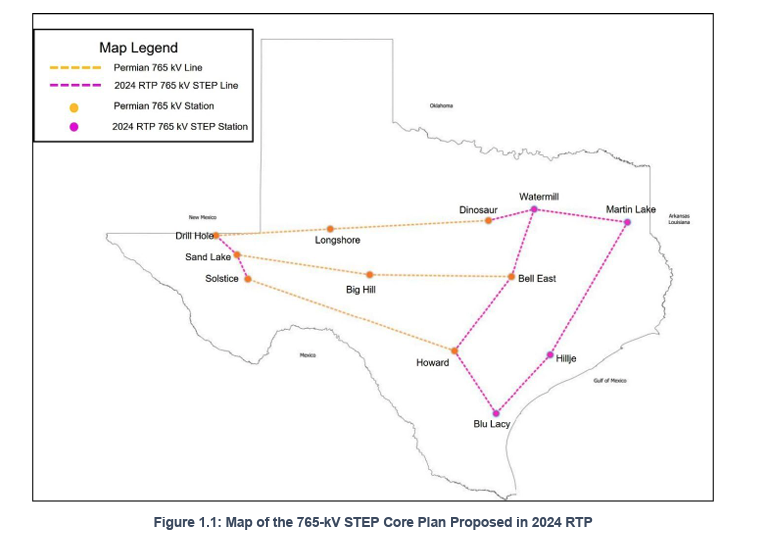
Utility companies Oncor and the Lower Colorado River Authority Transmission Service Corporation (LCRA TSC) proposed the 765-kV Bell County East to Big Hill transmission line. Spanning about 199 miles from just north of Austin to south of San Angelo, it links with the Big Hill to Sand Lake line from south of San Angelo to Pecos.
Both are part of the 765-kV Strategic Transmission Expansion Plan (STEP) Permian, a key part of the Permian Basin Reliability Plan (PBRP). STEP-Permian proposes three transmission lines spanning more than 1,200 miles to move electricity from East Texas to the natural gas-rich Permian Basin. The Bell County to Sand Lake line forms the central pathway.
In the October filing with the State Office of Administrative Hearings (SOAH), Oncor and LCRA TSC’s arguments included that the Bell County East to Sand Lake line offers an additional benefit to consumers. Namely, the line would allow the flow of wind and solar from the Permian Basin into the state grid.
Oncor and LCRA TSC wrote that the transmission systems in place cannot handle the amount of electricity that solar and wind generate at times of peak production, requiring grid manager ERCOT to curtail the amount of power flowing through.
“Oncor and LCRA just said the quiet part out loud, and now it’s in writing in a PUC brief,” Jason Isaac, founder and CEO of American Energy Institute, told Texas Scorecard. “These 765-kV lines will double as an export highway for West Texas wind and solar that gets curtailed today because the grid has no room to move it.”
“Throughout the proceeding, Oncor and LCRA have repeatedly demonstrated that the lines are needed to serve load in the Permian Basin, resolve reliability violations, and will reduce congestion,” Oncor spokesperson Roxana Rubio wrote to Texas Scorecard. “As stated on the page of the brief you cite, ‘The Import Path 2 projects will carry power in both directions, bringing power into the Permian Basin when local generation is low and carrying surplus Permian Basin generation out to the rest of the state when it is high.’”
Clara Tuma, spokesperson for LCRA, wrote, “We have nothing to add to the information in our legal filings.”
In the October filing, both companies wrote that ERCOT studies reported that the current system, according to federal North American Electric Reliability Corporation standards, risks voltage instability, thermal overloads, and cascading outages when attempting to move power into the Permian Basin, particularly when solar and wind generation in the region is low. Oncor and LCRA TSC argued the transmission lines are required to address these constraints.
State Sen. Kevin Sparks (R–Midland) and Texas Public Policy Foundation’s (TPPF) Dr. Brent Bennett had previously expressed concern that these energy sources would flood the STEP 765-kV lines. There’s a potential final 765-kV buildout that would reach into the Texas Panhandle, enabling ERCOT to tap into that solar- and wind-rich region.
The limits of wind and solar have been widely discussed.
The 2026 report from Potomac Economics, ERCOT’s independent market monitor, defined them as intermittent electric sources. That means the amount of power they generate at any given time is determined by certain factors, namely the time of day and the weather, that are outside human control.
Isaac has warned that wind and solar are unreliable and that Texas’ overreliance on them was a key factor in the February 2021 winter blackouts.
There are also impacts on ratepayers’ bills. Dr. Bennett and Michael Reed’s February 2025 report found that wind and solar drive up total system costs, with residential ratepayers’ costs increasing 20 percent since 2022, a greater increase than in neighboring states with a smaller wind and solar footprint.
These intermittent sources are on a steady growth path in Texas. At an April 2026 Senate committee hearing, Public Utility Commission of Texas (PUCT) Chairman Thomas Gleeson confirmed that wind, solar, and battery resources would account for 62 percent of Texas’ energy generation mix within the next four years. A July 2024 Energy Alliance report found that from 2014 to 2024, the percentage of Texas’ energy generation capacity shares composed of wind and solar increased from 13.5 percent to 38 percent.
“If a meaningful share of this capacity ends up carrying subsidized intermittent power out of West Texas, ratepayers across ERCOT will be paying billions to solve a congestion problem the wind and solar industry created,” Isaac stated. “Texans have seen this before with CREZ, when consumers paid roughly $7 billion for lines built largely to serve wind.”
Short for Competitive Renewable Energy Zones, in 2005 state lawmakers mandated the CREZ transmission lines with the purpose of transferring wind energy from West to East Texas.
Unlike with CREZ, Gleeson has admitted that state lawmakers never explicitly approved a 765-kV transmission plan. Critics have argued that the PUCT, the Electric Reliability Council of Texas (ERCOT), and Oncor transformed a regional reliability directive into a de facto statewide 765‑kV grid plan without state lawmakers’ authorization.
TPPF estimates the lifetime cost of all STEP projects ERCOT approved through December 2025 at approaching $100 billion, to be borne by ratepayers
As an alternative, Isaac and Dr. Bennett have advocated for the development of more reliable sources of electricity, such as natural gas, of which the Permian Basin is rich. To that end, Dr. Bennett and Jamila Piracci proposed injecting market reforms into Texas’ regulatory structure.
Dr. Bennett has stated that without these, the 765-kV STEP lines will primarily move this type of generation statewide, incentivizing further building, and resulting in more grid instability and the need for more transmission.
In October, Mark Ellis of MarketClear told the Texas Senate Business & Commerce Committee that Texas’ regulated utility monopoly structure incentivizes investment in new projects, as that is how investors earn returns. Reformers said it is in this environment that returns for investors, income for utilities, and ratepayers’ bills have exploded.
PUCT did not respond to a request for comment.
In September, the PUCT remanded the line to SOAH, with PUCT Chairman Thomas Gleeson claiming that the administrative law judges who presided over the Bell County East to Sand Lake hearing had failed to provide adequate information requested by the PUCT.
Judges Linda Brite, Linda Burgess, and Dee Marlo Chico had recommended that the PUCT deny Oncor and LCRA TSC’s application. They noted that the utilities had failed to properly notify 1,400 landowners and that there are “flaws” in the study regulators cited as proving the need for 765-kV lines.
The line remains in a holding position until SOAH finishes examining the issues Gleeson identified.