Oil and gas pipeline companies are asking Texas regulators to strengthen safety requirements for Oncor’s 765-kilovolt transmission line in West Texas.
The companies are requesting the Public Utility Commission of Texas insert pipeline protections in its approval of this line and require electricity delivery company Oncor to consult and coordinate with pipeline owners.
Oncor has asked commissioners to reject this request, arguing the commissioners’ approval order is sufficient as is. On October 15, commissioners will consider extending time to act on this and other rehearing motions.
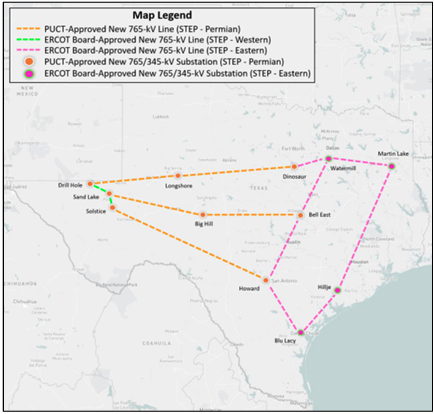
This is about Oncor’s Longshore Switch-Drill Hole Switch 765-kV transmission line. It would run approximately 160 miles, beginning west of Forsan in Howard County and ending near the Culberson–Reeves County line in West Texas.
This is part of the 765-kV Strategic Transmission Expansion Plan (STEP) Permian, a key part of the Permian Basin Reliability Plan (PBRP). STEP Permian proposes three transmission lines spanning more than 1,200 miles to move electricity from East Texas to the natural gas-rich Permian Basin. Longshore Switch-Drill Hole Switch connects with the Dinosaur to Longshore line to form the northern Dinosaur to Drill Hole import path.
Critics have voiced concern that the 765-kV projects would primarily be used to move unreliable wind and solar power around Texas.
Delaware Basin Midstream, LLC, Brazos Midstream Operating, LLC, and Brazos Midland Gas, LLC, filed motions to intervene roughly 10 months ago, stating they own and operate oil, gas, and, in Delaware Basin Midstream’s case, water facilities and pipelines that move “hydrocarbons and other product along” routes in Oncor’s application.
Delaware Basin Midstream, a subsidiary of Western Midstream Partners, LP, stated they operate pipelines that move oil, natural gas, and produced water in the Permian Basin.
PUCT approved both segments of Dinosaur to Drill Hole on August 28, ignoring calls from impacted landowners and lawmakers to deny all pending 765-kV applications.
On September 22, Delaware Basin Midstream and Brazos Midstream Operating filed a joint motion for a rehearing.
PUCT “has failed to adequately protect the safety and integrity of metallic pipelines, and the workers and communities who depend on them, during and after construction of the Proposed Transmission Line,” they wrote. “The oil and gas industry is essential to the State of Texas. Yet, the Commission offered no explanation for why federal and state pipeline safety requirements deserve less consideration than the other regulations addressed in the Order.”
“Delaware Basin Midstream and Brazos are raising a fair question, and the Commission owes them an answer,” American Energy Works CEO Jason Isaac wrote. “These companies operate pipelines that carry oil, gas, and water across the Permian Basin, and they are subject to strict federal and state safety rules. When the PUC routes a 765-kV line near that infrastructure, it should explain on the record exactly how those safety requirements were weighed.”
On October 7, Oncor replied that PUCT’s “standard ordering paragraphs offer adequate protection for 765 kV lines.”
Potential Threat
Delaware Basin Midstream and Brazos Midstream argued Oncor did not do enough homework.
They cited Oncor witness Corin Cooley’s statements that the utility “did not produce any project-specific engineering study on impacts to oil and gas infrastructure for this line,” that there is “no written analysis in the record that quantifies potential risks to oil and gas pipelines for each alternative route,” and Oncor “did not perform a statistical analysis of past projects to quantify risk level for this particular project.”
The pipeline companies stated their own witnesses, Jared Pannell and Justin Beto, established “that a transmission line crossing a metallic pipeline creates immense danger, including risk of [Alternating Current] fault and pipeline corrosion.” They wrote this threatens pipeline integrity, and the safety of both it and those working on it.
“Contact with fault-produced voltages above 15 volts alternating current can cause heart failure, muscle seizure, and workers being blown off a skid pad,” they wrote. If Oncor were to energize its lines before mitigation measures are in place, they continued, “any resulting pipeline corrosion is permanent and cannot be reversed.”
According to Isaac, these aren’t the only areas lacking due diligence.
“ERCOT’s own planning documents describe the Permian Basin Reliability Plan as something less than a comprehensive study, yet it remains the foundation for these lines, and no later study has independently shown they are necessary,” he wrote. “Now we are learning that the very producers these lines are supposed to serve have unresolved safety concerns about where they will run.”
Requested Changes
Delaware Basin Midstream and Brazos Midstream requested PUCT change its order.
As is, the current PUCT order requires consultation, surveys, and modeling coordination only on pipelines that parallel the proposed 765-kV transmission line. They want commissioners to require Oncor consult with owners whose pipelines cross and parallel it, and coordinate with these owners before energization.
The pipeline companies also cited federal rules that require them to put mitigation efforts in place to minimize the effects of stray current from transmission lines. Because of this, they request PUCT require Oncor to manage construction in such a way that would minimize the mitigation needed, and time to do it before Oncor energizes the line.
Oncor countered that nothing in PUCT’s order prevents the pipeline companies from doing their own surveys or analyses, or implementing required mitigation measures.
Delaware Basin Midstream and Brazos Midstream also want PUCT’s order to require Oncor’s compliance with Texas Health & Safety Code § 756.123. According to this law, builders are required to notify a pipeline operator of a project. Before work can proceed, an operator decides if the project will increase risk to the public or damage to the pipeline. If it does, then the builder pays the necessary, reasonable, and documented costs to mitigate those risks.
Other ways to satisfy the law are a pre-existing written agreement, or natural-disaster-initiated emergency work by a utility.
Regarding the pipeline companies’ requested changes, Oncor replied that PUCT has “consistently rejected the same or similar requests” in applications for lower voltage transmission projects, including those where Delaware Basin Midstream was the requestor.
Oncor wrote that expanding requirements to pipeline crossings, pre-energization, and other new conditions would deviate from PUCT precedent, and “would permit pipeline operators to delay or even prevent the construction of a Commission-approved route.”
Delaware Basin Midstream and Brazos Midstream argued this situation is “unprecedented.”
“[T]his is the first 765-kV transmission line to be built in Texas and therefore presents materially greater AC interference risk than the 138-kV and 345-kV lines on which the Commission’s standard ordering paragraphs were developed,” they wrote.
Oncor argued the companies “fail to demonstrate how that increase in voltage is actually tied to the measures” requested. If implemented, Oncor wrote it would have to “bear the burden of minimizing AC interference mitigation measures, and ultimately the costs, with pipeline owners and operators having the authority to determine when those measures and costs must be incurred.”
The electricity delivery company believes the transmission application process is not the place to decide who pays the cost. Instead, it cited a case in which administrative law judges, PUCT staff, and Oncor agreed that a rulemaking proceeding, involving the Texas Railroad Commission, would be “the appropriate venue.”
According to the Texas Public Policy Foundation, ratepayers will bear the lifetime cost of all STEP projects ERCOT approved through December 2025, which TPPF estimates is nearly $100 billion.
The Texas Railroad Commission and PUCT did not respond to a request for comment before publication.
Moving Forward
Isaac believes that multiple parties asking PUCT for a rehearing, and that these motions are on the commission’s October 15 agenda, “is a clear sign” their approval orders “were rushed.”
“The Commission should grant rehearing, address the pipeline safety issues on the record, and prove this line is needed before Texans are handed the bill,” he wrote.
As an alternative to STEP, critics have advocated for market reforms to incentivize the building of reliable power generation, such as natural gas plants near the area of demand, in the gas-rich Permian Basin.
The Texas Oil & Gas Association joined a coalition supporting the STEP Permian lines. It did not respond to a request for comment before publication.
“As we explained in our reply to the motion for rehearing, Oncor has a long history of working with pipeline companies and believes that the SOAH ALJs and PUCT provided the proper coordination requirements in the final order,” wrote Oncor spokesperson Andrew Clark.