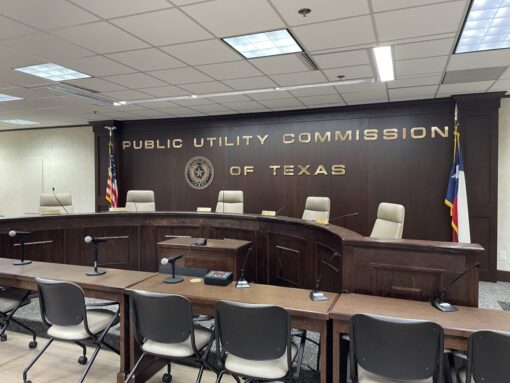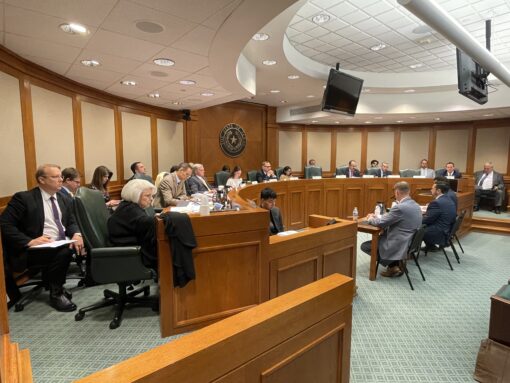
Members of the Public Utility Commission are set to consider extending time for acting on rehearing motions for electricity delivery company Oncor’s 765-kilovolt transmission line the commission approved in August. Without action next Thursday, the motions are likely to die this month, and the commission’s decision to approve the line would stand as written.
Oncor opposes the rehearing motions.
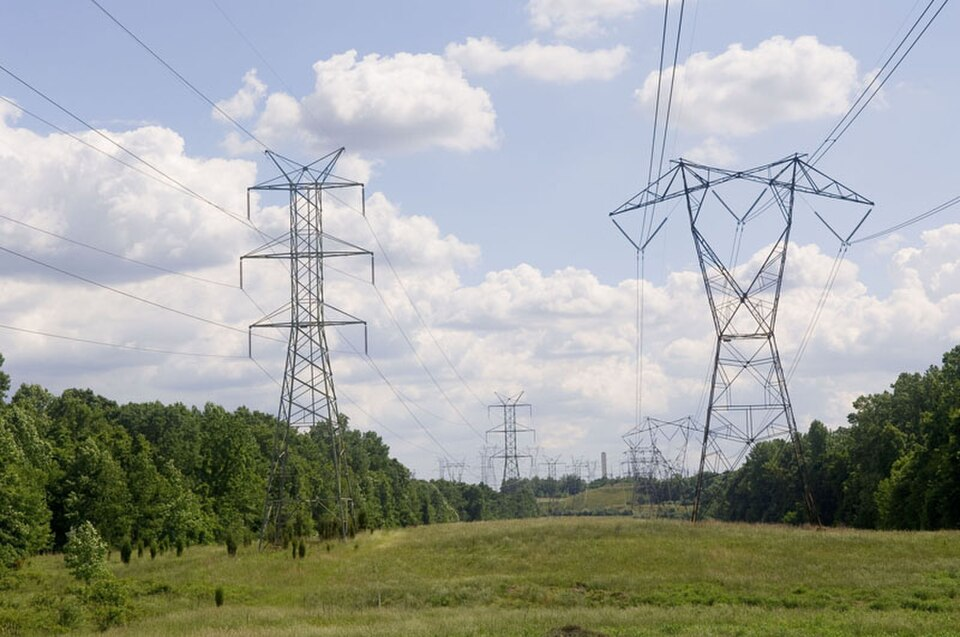
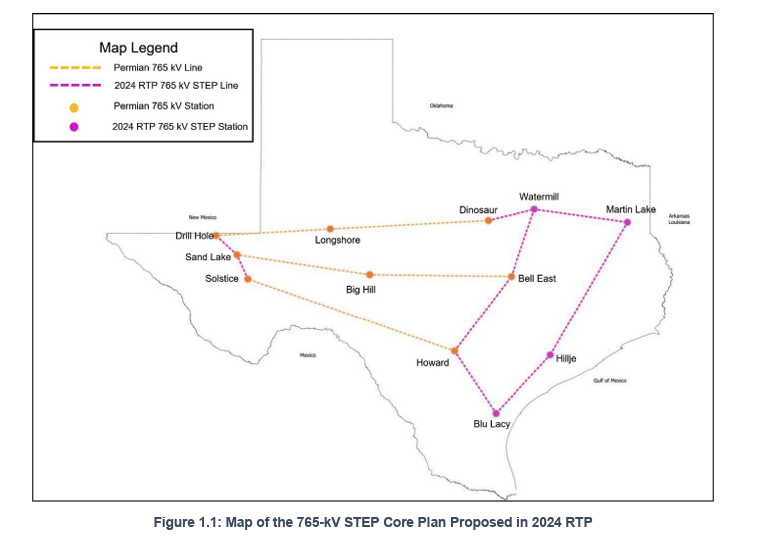
Made up of two segments, Dinosaur – Longshore and Longshore – Drill Hole, Oncor’s Dinosaur-to-Drill Hole line would span approximately 390 miles from near Glen Rose to near the Culberson–Reeves county line. This project is part of the 765-kV Strategic Transmission Expansion Plan (STEP) Permian, a key part of the Permian Basin Reliability Plan (PBRP).
STEP Permian proposes three transmission lines spanning more than 1,200 miles to move electricity from East Texas to the natural gas-rich Permian Basin. Dinosaur to Drill Hole is the north line.
PUCT Chairman Thomas Gleeson and Commissioners Courtney Hjaltman, Patrick Rhode, and Kathleen Jackson approved Dinosaur to Drill Hole in an order dated August 28. Commissioner Morgan Johnson was absent.
State law requires that 55 days from the date of a PUCT order, rehearing motions are overruled if commissioners do not act. In the case of the Dinosaur to Drill Hole line, the last day would be October 22. Commissioners may, in a written order, extend the deadline as late as 100 days after the PUCT order, in this case December 6. PUCT would have to issue that no later than the tenth day after the “period for filing a motion or reply or taking agency action expires.”
November 1 is ten days after October 22, the only remaining deadline.
Multiple parties filed motions for rehearing, including pro-landowner group American Stewards of Liberty.
In both motions, ASL argued that state lawmakers did not authorize a 765-kV buildout, but rather directed development of a reliability plan for the Permian Basin in House Bill 5066, a 2023 law. The organization asked PUCT to deny Oncor’s applications.
“It did not legislatively determine that any particular transmission project was necessary, mandate or authorize construction of a statewide 765-kV transmission system, nor exempt any resulting CCN application from the statutory-need determination required by PURA § 37.056,” Rutherford wrote in the Longshore motion.
Oncor replied that HB 5066 did not automatically necessitate any project, but its required study can still prove need.
Gleeson said in a July state senate committee meeting that HB 5066 did not explicitly approve 765-kV lines.
In its Dinosaur-to-Longshore motion, ASL argued that commissioners had reversed administrative law judges’ determination Oncor had “failed to comply with” PUCT’s requirements on public meeting notices.
“Many affected landowners did not learn of the Application until immediately before, or even after, the intervention deadline. Those landowners could not reasonably be expected to identify and preserve an objection to deficient public-meeting notice before they knew that Oncor had added a link affecting their property,” wrote Attorney Shan Rutherford.
Impacted landowners told a July state Senate committee hearing of their opposition to STEP Permian. Short response windows to utility notification of transmission crossing or coming close to their land were among their concerns.
Oncor replied that it held three public meetings in June 2025, and was required to hold only one before filing, and notice had to be tied to routes in existence when notification was sent. Furthermore, the utility argued that a missed notice would not be grounds to deny their application, and PUCT rules do not require a second meeting after links are added. Oncor continued that landowners impacted by such changes were given an opportunity to intervene when notified of Oncor’s application.
ASL also argued that PUCT “found that the PBRP establishes a need for additional service in the Permian Basin,” the Dinosaur to Drill Hole line is “part of the solution,” and concluded Oncor demonstrated the line’s “reasonable need.”
The nonprofit noted that PUCT also found “that Oncor ‘did not independently evaluate alternatives’ because the Commission, in direct violation of the plain statutory requirement that the applicant establish need for the Project, had already approved the 765-kV option and purported to exempt the PBRP projects from further” review.
Oncor replied that the utility company did not independently evaluate alternatives because ERCOT and PUCT had already compared the 765-kV option with lower-voltage transmission lines. The company also stated that energy generation is deregulated in Texas, so the state cannot direct generation building projects.
For the Longshore-to-Drill Hole segment, ASL argued that PUCT’s order approving the segment “commits a fundamental legal error by treating approval” of the PBRP and ERCOT on facilities proposed in this proceeding are necessary under” the Public Utility Regulatory Act.
In Oncor’s Longshore-to-Drill Hole and Dinosaur-to-Longshore responses, the company argued that ERCOT’s Permian study showed the line is needed to address thermal overloads, voltage instability, and unsolvable power flows in the Permian Basin. Oncor also argued that no party offered evidence the Permian issues could be solved without the transmission project.
The Texas Public Policy Foundation has advocated for market reforms to incentivize the building of reliable power generation at the location of demand.
On July 31, Lt. Gov. Dan Patrick and State Sen. Charles Schwertner (R–Georgetown) urged PUCT to deny all pending 765-kV applications. On September 9, Patrick said he was “very disappointed” in PUCT’s approval of Dinosaur-to-Drill Hole.
Republican Nate Sheets and Democrat Clayton Tucker, candidates for Texas agriculture commissioner, also expressed opposition to the current statewide 765-kV buildout.
Two days later, the commissioners approved a second line, a project of AEP Texas and City of San Antonio-owned CPS Energy. The third line, from Oncor and the Lower Colorado River Authority Transmission Services Corporation, is in a holding pattern after commissioners remanded a segment back to the State Office of Administrative Hearings.
PUCT and Oncor did not respond to requests for comment before publication.