This article has been updated since publication.
The same week state senators have planned to hear testimony on the impact 765-kilovolt transmission lines will have on private landowners, a transmission company is moving forward with its proposed transmission line and is holding a public meeting in Wharton County.
Another company has scheduled its own public meeting the evening before in Refugio County.
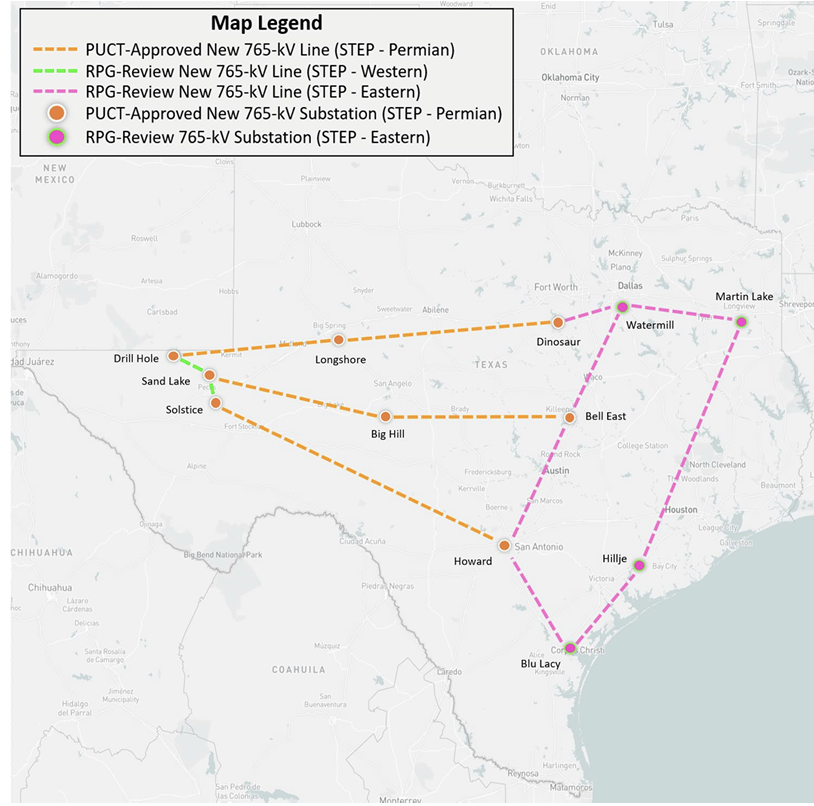
This centers on the Electric Reliability Council of Texas’ (ERCOT’s) 765-kilovolt Strategic Transmission Expansion Plan (STEP), a key part of the Permian Basin Reliability Plan (PBRP). Phase one is the STEP-Permian, which proposes three extra-high-voltage transmission lines, spanning over 1,200 miles to move power from East Texas into the natural gas-rich Permian Basin, with routes crossing North, Central, and South Texas. A pro-landowner group called this “akin to hauling water to the sea.”
The ERCOT board endorsed STEP’s two other phases in December 2025. These are the STEP-Western and STEP-Eastern 765-kV lines.
This week, State Sen. Kevin Sparks (R–Midland) and State Rep. Brad Buckley (R–Salado) asked PUCT to delay a final decision on “all the 765-kV segments” until after the 2027 legislative session. A coalition of transmission companies that stand to profit from these lines opposed this request.
Despite lawmakers asserting themselves, transmission companies appear to be pressing on in defiance.
CenterPoint Energy is holding an open house in Wharton County for the proposed Hillje-Blu Lacy 765-kV line project on July 29, the same day as the Texas Senate Business & Commerce Committee public hearing on the state grid and ways to mitigate the 765-kV lines’ impacts on private property rights.
Another will be held on August 1 in Victoria, Texas. CenterPoint Energy has partnered with AEP Texas on this project, which would span close to 200 miles from Wharton County to Nueces County.
“Texans expect and deserve a more resilient, reliable and affordable energy future, and we are committed to partnering with our state and local government officials, community stakeholders as well as property owners on these vital electric resiliency and reliability projects,” CenterPoint Energy wrote in a statement. “Currently, we are in the initial planning phase of the Hillje-Blu Lacy Transmission Improvement Project and are gathering local feedback to shape this important infrastructure project to help ensure it can best serve Texas communities for generations to come.”
AEP Texas is holding its own open house the day before the committee hearing.
“AEP Texas strives to deliver safe, reliable electric service to at a reasonable rate – that’s our promise to our customers. We remain committed to participating in the process that accommodates the planning and construction of new infrastructure within our service territory,” the company wrote in a statement. “We follow Public Utility Commission of Texas rules and state law; as well as our perspective and the expectations of customers and lawmakers to work with the communities we serve. We look forward to hearing their decisions involving these projects and others in the future.”
Landowners affected by the STEP-Permian line have complained that routes impacting their land were added after such meetings and they were given little time to respond.
AEP Texas plans to file an application for a Certificate of Convenience and Necessity in early 2027, which will then go through an administrative law hearing process through the State Office of Administrative Hearings (SOAH). The company expects a final PUCT decision in the fall, and construction to start at the end of 2029.
Opposition to the STEP-Permian lines has steadily grown. Landowners have cried out about a complex, rushed, and vague process that left them scrambling to stop the lines from crossing into or approaching their private property.
Additionally, concerns regarding the 765-kV lines’ impacts on national security, water, and agriculture have been raised. Questions about Oncor’s “due diligence,” and the revelation that the project will help companies meet their ESG goals have also surfaced.
Sparks and Buckley have expressed concern that the 765-kV STEP is built on “an assumption that future generation in Texas will primarily be wind and solar, and it does not consider any alternative scenarios that involve more gas generation.” As previously reported, transmission service providers admitted that reliance on wind and solar power is driving Permian Basin energy issues.
Sparks and Buckley wrote that ERCOT should conduct “a full reappraisal” of the 765-kV lines, and that PUCT review “market design changes that could bring online the gas generation needed to avoid the 765-kV lines.”
In a statement, Oncor wrote that it “will continue to follow the long-established regulatory process for proposing new transmission line projects. The projects you reference were endorsed by the ERCOT Board of Directors in 2025 and are paramount for meeting Texas’ soaring electricity demand.”
The Texas Public Policy Foundation estimates the lifetime cost of all STEP projects ERCOT approved through December 2025 approaches $100 billion and would be borne by ratepayers.
There is another 765-kV project in process that is not a part of STEP and is outside of the ERCOT grid. That is Southwestern Public Service Company’s Potter-Crossroads-Phantom 765-kV Transmission Line Project. It would span roughly 120 miles, from Amarillo, Texas, to Portales, New Mexico. The company, a subsidiary of Xcel Energy, filed its CCN application in June 2026, and it is making its way through the SOAH administrative law hearing process.
Both PUCT and the New Mexico Public Regulation Commission must give final approval for it to proceed.
“The Potter-Crossroads-Phantom line is a Southwest Power Pool reliability project. It is not part of ERCOT’s plan, and the legislators’ letter is about ERCOT. Conflating the two is simply inaccurate,” wrote an Xcel Energy spokesperson.
However, Dr. Brent Bennett of the Texas Public Policy Foundation warns that the Southwest Power Pool is dealing with the very same problem ERCOT is dealing with. “They have overbuilt wind and solar far from demand centers, and they need large transmission lines to balance the system and move the power,” he told Texas Scorecard. “The more they keep building wind and solar in distant areas, the more transmission that will be required. It’s simple physics.”
Neither PUCT, ERCOT, nor CPS Energy responded to a request for comment before publication.
Gov. Greg Abbott appointed all five PUCT commissioners.
If you are a citizen with information regarding bureaucratic overreach, please email scorecardtips@protonmail.com.