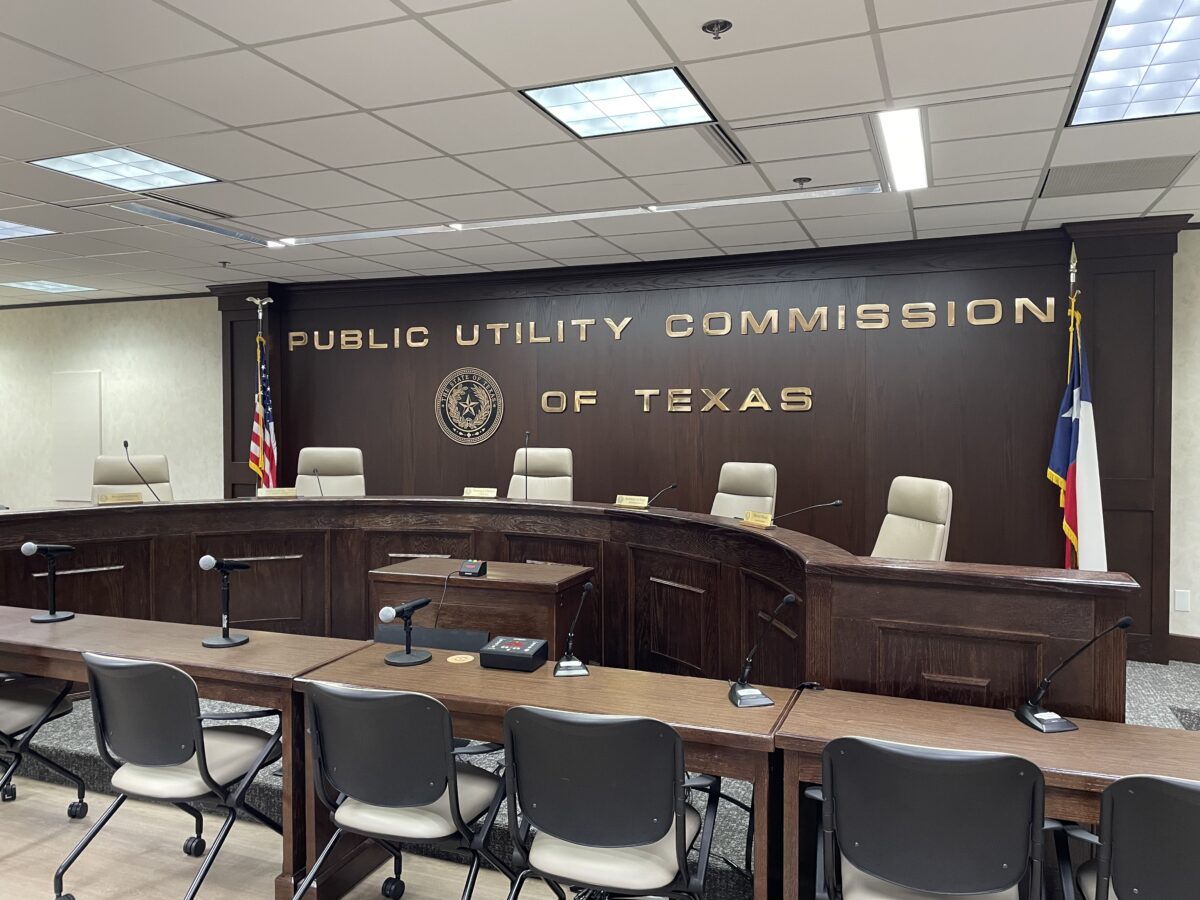
In his applications to the governor’s office, Public Utility Commission of Texas Chairman Thomas Gleeson listed Oncor vice president Brian Lloyd as a reference.
Before joining Oncor, Lloyd served as the PUCT’s executive director from December 2010 to March 2018. During the time Lloyd was the commission’s executive director, Gleeson served as its fiscal project manager and later director of finance and administration. Gleeson was promoted to chief operating officer in April 2018, one month after Lloyd left PUCT. Gleeson became executive director in December 2020.
Gov. Greg Abbott appointed Gleeson as chairman of the Public Utility Commission of Texas in January 2024. State senators confirmed him in May 2025.
Texas Scorecard obtained Gleeson’s December 2023 and March 2025 applications to the governor in a public information act request.
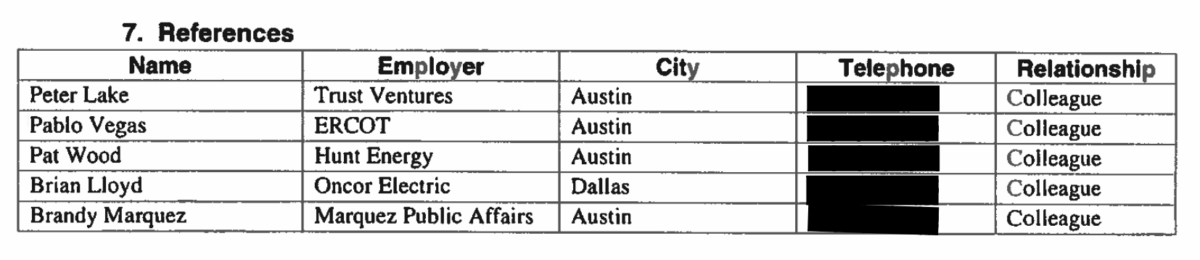
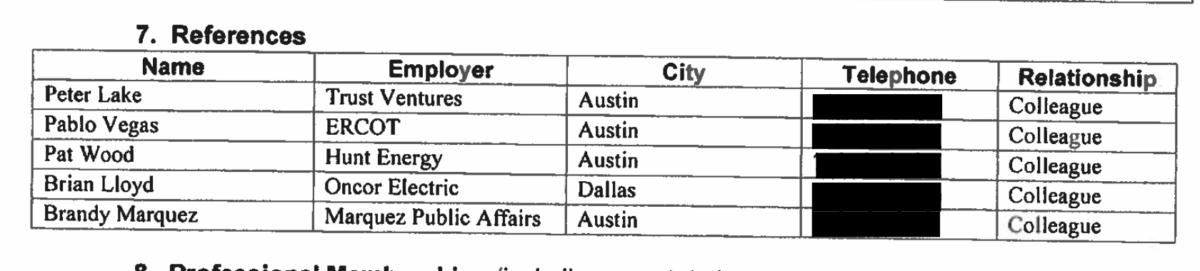
Lloyd left PUCT to join Sempra, Oncor’s California-based owner. He went on to become Oncor’s vice president of regulatory policy in 2022, according to his testimony as an Oncor witness in a May 2025 rate case in which he outlined his long career at the commission.
He joined PUCT after graduating with a master’s degree from the University of Texas in 1998 and eventually became PUCT’s director of retail market oversight. After a stint as senior consultant with Missouri-based energy consulting firm J. Pollock, Inc., Lloyd rejoined PUCT in 2005 as special projects director. In 2009, he became Gov. Rick Perry’s deputy director of budget, planning, and policy before taking over as PUCT’s executive director.
Watchdogs told state senators last Wednesday that Oncor is among the transmission and distribution utilities that have profited from Texas’ “regulated monopoly.” Oncor’s quarterly profit rose 65 percent from the same period last year. Annual net income reportedly increased from $651 million to just over $1 billion from 2019 to 2025, and its residential rates have increased 15 percent over the past two years.
Mark Ellis of MarketClear said the state’s current structure incentivizes building projects.
‘Legitimate Questions’
“Texans deserve a Public Utility Commission whose independence from the utilities it regulates is beyond question,” Jason Isaac, CEO of American Energy Institute, wrote to Texas Scorecard. “Chairman Gleeson listing Brian Lloyd, a former PUCT executive director who is now an Oncor vice president and outspoken advocate for the 765-kV transmission buildout, as a reference raises legitimate questions about that independence, especially after the PUCT approved billions of dollars in 765-kV projects that Oncor will build and recover from ratepayers.”
Isaac was referring to the more than 1,200-mile-long Strategic Transmission Expansion Plan (STEP) Permian. A key part of the Permian Basin Reliability Plan (PBRP), which the Electric Reliability Council of Texas (ERCOT) developed and PUCT approved in 2024, STEP Permian proposes building three 765-kilovolt transmission lines to move power from East Texas to the natural gas-rich Permian Basin.
Oncor is an applicant for two of these lines.
Impacted landowners raised concerns this year about short deadlines to respond to utilities’ notifications that proposed routes would cross or come into proximity to their land.
On July 31, 2026, Lt. Gov. Dan Patrick and State Sen. Charles Schwertner (R–Georgetown) urged PUCT to deny all pending 765-kV applications until lawmakers reformed the approval process in 2027. A month earlier, 43 lawmakers had asked PUCT to pause the project.
PUCT’s commissioners approved Oncor’s Dinosaur to Drill Hole 765-kV line on August 28. On September 9, Patrick said he was “very disappointed” in PUCT’s decision. Two days later, the commissioners approved a second line, a project involving AEP Texas and City of San Antonio-owned CPS Energy.
The third line, from Oncor and the Lower Colorado River Authority Transmission Services Corporation, is in a holding pattern after commissioners remanded a segment back to the State Office of Administrative Hearings.
In a statement, Oncor wrote that “Mr. Lloyd and Mr. Gleeson were both employed at the Public Utility Commission of Texas when Mr. Lloyd was executive director and prior to that interacted with each other when Mr. Lloyd worked for Governor Perry and Mr. Gleeson was at the Legislative Budget Board. Mr. Lloyd is flattered that he was listed as a reference, but was not contacted by the Governor’s office with respect to the Chairman’s appointment as a Commissioner.”
Unreliable Energy
For his part, Oncor’s Brian Lloyd made multiple social media posts this year supporting the controversial STEP Permian.
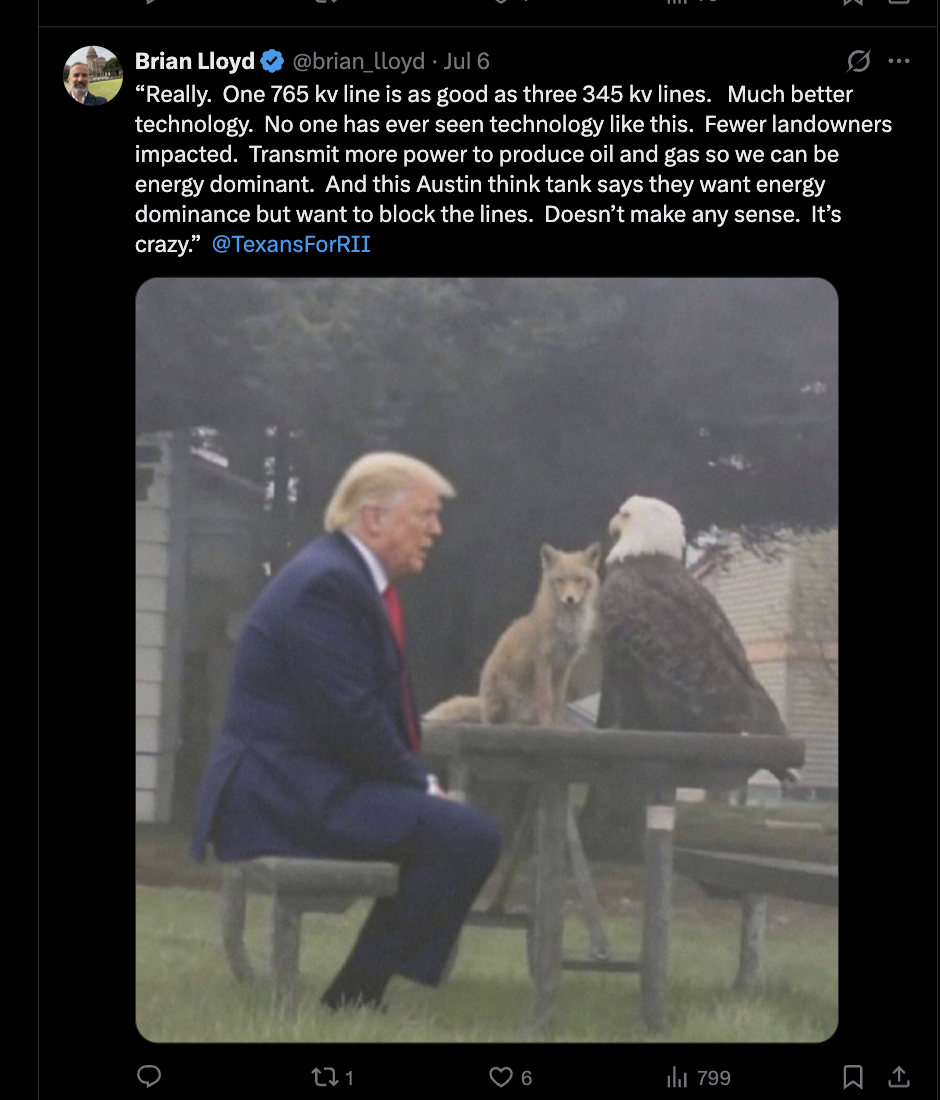
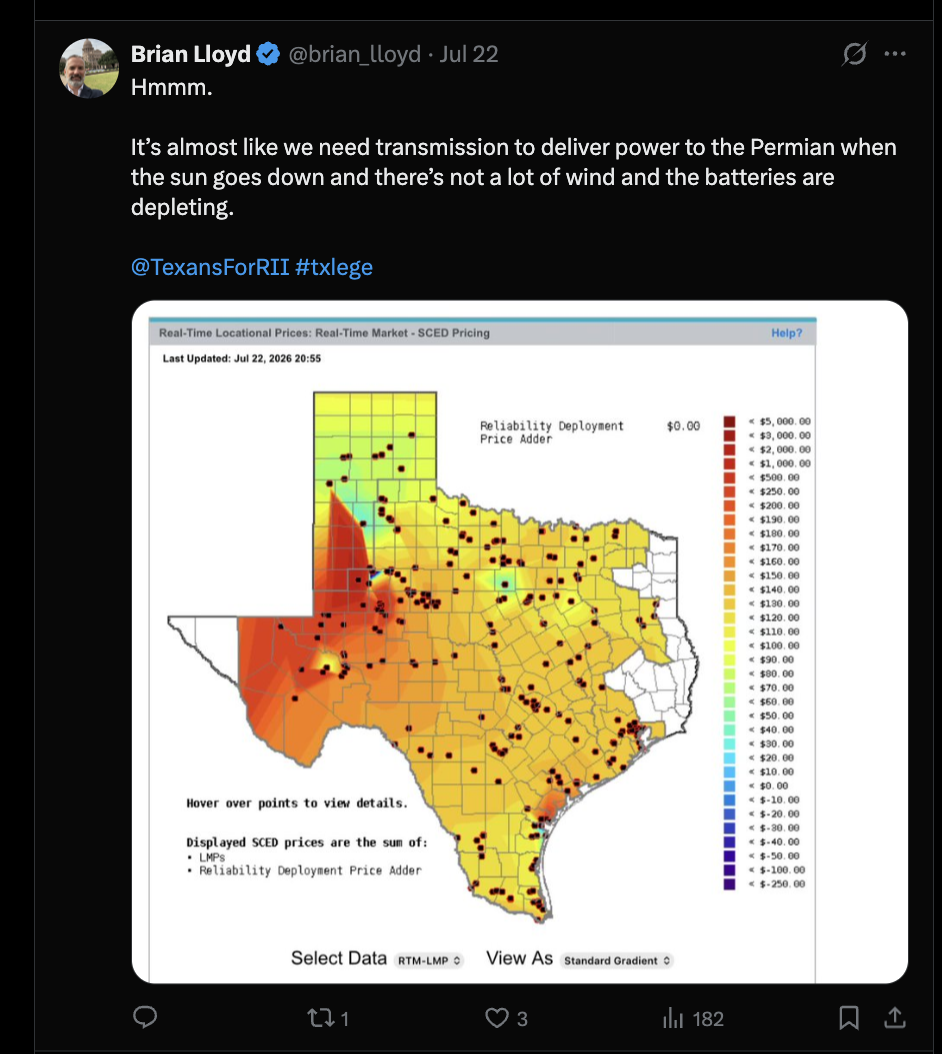
Lloyd, PUCT, and a major transmission project have overlapped before.
In 2005, state lawmakers authorized the 3,600-mile-long Competitive Renewable Energy Zone (CREZ) transmission line project. Although the project began before Lloyd became executive director, it was completed during his tenure, according to a September 2022 National Renewable Energy Laboratory report that dates CREZ’s completion to December 2013.
At PUCT’s August 28 meeting, Gleeson referenced having “been around for the CREZ projects.”
A Texas Public Policy Foundation (TPPF) report stated CREZ was “being built to transmit electricity from wind farms in West Texas” and at the time was “Texas’ largest subsidy for renewable energy.”
Unlike CREZ, state lawmakers did not explicitly approve 765-kV transmission lines.
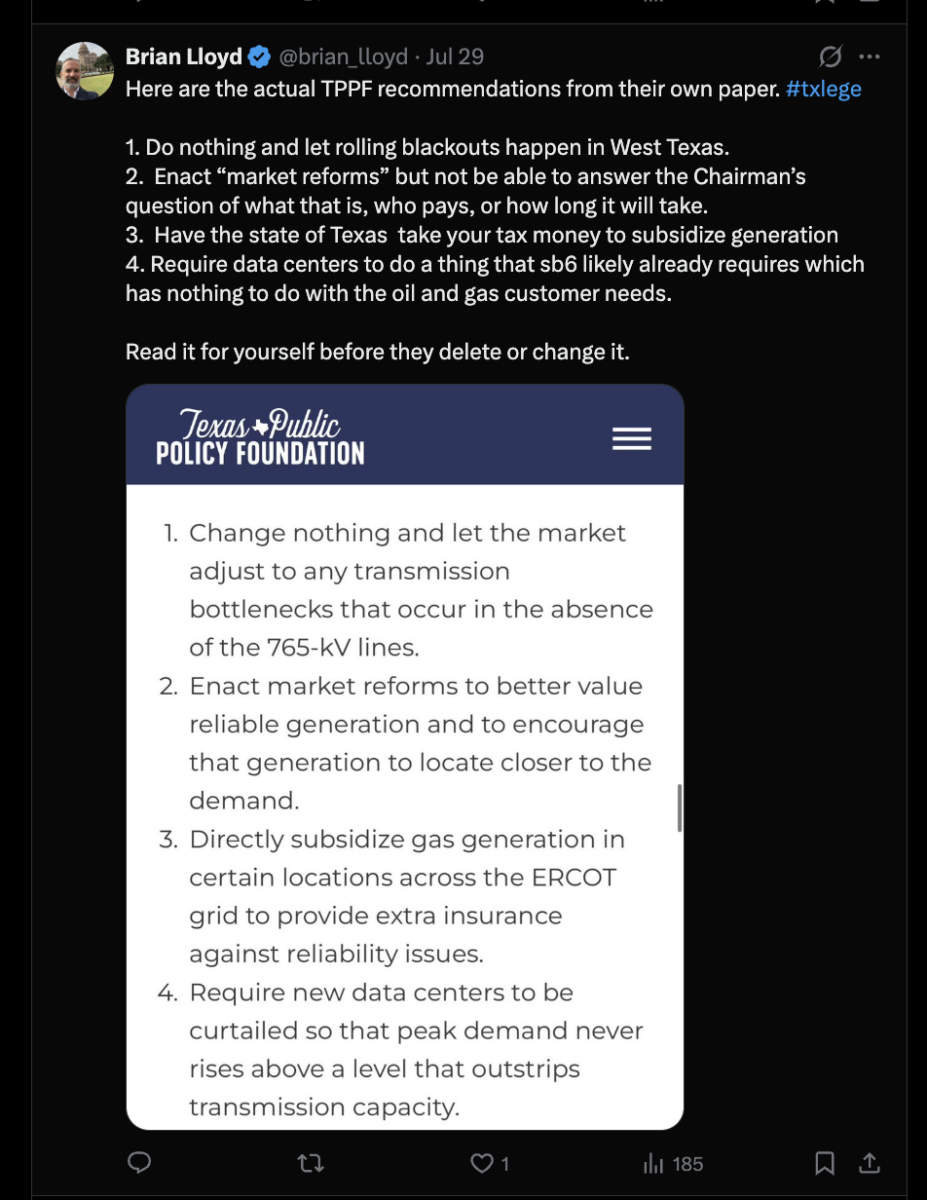
TPPF’s Dr. Brent Bennett, in his STEP assessment, wrote that the overbuilding of wind and solar generation is driving the need for 765-kV lines. He believes adding 4-5 gigawatts of gas generation, which the Permian Basin is rich in, and moving some generation across other parts of the ERCOT grid “could eliminate the need for 765-kv lines.”
Bennett listed four primary alternatives state lawmakers could consider, including reforming the market to incentivize building reliable electric generation closer to demand. He also wrote that lawmakers could consider directly subsidizing gas generation in “certain locations,” but cautioned that “permanent subsidies will only exacerbate the central planning problems that led to” STEP.
Lloyd took to social media, expressing his dislike of TPPF’s analysis.
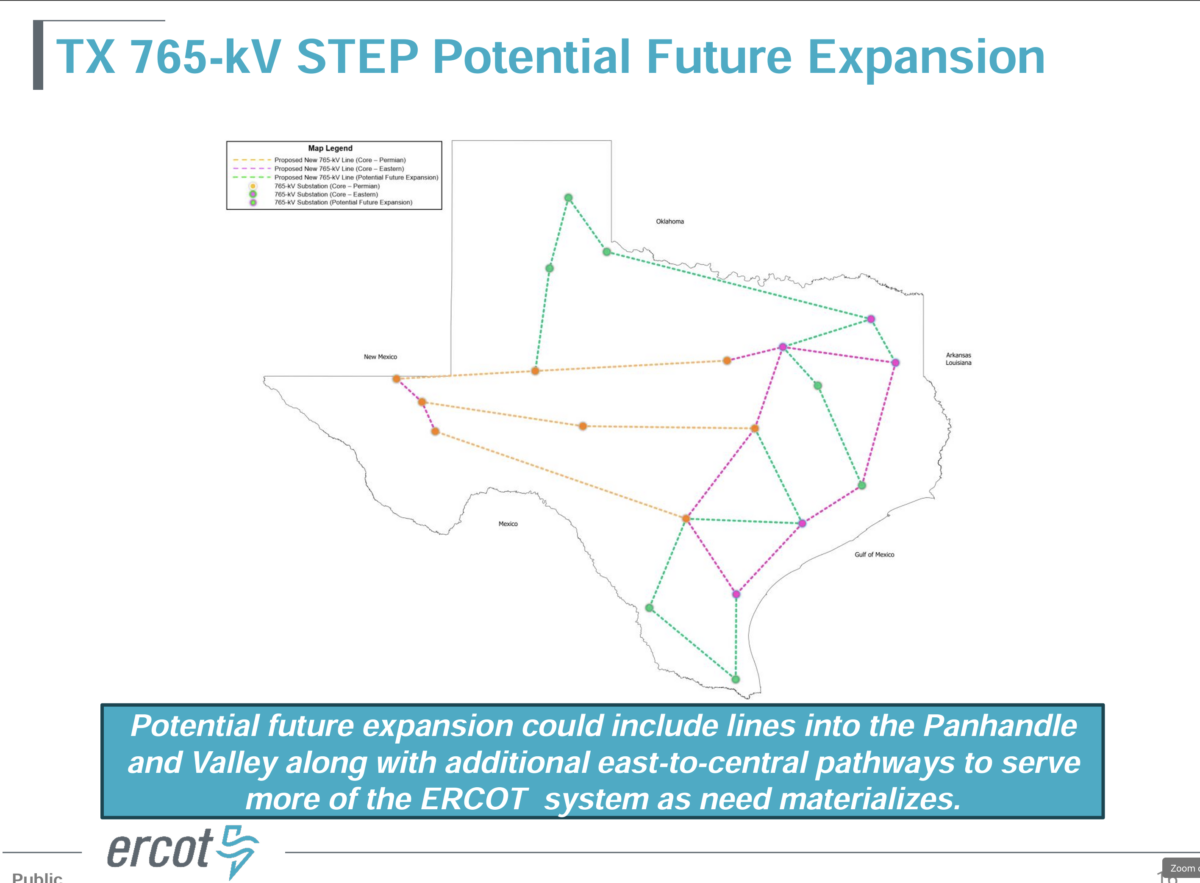
STEP Permian itself is only one part of a larger proposed 765-kV buildout. The ERCOT board endorsed two more 765-kV projects in East and West Texas in December 2025. These would link with the STEP Permian lines. TPPF estimates the lifetime cost of all STEP projects ERCOT approved through December 2025 at nearly $100 billion.
As previously reported, records from ERCOT show a potential final 765-kV buildout that could connect the wind-and-solar-heavy Texas Panhandle to the entire proposed 765-kV network.
PUCT did not respond to a request for comment before publication.
“Texans deserve a Public Utility Commission whose independence from the utilities it regulates is beyond question,” Jason Isaac wrote.